The Seventh Prompt Asked Her to Choose Her Husband. She Finally Told Him Why She Couldn’t.
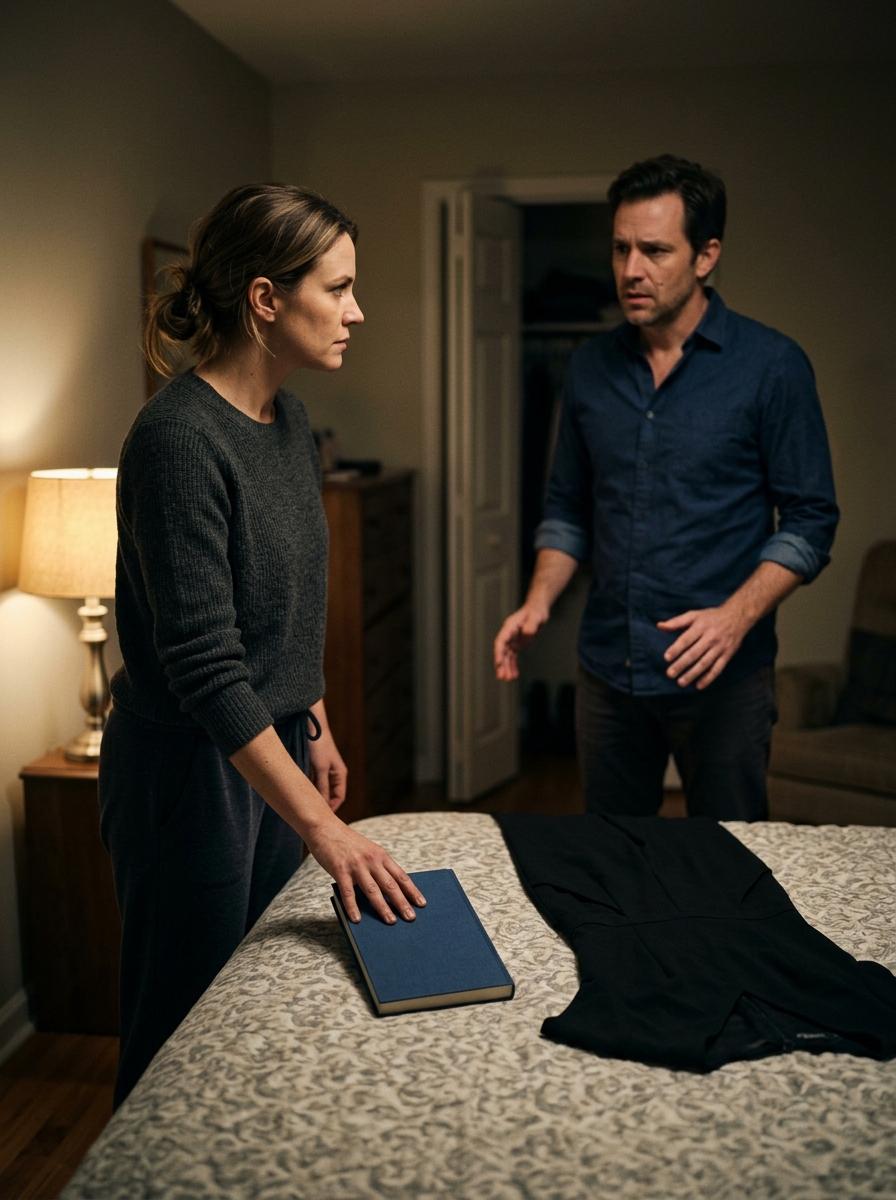
On the seventh night of our thirty-day intimacy challenge, Adrian laid out the black jumpsuit I wore on our first date and asked me to say, “I still choose you.”
I was thirty-seven. Adrian was thirty-nine. We had been married for eight years, long enough for him to know that I hated overhead lighting and for me to know that he became overly polite when he was afraid.
That night, every lamp in the dining room was turned low. Two plates sat across from each other on the table. A playlist from our first year together murmured from the speaker near the window.
The little yellow book rested between the plates.
Its title was *Thirty Days Back to Us*, and its author promised that a couple could rebuild desire through a nightly ritual of attention. Each day offered a prompt, a small activity, and a line to complete in a journal.
The seventh prompt said to recreate the moment when one partner first felt chosen.
Adrian had done his research.
He had found the black jumpsuit at the bottom of the closet, folded inside a donation bag. He had ordered takeout from the restaurant where we ate after our first date. He had even located the same playlist, though the song playing now sounded thinner than I remembered.
“Where did you get that?” I asked.
He looked at the jumpsuit as if it were a peace offering. “The closet.”
“It was in the donation bag.”
“I know.”
“You went through the donation bag?”
“I was trying to get it right.”
“That’s the problem.”
His shoulders dropped a fraction. “I thought you might want to wear it.”
“I don’t want to wear the woman I was before I knew what you could hide.”
The sentence stayed in the room between us.
Adrian looked down at the yellow book. Beside the first six dates, he had drawn blue check marks.
“Did you mark tonight complete?” I asked.
“It isn’t a test.”
“Then why is there a check beside every other night?”
“They’re not check marks. They’re notes.”
“They look like check marks.”
He picked up the journal. “I just wanted to keep track.”
“Of what?”
“Nora.”
“Of whether I smiled? Whether I leaned toward you? Whether I made it easy enough for you to believe we were getting better?”
His expression tightened, not with anger exactly. With the shame of someone being recognized too accurately.
“I haven’t asked you to make anything easy.”
“No,” I said. “You asked me to do the exercises. You just didn’t ask what I was doing them for.”
He opened his mouth.
I had expected an explanation. Maybe he would say the challenge was a suggestion, not a contract. Maybe he would remind me that I had agreed. Maybe he would say he was only trying to give us something concrete to hold on to.
Instead, he said, “What were you doing them for?”
The question was so gentle that something in me gave way.
“I have been performing,” I said.
His face changed. “You haven’t had to do anything.”
“That’s not the same as saying I wanted to.”
He stood, but I lifted a hand.
“Don’t touch me.”
“I’m not trying to—”
“I know. That’s the problem. You keep trying to make this work instead of asking whether I’m still in it.”
The refrigerator clicked on. Somewhere upstairs, a pipe knocked once in the wall.
Adrian glanced at the black jumpsuit. “I thought tonight was supposed to remind us of the beginning.”
“It reminds me that you know how to recreate a feeling without telling me the truth that came after it.”
He flinched.
I hated that I noticed. I hated that even then I could read his face.
For six nights, I had answered the prompts. I had named something I missed. I had sat across from him without my phone. I had held his hand while he apologized. I had kissed him when I wanted to, and once when I wanted the conversation to end.
Every night, Adrian thanked me with the careful relief of a man watching a gauge move in the right direction.
“I’m not doing another night,” I said.
He looked at the book. “You don’t have to.”
“I know.”
“You can stop whenever you want.”
“I should have stopped on night one.”
“You said you wanted to try.”
“I wanted to want to try.” I swallowed. “That’s different.”
He sat down again. The chair made a small scraping sound against the floor.
“I thought we were finding our way back,” he said.
“There is no way back.”
“That’s not what the book says.”
“The book doesn’t know what you did.”
His eyes lifted to mine.
I had not planned to say it like that. I had not planned to say anything else. But the sentence had been waiting behind my teeth for months.
Adrian had broken our marriage with someone else’s private messages, but I had helped him disguise the damage as a project. I had agreed to the thirty days because I was afraid that if we stopped trying, I would have to decide whether love was enough to stay.
He looked at the open page. Tomorrow’s prompt waited beneath a cheerful illustration of two hands reaching across a table.
“What are you saying?” he asked.
I closed the book between us.
“I’m saying there will not be a night eight,” I said. “And if this marriage survives, it won’t be because I perform healing for thirty days.”
***
Before there was a book, there was a rooftop movie and a storm.
I worked for a community theater then, mostly designing sets and occasionally painting them when the volunteer crew failed to show. Adrian had come to the screening with a friend of mine. I remember that he wore a blue shirt with the sleeves rolled neatly to his elbows, and that he listened when I talked about the set I was building instead of pretending to understand theater.
Halfway through the movie, rain began blowing sideways across the roof.
Everyone else ran for the stairwell. I stayed behind to drag two boxes of lighting equipment under the awning.
Adrian came back.
“You don’t have to help,” I told him.
“I know.”
He picked up one end of a box.
That was the first thing I liked about him. He did not turn helping into a performance of heroism. He simply saw what needed to be moved and put his hands under it.
Afterward, we ate fries in his car because the restaurant had closed. I was still wearing the black jumpsuit, which had a loose thread near the waist. Adrian asked questions until I ran out of answers. Then he sat with the silence without trying to fill it.
I felt chosen, though I would not have used that word then.
For years, our marriage was built out of moments like that. Practical kindness. Shared errands. Knowing which groceries the other person forgot. Adrian charging my phone when I fell asleep on the couch. Me leaving a lamp on when he worked late.
We were good at making a life.
We were not as good at admitting when the life had changed.