She Overheard Her Husband Call Their Bedroom Dead—Then Learned What Sobriety Had Taken With It
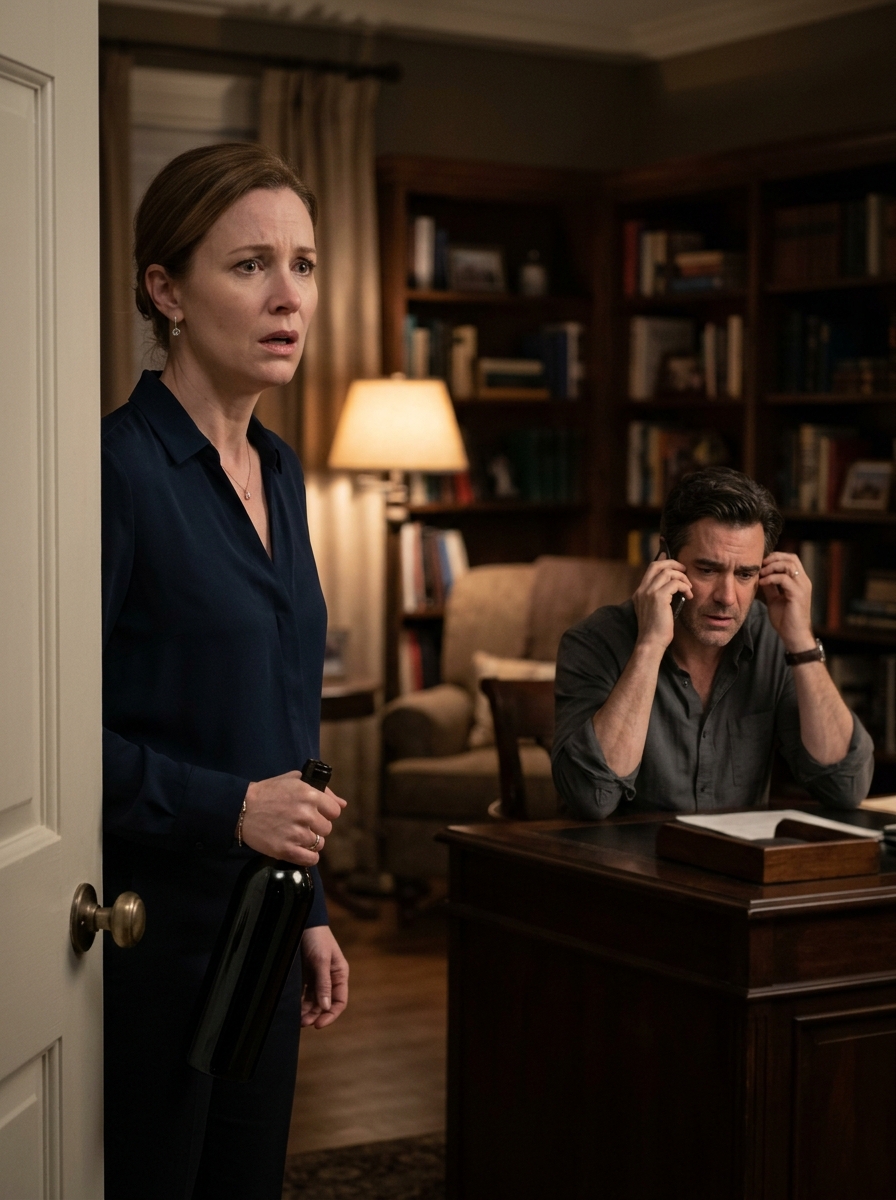
“I haven’t known how to be close to you without being drunk,” Noah said.
Tessa kept one hand on the bottle of red wine and the other curled at her side.
The den seemed suddenly too small for all the words they had avoided. Noah’s phone lay face down on the desk. Marcus was gone from the call, but his question remained in the room.
Dead because neither of you wants it, or dead because neither of you talks about it?
Tessa looked at her husband. “You knew I was there?”
“No.”
“Then you meant for Marcus to hear it.”
“Yes.”
“And you didn’t mean for me to?”
“No.”
“That makes it better?”
“No.”
At least he answered quickly. At least he had stopped reaching for the safe answer—the one that made everything sound less serious than it was.
Tessa lifted the bottle slightly. “I bought this for tonight.”
Noah looked at the label. It was the red they had served at their wedding, a bottle they had talked about for years because it had been too expensive for them at the time and too good for the restaurant’s tiny glasses. She had found the same vintage at a wine shop downtown.
She had imagined pouring herself one glass while Noah opened a bottle of sparkling water. She had imagined music. She had imagined, perhaps, that the familiarity of the ritual would remind them how to be familiar with each other.
“I wasn’t asking you to drink,” she said.
“I know.”
“I thought maybe we could have dinner in the bedroom.”
“We haven’t eaten in there in a long time.”
“I know.”
He rubbed both hands over his face. Noah had been sober for twenty-three months. Tessa knew the exact number because she had watched him collect the small bronze chips from his recovery meetings and tuck them in the kitchen junk drawer. She knew the month he had stopped. She knew Marcus had driven him to his first meeting. She knew that Noah no longer ordered alcohol at work dinners, no longer accepted the casual beer offered after a theater load-in, no longer kept emergency bottles in the garage.
She had thought she knew what sobriety meant.
She had not known it included the bedroom.
“I didn’t stop wanting you,” Noah said.
Tessa looked at him. “That sounds like the sentence people say when they are about to explain why they stopped wanting you.”
“I know.”
“So explain it better.”
He nodded once, as if she had given him an assignment he deserved.
“Before I quit drinking, I thought alcohol made me more open. More relaxed. More present.” He paused. “Really, it made me less aware of everything I was afraid of. I didn’t have to think about how I looked. Or whether I was doing something wrong. Or whether you were disappointed. I could just move toward you.”
“And after you quit?”
“I could hear all of it.”
The answer angered her because it was not the answer she had spent two years preparing to receive.
She had been ready for his body to have changed. She had been ready for work stress, depression, medication, an affair, another woman, a private fantasy that did not include her. She had read enough articles at two in the morning to build a small library of explanations.
She had not been ready for Noah to say that sobriety had made him frightened of being seen.
“You could have told me,” she said.
“I should have.”
“You told Marcus.”
“I told Marcus that our bedroom was dead. I didn’t tell him why.”
“You gave him the headline.”
“I know.”
“And left me living in the story.”
Noah flinched.
That was the first sign that he understood what the last two years had felt like from her side.
***
They had met at thirty and thirty-two, old enough to believe they had outgrown the mistakes their parents made.
Tessa worked in exhibit design for a natural history museum. She could walk into a half-built gallery full of exposed wiring, missing labels, and crates blocking the emergency exits and see the finished room in her head. Noah worked live sound for touring theater companies. He could stand at the back of a noisy auditorium and identify which microphone had failed before anyone else noticed.
They were both good at making disorder look temporary.
For the first several years, drinking had been a small part of their marriage. Wine with dinner. A cocktail when they tried a new restaurant. A bottle split between them on vacation.
Then Noah’s work got busier. He began taking jobs that required twelve-hour days in theaters with unreliable heating and directors who treated every technical problem as a personal betrayal. Tessa’s museum went through a renovation that turned a six-month project into two years of dust, missed deadlines, and contractors calling her at home.
The wine became less decorative.
It became a doorway.
After a glass, Tessa could stop tracking the next morning’s schedule. Noah could stop rehearsing every expression on her face. They would talk more easily. They would laugh. Sometimes they would go to bed close and affectionate, relieved to have found each other at the end of the day.
Neither of them had called it a problem because neither of them was drinking alone in a locked room.
The problem arrived quietly, disguised as a ritual they both enjoyed.
When Noah quit, Tessa had been proud of him. She had also been afraid.
The decision came after a Friday night when Noah returned from a theater install, sat at the kitchen table, and asked her the same question three times in ten minutes.
“What question?” Tessa had asked.
He stared at her.
She had watched the confusion move across his face. Then shame. Then fear.
The next morning, he told her he needed help.
There had been no dramatic intervention. No broken furniture. No affair to uncover. No accusation that he had ruined everything.
That almost made it harder.
Noah had been a functional drinker, which meant Tessa had spent years asking herself whether she was allowed to be worried. He went to work. He paid bills. He remembered birthdays. He did not become cruel.
He just became less available, one drink at a time.
When he stopped, Tessa treated sobriety like a fragile object. She did not ask about cravings. She did not ask whether he missed drinking with her. She did not ask what parts of their marriage had been built around alcohol.
She thought kindness meant not making him defend the decision.
Noah, meanwhile, thought her silence meant the subject was closed.
The bedroom went quiet in the weeks after he quit. Tessa assumed he needed time. When a month passed, she assumed it was stress. When three months passed, she told herself that bringing it up would sound shallow beside the work of recovery.
By the end of the first year, neither of them knew how to begin the conversation without making it enormous.
So they did not begin it.
“We both decided not to say anything,” Tessa said now.
Noah sat down in the desk chair. “I thought I was giving you space.”