My Mother Let My Wife Collapse—Then the Camera Found Her Hidden Plan
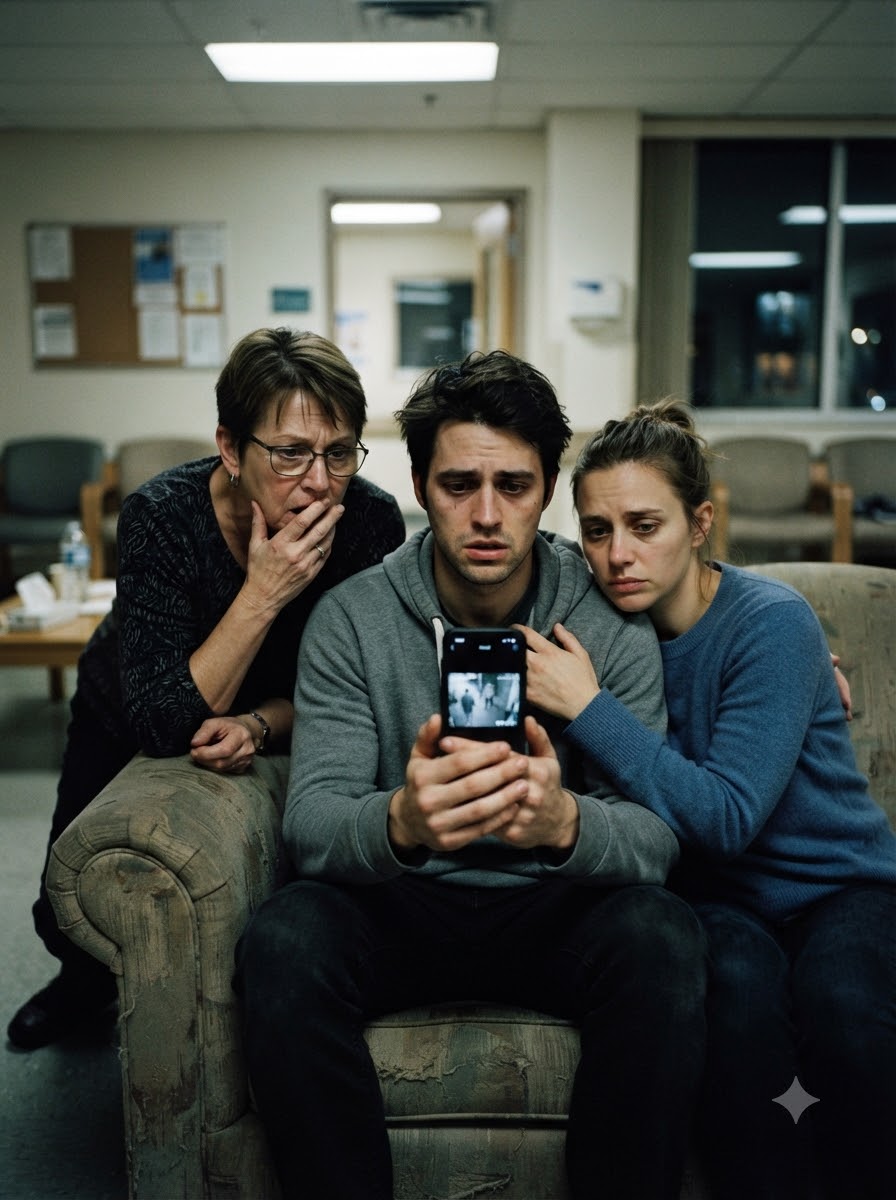
I knew something was wrong before I turned on the lights.
The apartment was too quiet in the wrong places and too loud in the one place that mattered.
Milo was screaming.
Not fussing. Not making the restless, hiccupping noises he usually made when he was hungry or tired. He was screaming with the raw, exhausted fury of a baby who had been crying for a long time and had learned no one was coming.
I dropped my briefcase beside the door and ran toward the living room.
Our apartment looked as if a storm had passed through it. Bottles lay uncapped on the coffee table. Used diapers spilled from the small wastebasket. A blanket was twisted on the floor, and one of Milo’s tiny socks had been crushed beneath a chair.
Clara was on the couch.
At first, I thought she was asleep. Then I saw her face.
Her skin had a grayish cast. Her lips were cracked and nearly white. Her hair was damp against her forehead, and one arm hung over the edge of the cushion, fingers barely moving.
“Milo,” I said, though I was already lifting him from the bassinet. “I’m here. Daddy’s here.”
He clung to my shirt with surprising strength, his cries turning into frantic gasps against my neck.
Behind me, a fork scraped across a plate.
I turned.
My mother was sitting at our dining table, eating roast chicken and potatoes.
She had removed her coat and placed it neatly over the back of a chair. Her handbag rested beside her. A glass of wine stood at her right hand.
For one absurd second, I stared at the plate.
It was the dinner Clara had prepared that morning, before I left for work. She had texted me a photograph of it while I was on the train: chicken, potatoes, and green beans, all arranged in a casserole dish. She had written, I made enough for your mother too. Please don’t let her complain that I forgot.
My mother looked up at me with irritation.
“You’re home early,” she said.
“What happened to Clara?”
My mother sighed as if I had asked her to solve a problem she had already explained several times.
“She’s resting.”
“She’s unconscious.”
“She is not unconscious. She’s being dramatic.”
I carried Milo to the couch and crouched beside Clara. Her eyes fluttered but did not open fully.
“Clara?” I said. “Can you hear me?”
Her mouth moved. No sound came out.
I felt her forehead. She was clammy and cold.
“What did you give her?” I asked.
“Nothing. I’m not a doctor.”
“Did you call anyone?”
My mother took another bite.
“She told me she was tired. I told her to lie down.”
“And Milo?”
“He was fed earlier.”
“He is starving.”
“He has been crying for twenty minutes. Babies cry.”
I looked at the clock on the wall.
The time was 6:42.
I had left the apartment at 8:10 that morning. My mother had arrived at nine. She had sent me a message at noon saying, Clara is having one of her difficult days. I assumed she meant Clara was emotional. I had replied, Thank you for helping. I’ll be home as soon as I can.
Now I understood the message differently.
I called emergency services.
My mother rolled her eyes.
“You’re making a spectacle over nothing.”
I ignored her. I gave the dispatcher our address, described Clara’s condition, and told her we had a four-week-old infant. While I waited, I warmed a bottle with shaking hands and held it to Milo’s mouth. He latched immediately, gulping so desperately that milk spilled down his chin.
Clara tried to sit up.
“I’m sorry,” she whispered.
“You have nothing to apologize for.”
“I tried to finish dinner.”
My mother made a small, disgusted sound.
“She was perfectly capable earlier. I asked her to prepare something instead of lying around all day, and she turned it into a tragedy.”
I looked at the plate in front of her.
“You asked her to cook?”
“She offered.”
“She was recovering from childbirth.”
“Four weeks ago,” my mother said. “Women have babies every day. They don’t all behave like invalids.”
The sirens approached.
My mother pushed back her chair.
“I’m not staying here to be accused.”
“You’re not leaving.”
Her eyebrows rose.
“Excuse me?”
“You were the only adult here.”
“I came to help.”
“You watched my wife collapse.”
“I did not watch her collapse. She went to sleep.”
“You sat ten feet away and ate the food she cooked.”
Her face hardened.
“That woman has manipulated you from the beginning.”
The paramedics entered before I could answer.
Within minutes, the living room filled with movement. One medic examined Clara while another checked Milo. Clara’s blood sugar was dangerously low. Her blood pressure had dropped. When they placed an IV in her arm, she began to cry—not from the needle, but from humiliation.
“I’m sorry,” she kept saying.
I held her hand.
The paramedic looked at me. “How long has she been like this?”
“I don’t know.”
My mother folded her arms. “She was tired when I arrived, but she was talking and walking.”
“Did you give her food or fluids?”
“She had coffee.”
“Anything else?”
“She refused lunch.”
I stared at her.
“You didn’t tell me that.”
“No one asked.”
At the hospital, doctors told me Clara was severely dehydrated and suffering from a serious blood sugar crash. Her exhaustion had reached a dangerous point, made worse by the demands of nursing and the fact that she had barely eaten or slept for days.
“If she had remained unconscious much longer,” the doctor said, “we would be discussing a much more serious situation.”
Clara slept for nearly four hours after they stabilized her.
I sat between her bed and Milo’s carrier, replaying my mother’s words.
She needs to learn how to be a real woman.
I had heard versions of them all my life.
When I was eight and came home with a fever, my mother said I was seeking attention.
When I was fourteen and failed a math test, she took away dinner because “comfort made boys weak.”
When I was twenty-two and told her I was struggling at work, she laughed and said everyone else managed without whining.
She had called it discipline. I had called it her personality.
I had spent years translating cruelty into something more acceptable.
Strict became strong. Controlling became concerned. Insulting became honest.
Now she had applied the same language to Clara, except this time I had watched the consequences spread across a hospital bed.
When Clara woke, she asked whether my mother was still at the apartment.
“No,” I said. “I told her to leave.”
Her eyes filled.
“She’ll tell everyone I’m unstable.”
“She can tell them whatever she wants.”
“She said you would believe her.”
I leaned closer. “I believe what I saw.”
Clara looked away.
For a moment, I thought she was going to cry. Instead, she whispered, “There’s something you need to know.”
Three weeks earlier, while I was assembling Milo’s changing table, Clara had asked me to install cameras in the apartment.