Dad Took Away My Seat—Then Ruth Played the Recording About My Signature
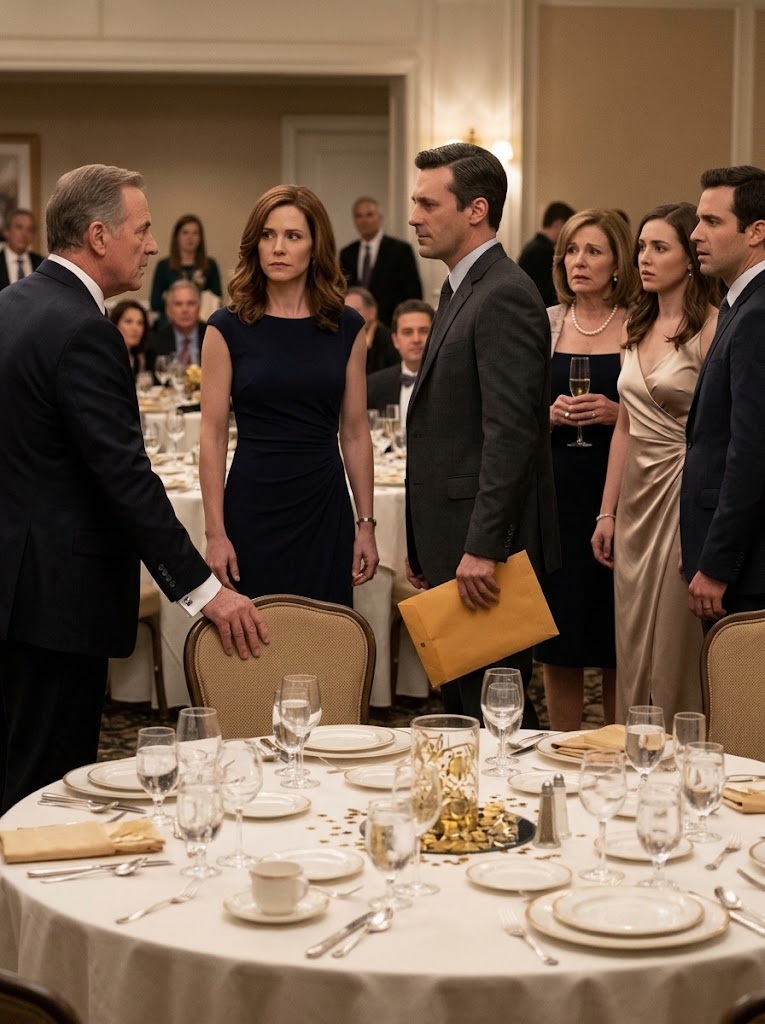
My father put one hand on the back of my chair before I could reach it.
“That seat is for the daughter this family is here to celebrate,” he said.
The ballroom at Oakridge Country Club went quiet in the uneven way a room does when people are trying not to look. A server stopped pouring wine. Someone behind me gave a nervous little cough.
I looked at the place card beneath my father’s hand. It said CAROLINE.
My mother had written the cards herself. I recognized the careful curl of the C.
“I’m your daughter,” I said.
My father, Thomas, slid the card out from under his palm and turned it facedown.
“Then act like someone who understands what this evening means.”
Behind him, a banner thanked him for forty years of leadership at the Hartwell Group. My younger sister, Stephanie, stood beneath it in a silver satin dress, accepting a compliment from one of his board members. Her husband, Mark, had his arm around her waist.
I had been invited to the dinner three weeks earlier. My mother had called twice to make sure David and I were coming. Yet there she was, watching my father deny me a seat as though the problem was that I had noticed.
“Please,” she whispered. “Don’t make this uncomfortable.”
David’s hand settled lightly at my back. He didn’t guide me away.
My father looked at him. “There are empty places near the doors. Take Caroline over there before she embarrasses herself.”
David stepped beside me.
“Thomas,” he said, “I think you should let her sit down.”
My father gave him the patient smile he used on people he intended to ignore. “This is a family matter.”
“No,” David said. “It stopped being one this morning.”
For the first time that night, my father looked afraid.
I understood the chair. My father had spent my whole life moving me out of the frame so Stephanie could stand in the center. What I didn’t yet understand was why David had mentioned that morning, or why Mark’s smile had vanished.
Three days earlier, I had gone to the Hartwell offices to collect a box of old photographs for the retirement slideshow.
Dad hadn’t asked me to help. He never asked me to help with anything that involved his company, although I was a forensic accountant. My mother wanted pictures of him accepting his first industry award, and his longtime office manager, Ruth Alvarez, had offered to find them.
I arrived just before lunch. Ruth was in the records room, standing over a carton of yellowed albums with her coat still on.
“You look exhausted,” I told her.
She shut the box she’d been looking through. “It’s been a long month.”
Ruth had worked for my father since I was in middle school. She remembered which school concerts he missed and had often been the one who drove me home from them. She was usually direct. That day, she wouldn’t quite meet my eyes.
While she searched for the albums, a folder slid from the edge of the table. I caught it before it hit the floor. A printed transfer request had slipped halfway out.
My name was on it.
The document authorized a payment from a small Hartwell charitable trust to a consulting company called Bellwether Advisory. At the bottom, beside “Prepared by,” was a scanned image of my signature.
I hadn’t prepared it. I had never worked for Hartwell.
I put the paper back in the folder and asked Ruth what I was holding.
She glanced at the signature, then closed her eyes. “I was hoping you wouldn’t find out like this.”
She told me the trust had been paying Bellwether for more than a year. Mark had arranged the contract and approved its invoices. My father chaired the trust, and Mark was its treasurer. According to Ruth, my father had begun asking questions about the payments only after a bank statement came to his house by mistake.
“Why is my name on a transfer?” I asked.
Ruth said she didn’t know.
I took a photograph of the page. Ruth watched me do it. Then she said, “Your father told me to box these files up after tonight.”
That frightened me more than the signature.
At home, I sent David the photograph. He was at work, but he called within minutes. He asked me not to contact my father or Mark yet. Then he asked whether I had access to any other original records.
I did. Years earlier, the trust’s annual reports had been publicly posted. I spent the afternoon comparing them against the payments Ruth had described. The trust was supposed to fund technical college scholarships for local students. In the previous year, its reported expenses had risen sharply, while the number of scholarships had fallen.
On paper, the difference was explained as “program development.”
The company receiving those payments had been formed eighteen months earlier. Its registered address was a mailbox. The name of its manager was listed as a business services firm, but a second filing showed that Mark had signed Bellwether’s lease.
By the time David got home, I had a legal pad covered with dates and figures. He brought takeout neither of us ate.
David was a lawyer for a regional lender that had recently financed a Hartwell expansion. He told me the lender had requested updated financial documents that week. He couldn’t show them to me; they belonged to his client. But he could tell me that what I’d found was serious enough to report, and that he had to step back from any work involving Hartwell because of our marriage.
I called Ruth that evening. With her permission, I recorded our conversation so she could give an accurate account later. She told me she had kept copies of the invoices, bank statements, and approval records because the totals didn’t agree with the trust’s annual reports. She had already contacted an attorney of her own.
Then she said something that made me sit down.
“Your father knows you didn’t sign it.”
“How?”
“I told him.”
According to Ruth, she had shown Dad the transfer request six weeks earlier. He had stared at my signature and said he would handle it. Two days later, he ordered her to stop asking questions until after the retirement dinner.
I spent that night remembering every time my father had described my work as “counting other people’s mistakes.” He had never been interested in what I did until someone needed my name on a form.
The next morning, David made his conflict disclosure at work. I gave the photograph to Ruth’s attorney, along with the public reports and the filings I had found. David said I should preserve my phone and notes. Ruth’s attorney arranged for an independent investigator to receive her documents.
That was all I knew for certain when we left for the party.
I had nearly stayed home. My mother had spent weeks talking about how much it would mean to my father to see us all together. I thought perhaps, at the end of his working life, he might finally let us be a family for one evening.