My Mother Called Poisoning Vitamins—Until My Teacher Found Grandma’s Trust Agreement
The blue pellets made a dry little clatter in the paper cup, like teeth striking porcelain.
My mother held them between two fingers and smiled.
“Take your vitamins, honey,” she sang.
The kitchen light bleached her blond hair nearly white. Behind her, garlic bread browned in the oven. Lavender perfume hung in the air, thick enough to make my throat itch. Everything looked warm and ordinary, which was how my mother preferred her cruelty: hidden inside pleasant things.
I stared at the pellets.
“I already took them this morning.”
“We both know that’s not how this works.”
Her smile remained, but her eyes went flat.
At fourteen, I knew the difference between my mother’s real voice and her performance voice. The performance voice had a cheerful bounce, the tone of a woman speaking to a toddler before taking away a dangerous toy.
“Daphne,” she said softly. “Do we need to ask your father to come in here?”
My father was in his study. If he came, he would not shout. He would sit across from me and explain, calmly and patiently, why disobedience was a form of selfishness. He would talk about nutrition, responsibility, and the sacrifices my parents made.
Then he would watch until I swallowed.
My stomach was already burning. The pellets had been making me sick for years, but lately the pain had sharpened. My hands shook during class. My nose bled without warning. Sometimes I woke at night with a metallic taste coating my tongue.
The blue pellets smelled bitter and chemical.
I took the cup.
My mother leaned closer as I tipped them into my mouth.
“Water,” she said.
I swallowed, trying to keep the pellets tucked against my cheek. I had become good at pretending. I drank loudly, tilted my head back, and opened my mouth when she ordered me to.
“Lift your tongue.”
I did.
She checked carefully. Then she patted my cheek.
“Good girl. Dinner in twenty minutes.”
She turned toward the stove.
I waited until her heels clicked down the hall. One, two, three, four. She paused near the pantry. Then the sound moved toward the living room.
I ran for the downstairs bathroom, locked the door, and dropped to my knees.
The first attempt brought up nothing. The second made my throat spasm. On the third, bitter fluid splashed into the toilet, followed by tiny blue fragments.
I flushed twice and scrubbed my mouth until my gums bled.
Then I went upstairs.
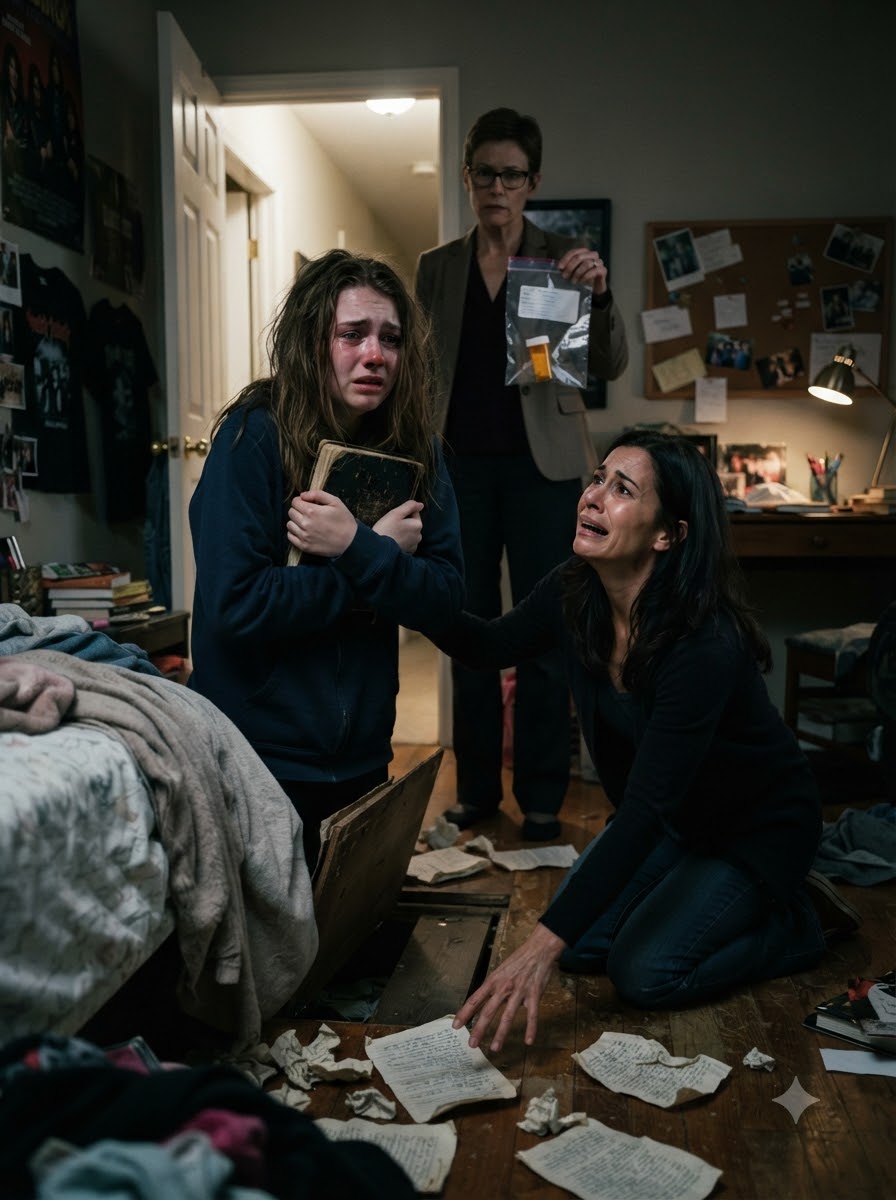
In my bedroom closet, behind a box of winter sweaters, a floorboard lifted if I pried at the corner with a butter knife. Under it was an old shoe box wrapped in one of my grandmother’s scarves.
Inside was my diary.
I opened it and wrote the date, the time, and everything that had happened. I wrote about the two pellets, the burning, the metallic taste, and the blue fragments in the toilet.
Then I added a note about the box in the garage.
RVD-X Extreme. Skull symbol on the label. Same blue pills. Almost empty. Mother keeps replacing them.
My handwriting had grown smaller over the years. The words crowded together as if they were afraid of being seen.
At the bottom of the page, I wrote:
Tomorrow I tell Mr. Patterson. I bring the diary. If he doesn’t help me, I die here.
I stared at the sentence.
It sounded dramatic. My mother had trained me to distrust anything that sounded dramatic. Whenever I cried, she called me sensitive. Whenever I said the pills made me ill, she called me anxious. When I told my father I thought something was wrong, he said fear could create symptoms.
But the sentence was true.
Three years earlier, my grandmother had died.
A week later, my parents began talking about my health.
They said I was pale. They said my blood was weak. They said I had inherited a delicate constitution from my grandmother. My mother began giving me the “vitamins” after dinner. My father inspected my mouth each night to make sure I had swallowed.
At first, I believed them.
Then the cramps started.
The nosebleeds followed. So did dizziness, trembling, exhaustion, and a strange numbness in my fingertips. I stopped being able to run in gym class. I fell asleep over homework. Once, I fainted during a spelling test.
The pediatrician ordered blood work.
My father came with me. He answered every question before I could.
“She’s always been dramatic about discomfort,” he told the nurse.
My mother cried in the examination room and said she was terrified of losing me.
The doctor recommended iron, rest, and a follow-up appointment.
We never went back.
I began keeping the diary after finding the first box in the garage. It was tucked behind paint cans, beneath a plastic tarp. The label had been scratched, but I could still see the skull symbol. I took a photograph with a disposable camera I had found in a drawer.
Later, I found another box in the laundry room.
Then another in the trunk of my mother’s car.
I wrote down every brand name, every symptom, every time one of my parents watched me swallow.
I didn’t know what the pellets were. I only knew they were making me sick.
A floorboard creaked outside my room.
I shoved the diary beneath the scarf and lowered the board.
The doorknob turned once.
Then my mother spoke through the door.
“Don’t stay up too late, sweetheart. Big day tomorrow.”
My hand froze on the closet.
She hadn’t asked what tomorrow was.
I had not told anyone.
For several seconds, neither of us moved.
Then her footsteps retreated.
I waited until they disappeared downstairs before I took the diary out again. My fingers were shaking so badly I could barely write.
She knows.
I slept in my clothes with the diary beneath my pillow.
At six in the morning, I heard my mother enter the room. She stood beside my bed for a long time. I kept my breathing slow and even.
Her hand brushed my hair away from my face.
“Poor baby,” she whispered.
Something cold touched my wrist.
I opened my eyes.
She was holding another paper cup.
For the first time in three years, I screamed.
My mother jumped back. The cup hit the floor, and blue pellets scattered across the carpet.
“What are you doing?” I shouted.
“Daphne, calm down.”
“You came into my room with them.”
“They’re your medication.”
“They’re poison!”
The word escaped before I could stop it.
Her expression changed. Not into surprise. Into calculation.
Behind her, my father appeared in the doorway wearing his gray robe.
“What happened?” he asked.
“She’s having an episode,” my mother said.
I ran.
I pushed past them and bolted down the stairs barefoot. My father caught my arm near the front door. His grip was hard enough to bruise.
“Let go.”
“Daphne, you are frightened and confused.”
“I’m going to school.”
“You’re not well enough.”
My mother came down the stairs carrying the cup. “If you leave this house, I’ll call the police and tell them you’re unstable.”
That stopped me for one second.
Then I saw the blue pellet near the umbrella stand.