I Found My Dead Brother Alive—Then He Showed Me What Our Father Hid
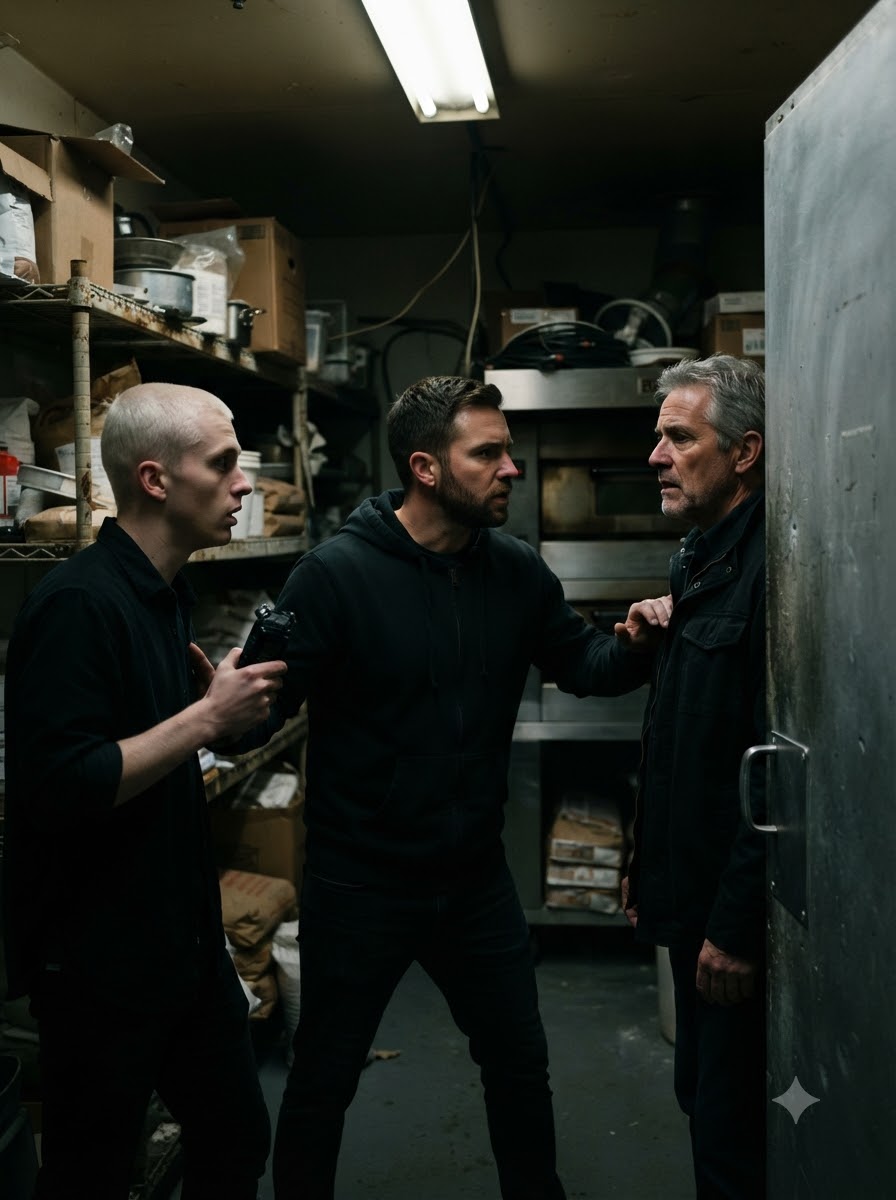
The first thing my father did when I told him Ryan was alive was slap me.
The second thing he did was lock the front door.
My mother stood between us in the kitchen, one hand pressed to her mouth, the other gripping the edge of the table. For seven years, she had worn grief like a second skin. She had gone to Ryan’s grave every Sunday, regardless of snow, fever, or the angry silence my father carried whenever she mentioned our older son.
Now her face had gone completely white.
“Say it again,” she whispered.
I looked at my father.
Robert had not moved since I walked through the door. He was still wearing his office clothes, his tie loosened, his gray hair damp from the rain. But the color had drained from his face.
“I saw Ryan,” I said. “He’s alive. He works at a bakery on the Lower East Side.”
My father’s hand came down so quickly I barely saw it.
The blow snapped my head sideways. My cheek burned. My mother cried out.
“Luke, you don’t know what you’re saying,” Robert said.
“I spoke to him.”
“You saw someone who looked like him.”
“He called me by my childhood nickname.”
That silenced him.
Ryan had called me Sprout because, when I was six, I planted a bean in a paper cup and cried when it failed to grow. Nobody outside our family knew that story. Nobody except Ryan.
My mother sank into a chair.
“Where is he?” she asked.
“Dad—”
“Where?”
I told her the address Ryan had written on the paper he slipped into my hand.
742 Broadway. Eleven o’clock.
Beneath it, he had written: If Dad finds out before you understand the truth, Mom will die.
My father lunged for the paper.
I stepped back. He missed it by inches.
“Give me that,” he said.
“No.”
His expression changed then. Not anger. Calculation.
I had seen that expression all my life whenever Robert dealt with insurance companies, contractors, or police officers. It was the look of a man searching for the most efficient way to close a problem.
“You’re upset,” he said. “You’ve had a shock. Go upstairs and sleep.”
“Why did Ryan tell me not to let you know?”
My father’s jaw tightened.
My mother raised her head. Tears streaked her face.
“Robert,” she said, “what does he mean?”
“He means nothing. It’s some cruel misunderstanding.”
“Is Ryan alive?”
My father looked at her.
For seven years, I had watched my mother kneel before a black granite headstone engraved with Ryan’s name. I had watched her place fresh flowers beneath the dates of his birth and death. I had watched my father refuse to enter the cemetery after the funeral.
Now, for the first time, fear moved visibly across his face.
“No,” he said.
The answer came too quickly.
That was when I understood the slap had not been grief.
It had been panic.
Seven years earlier, Ryan had supposedly died on a highway outside Albany. His car had left the road, struck a barrier, and caught fire. The police report said the vehicle was destroyed and the body inside could not be identified.
The only things they found were a silver bracelet and Ryan’s wallet.
My father handled everything.
He arranged the funeral. He spoke with the police. He contacted the insurance company. He ordered a closed casket because, as he told my mother, “You should remember Ryan as he was, not as the accident left him.”
At the time, I was twenty-one and too shattered to question him.
My mother never recovered.
She lost her voice for three days after the funeral. Later, she began visiting the cemetery every Sunday. Sometimes she spoke to Ryan for hours. She told him about the weather, the neighbors, my job, and the meals she cooked. Once, I heard her apologizing because she had bought the wrong brand of coffee.
My father never visited the grave.
Not once.
When I asked him why, he said cemeteries were for the living, and he had no interest in “performing sorrow.”
I had hated him for that.
Now I wondered whether he had avoided the grave because he knew there was no one beneath it.
At ten-thirty that night, I left the house through the back door.
My father had gone upstairs. My mother remained in the kitchen, sitting beneath the yellow light with both hands wrapped around a cold cup of tea.
“I’m coming with you,” she said.
“No. Ryan told me to come alone.”
“He is my son.”
“I know.”
“And if he is alive—”
“I know.”
She looked toward the staircase.
“Your father will follow you.”
“I’ll make sure he doesn’t.”
I drove three blocks, parked beside a laundromat, and waited in the darkness. Ten minutes later, my father’s sedan passed slowly through the intersection.
He had followed me.
I waited until his car disappeared, then took a taxi to Broadway.
The building at 742 was old and narrow, with a rusted fire escape and a broken intercom. The lobby smelled of dust and boiled cabbage. I climbed four flights.
At the top, a door opened before I knocked.
Ryan pulled me inside.
For a moment, neither of us spoke.
He looked older than thirty-four. His hair was longer, his face leaner, and a pale scar cut through his right eyebrow. But his eyes were unchanged. Same hazel color. Same wary way of studying a room before entering it.
I grabbed him.
He held me tightly, and the breath left my body.
“I thought you were dead,” I said against his shoulder.
“I know.”
“You let us bury you.”
“I didn’t have a choice.”
“You had seven years.”
His arms fell away.
Behind him, the apartment was nearly empty. A mattress lay on the floor. There was a hot plate, a small refrigerator, and a wooden table covered in papers.
“Sit,” he said.
I remained standing.
“Tell me what happened.”
Ryan rubbed both hands over his face.
“Dad found out I knew.”
“Knew what?”
“That the accident wasn’t an accident.”
He took a folder from the table and opened it.
Inside were photographs, photocopies, bank statements, and pages covered in handwritten notes.
“Three days before I died,” he said, “I found transfers from Dad’s company into accounts in the Cayman Islands. The money came from construction contracts and city redevelopment grants. He was stealing from projects his own company was managing.”
“Dad?”
“He had partners. One of them was a city inspector named Howard Voss. Another was a lawyer called Alan Pike. They were using fake subcontractors, inflated invoices, and abandoned properties to move money. I found it because I was helping with the company’s accounting.”
I stared at the papers.
“Why didn’t you go to the police?”
“I tried.”
Ryan pulled out a police envelope. Inside was a photocopy of a complaint filed seven years earlier.
“I met a detective named Ellis. I gave him copies of the accounts. Two days later, Dad knew.”
“What happened?”
Ryan’s mouth tightened.
“Dad called me to the warehouse in Queens. He said he wanted to talk. Voss was there. So was Pike. They told me I had misunderstood the numbers. Then Dad offered me money to leave town.”