My Family Called Me an Embarrassment—Then Grandma’s Recording Exposed Their Lie
I came home to find my sister pointing at me like I was a criminal.
The police had barely crossed the threshold when Tiffany lifted one manicured hand and said, “That’s her. That’s the one who did it.”
The room went silent.
A moment earlier, music had been shaking the walls. Tiffany’s friends were filming themselves beneath strings of gold lights, laughing over champagne and tiny desserts arranged on mirrored trays. Her engagement party had been designed for an audience, not guests.
Now every phone had turned toward me.
One of the officers, a broad man with tired eyes, unfolded a document. “Captain Elena Vale?”
I looked at the badge clipped to his belt, then at the paper in his hand. “Yes.”
“You’re being detained in connection with suspected financial fraud and unlawful transfer of property.”
Tiffany’s smile trembled, but only for a second. Then she pressed herself against Brad’s arm.
“I told you,” she whispered loudly. “She came back because she knew we were about to expose her.”
My mother stood near the staircase, one hand covering her mouth. My father was beside her, pale and rigid. Neither asked what evidence the officers had. Neither asked whether the accusation made sense.
They had already chosen their side.
I looked past them toward the windows. Outside, headlights swept across the curtains. A black SUV rolled to a stop at the curb.
Then another.
Then a third.
The front door opened before anyone could reach it.
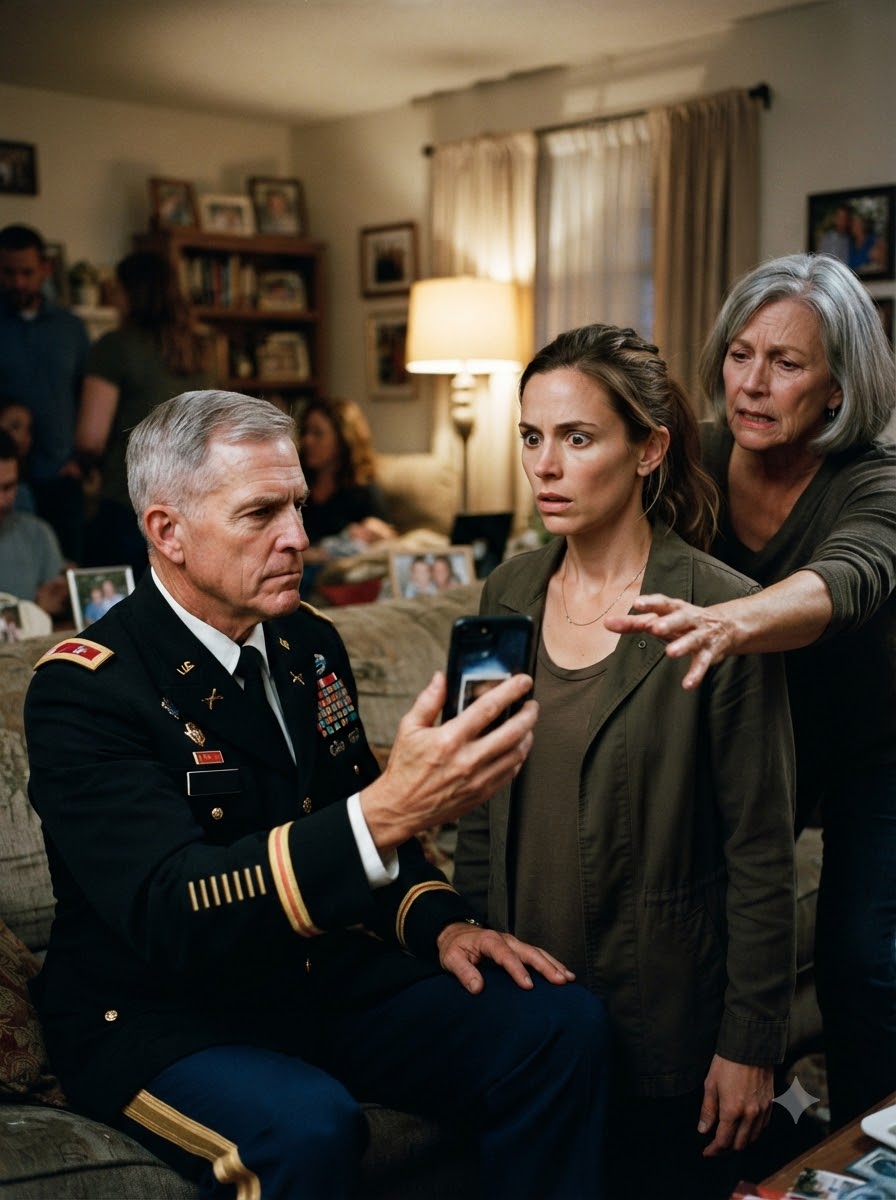
A man in a dark formal uniform entered with two aides behind him. His silver hair was cut close, his posture impossibly straight. Four stars gleamed on his shoulders beneath the chandelier light.
Tiffany’s phone lowered.
Brad stopped breathing.
The general scanned the room until he found me.
“Captain Vale,” he said.
I gave him a small nod. “General.”
He walked toward me, and the police officers stepped aside without being asked.
“I’m sorry you had to endure this,” he said. “The Army’s legal office has been working to stop it for six weeks. We arrived as soon as the warrant was confirmed.”
My mother’s face changed.
“What warrant?” she demanded.
The general didn’t look at her. “The warrant for the arrest of Brad Mercer and Tiffany Vale.”
The room seemed to lose all sound.
Tiffany stared at him. “What?”
The general finally turned. “You heard me.”
Brad released her arm as if she had become dangerous to touch.
The officer holding my paperwork folded it shut.
“General,” he said, “we were told Captain Vale was the suspect.”
“You were misled,” the general replied. “And your department will receive the full file tonight.”
My father gripped the banister. “This is a misunderstanding.”
“No,” I said quietly. “It’s the end of one.”
Five years earlier, I had left Denver with a duffel bag, a broken heart, and a family that had already decided I was difficult.
I had been twenty-three when I enlisted. My parents called it a phase. Tiffany called it embarrassing.
She had just started dating Brad then, and he had built his identity around expensive watches, aggressive handshakes, and telling people he was destined for executive leadership. He worked at a financial services company and wore a suit even to casual restaurants.
When I told my family I was joining the Army, my mother cried—not because she feared for me, but because she said I was throwing away my education.
“You could be someone,” she told me.
Tiffany laughed from the kitchen. “She wants to play soldier.”
I left anyway.
Over the next five years, I served overseas, completed officer training, and rose faster than anyone in my family knew. My work involved logistics, security, and financial compliance in unstable regions. I learned how money vanished through shell companies, forged signatures, and trusted people who smiled while stealing.
I stopped telling my family where I was stationed.
At first, I sent updates. My mother rarely responded. My father sent one message asking whether the military paid enough to justify “the sacrifice.” Tiffany sent photographs of herself in designer clothes with captions about ambition.
Eventually, silence became easier.
Then, three months before my return, my grandmother died.
She had been the only person in the family who never treated my service like a rebellion. She had saved every letter I sent her and kept a photograph of me in uniform beside her bed.
Her will left me the house in Denver, along with an investment account and a small trust she had established years earlier.
I didn’t know about the details until an Army legal officer contacted me.
The house was not just a family home. It was legally mine.
My grandmother had transferred it to me before her death, with the deed recorded and the trust protected from anyone else’s claims. She had left my parents the right to live there for as long as they wished, but they could not sell, refinance, or transfer the property without my written consent.
I planned to return quietly, inspect the house, and decide what to do.
Instead, I found my family preparing to sell it.
The party was supposed to celebrate Tiffany’s engagement to Brad. But beneath the balloons and champagne, something else was happening.
They were celebrating the sale.
When I arrived, Tiffany’s livestream was already running. She stood beneath a wall of white roses, wearing a diamond that looked large enough to require its own security detail.
Her expression changed when she saw me.
“Oh my God,” she said. “You actually came back.”
Dozens of faces turned.
I wore a plain gray jacket over my uniform trousers. My rank insignia was visible, but I had left my medals in my car. I didn’t want to walk into that house carrying proof for people who had spent five years pretending I had accomplished nothing.
My mother came toward me with a smile that never reached her eyes.
“Five years,” she said. “No warning. No updates. We barely knew if you were alive.”
“I sent letters.”
“You sent official-looking nonsense,” Tiffany said. “Nobody understood what you were doing.”
Her gaze dropped to my shoulder.
“So what are you now?” she asked. “Still low-ranking?”
A few people laughed.
Brad raised his glass. “You’re military?”
“That’s what the uniform suggests.”
He looked me up and down. “You don’t seem like the type.”
Tiffany leaned toward the camera. “Elena does something small on base. Brad actually manages people.”
Brad smiled as if she had handed him a medal.
My father emerged from the dining room. “Try not to cause a scene tonight.”
“I just arrived.”
“And you’re already making everyone uncomfortable.”
I looked at the walls. My grandmother’s photographs were gone. The old piano had been moved. A huge abstract painting hung where my grandfather’s portrait used to be.
“Where’s Grandma’s picture?” I asked.
Tiffany waved a hand. “We redecorated.”
“Without asking me?”
My father’s jaw tightened. “This is still our home.”
“No,” I said. “It isn’t.”
The music continued, but the mood shifted. People watched me the way people watch a cracked glass near the edge of a table.
I walked through the house slowly.