I Returned From Bradley’s Funeral—His Family Was Removing Evidence From My Home
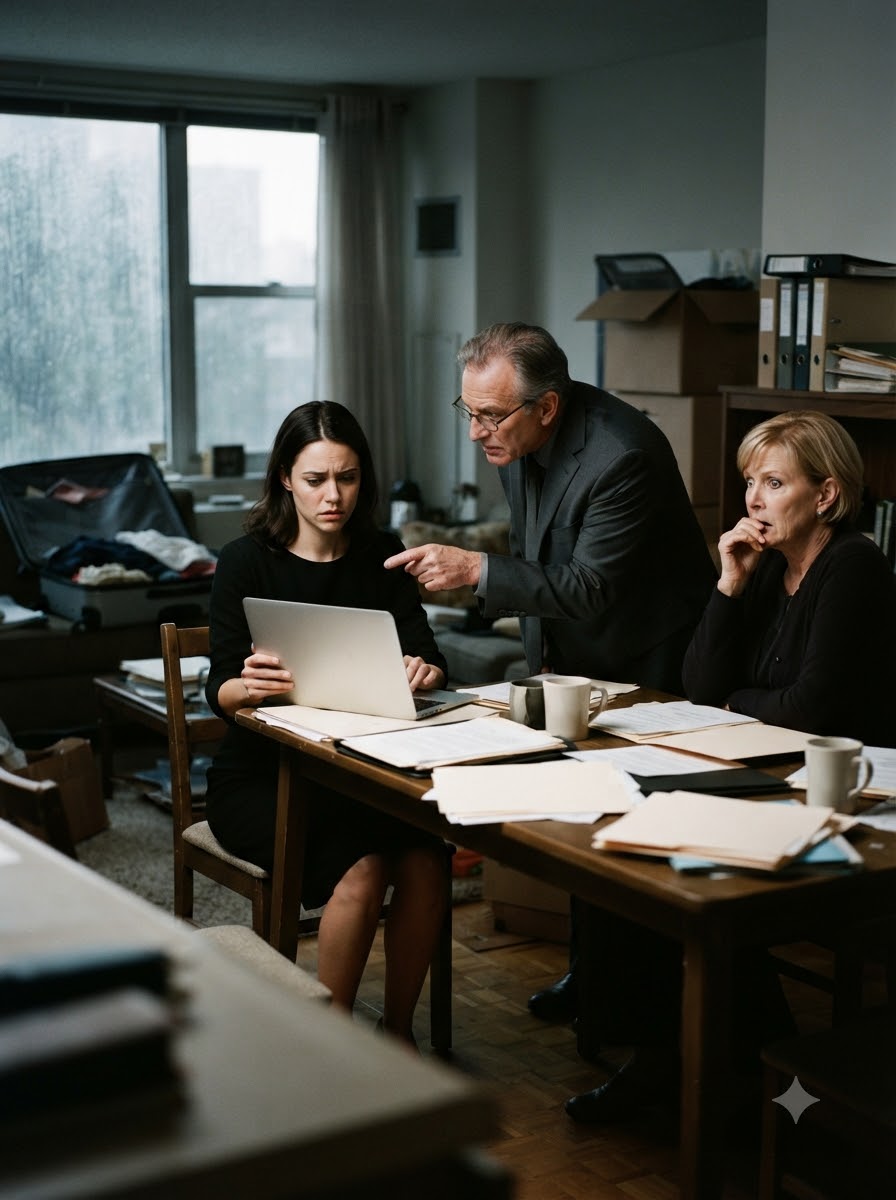
I came home from my husband’s funeral with rain in the hem of my black dress and strangers carrying his belongings out of our apartment.
For several seconds, I stood in the open doorway and convinced myself I had entered the wrong home.
The living room was familiar, but everything in it had been disturbed. Drawers hung open. Books lay in crooked stacks on the floor. The framed photograph from our anniversary trip to Charleston had been turned facedown. Two suitcases sat beside the sofa.
One was half-zipped.
Inside it were Bradley’s silver candlesticks, his father’s carved wooden box, and several folders from his office.
I heard his mother’s voice from down the hall.
“Take the files too. She won’t know what matters.”
My fingers tightened around the funeral program in my purse.
Three hours earlier, we had buried Bradley Hale beneath a sky the same color as the ocean. People had called him brilliant, kind, private, devoted. His brother Declan had stood beside the casket wearing a solemn expression he seemed to have practiced in a mirror. His sister Fiona had whispered about “next steps” before the grave was filled.
Now they were taking apart my home while I was still wearing the clothes I had been buried in emotionally.
I stepped inside.
Declan appeared first. He was holding the handle of the open suitcase.
“Avery,” he said. “You’re back early.”
“From my husband’s funeral?”
His smile vanished.
Fiona came out of Bradley’s office with one of his leather notebooks pressed to her chest. She glanced at my wet hair and bare feet, then looked annoyed rather than ashamed.
“You should have stayed at the reception,” she said. “Mother thought you needed time.”
“Time for you to finish stealing?”
Marjorie Hale emerged behind her carrying a stack of folders. Bradley’s folders. His handwriting was visible on the tabs.
She wore black pearls and the expression of a woman handling an unpleasant business matter.
“Don’t be dramatic, Avery,” she said. “We’re securing family property.”
“This is my home.”
“It was Bradley’s home before you married him.”
“It was our home.”
Marjorie gave me a thin smile. “You were married five years. I was his mother for forty-one.”
Behind her, one of Bradley’s aunts was wrapping a brass lamp in a towel. Someone was opening cabinets in the kitchen. I counted eight relatives in all.
Eight people had entered my apartment while I was at the cemetery and decided what they were entitled to carry away.
I looked at the suitcases.
“Put everything down.”
Declan laughed. “You’re grieving. You’re not thinking clearly.”
“I said put it down.”
Fiona dropped the notebook onto the table with deliberate care. “Bradley had business interests you knew nothing about. There are documents and assets that belong to the family.”
“The family?”
Marjorie’s eyes sharpened. “You wouldn’t understand.”
That sentence had been used against me for years.
You wouldn’t understand the business.
You wouldn’t understand why Bradley needed to help Declan again.
You wouldn’t understand why Fiona had a key to our apartment.
I had tolerated it because Bradley always apologized afterward. He would close the bedroom door, take my hand, and say, “I’m handling it.”
During the last month of his life, though, he had stopped saying that.
Instead, he had begun saying, “If anything happens to me, don’t trust my family.”
At the time, I had thought he was frightened by his own exhaustion.
Now I looked at the folders in Marjorie’s arms and remembered the night he had stood in our kitchen, pale and sweating, while he deleted something from his phone.
“Promise me,” he had said.
“Promise you what?”
“That if they come here, you don’t let them explain anything.”
I had laughed nervously. “Bradley, your family doesn’t scare me.”
“They should.”
He had never explained why.
Now I understood that he had been trying.
I walked to the dining table and picked up the top folder. Marjorie reached for it.
“Don’t touch that.”
I opened it.
Inside were copies of account statements, corporate filings, and a document titled Durable Financial Power of Attorney. The signature at the bottom looked like Bradley’s, but something about it made my stomach turn.
Bradley signed his name with a sharp, narrow loop in the B. This signature had a round, hesitant curve.
I looked at the date.
It had been signed two days after Bradley’s death.
The room seemed to tilt.
“This is forged.”
Declan stepped toward me. “Careful.”
“No.” I held up the page. “This was signed after Bradley died.”
Fiona’s face went white.
Marjorie did not flinch. “The date is a clerical error.”
“A clerical error on a power of attorney?”
“Bradley signed documents before his death. The filing was delayed.”
“The date says the seventeenth.”
“He died on the fifteenth,” I said.
No one answered.
The rain tapped against the windows. Somewhere in the kitchen, a cabinet door closed.
I turned the page. The document granted Marjorie control over Bradley’s accounts, his company, his investments, and all property “held in his individual name.”
I looked at her.
“You brought a forged power of attorney into my house on the day of his funeral.”
“You are upset,” she said. “You’re interpreting things emotionally.”
“Why is it in your suitcase?”
“Because we need to protect the estate.”
“And why are you taking his computer?”
Declan’s voice hardened. “Because you have no idea what’s on it.”
“I know exactly what’s on it. His work. His photographs. His private correspondence.”
“And financial records.”
He said it too quickly.
I looked at him more carefully.
Declan had a bruise along his wrist. A dark oval, half-hidden beneath his cuff. Fiona’s right hand was trembling. Marjorie kept touching the pearl at her throat.
They were not confident.
They were desperate.
I took one step backward and reached into my purse for my phone.
Declan noticed.
“Don’t call the police.”
The command landed harder than the theft.
“Why not?”
“This is a family matter.”
“It stopped being a family matter when you broke into my home.”
Marjorie moved toward me. “Avery, listen. Bradley left debts. Serious ones. If we don’t secure his assets, creditors will take everything. You’ll lose the apartment.”
“Bradley had no debts.”
“You don’t know that.”
“I saw his accounts.”
“Before you stopped being included.”
The words were meant to frighten me. Instead, they confirmed what Bradley had hidden.
He had changed something.
Perhaps they knew it. Perhaps they did not.
I pressed my phone screen, but before I could dial, the apartment door opened again.
A man in a charcoal suit entered without an umbrella. He was in his early sixties, with a silver beard and a leather briefcase. I recognized him from the funeral.
Graham Vale.
Bradley’s attorney.
He closed the door behind him and looked around the apartment.
His gaze moved from the suitcases to the open drawers, then to the forged document in my hand.
“Good,” he said quietly. “You found it.”
Marjorie straightened.
“Graham, this is a private family matter.”
“No,” he replied. “It is a criminal matter.”
Every person in the room went silent.
Graham placed his briefcase on the table. He did not look surprised by the relatives, the missing items, or the forged document.