My Family Cropped Me From Every Holiday Photo—Then Sarah Found the Invoices
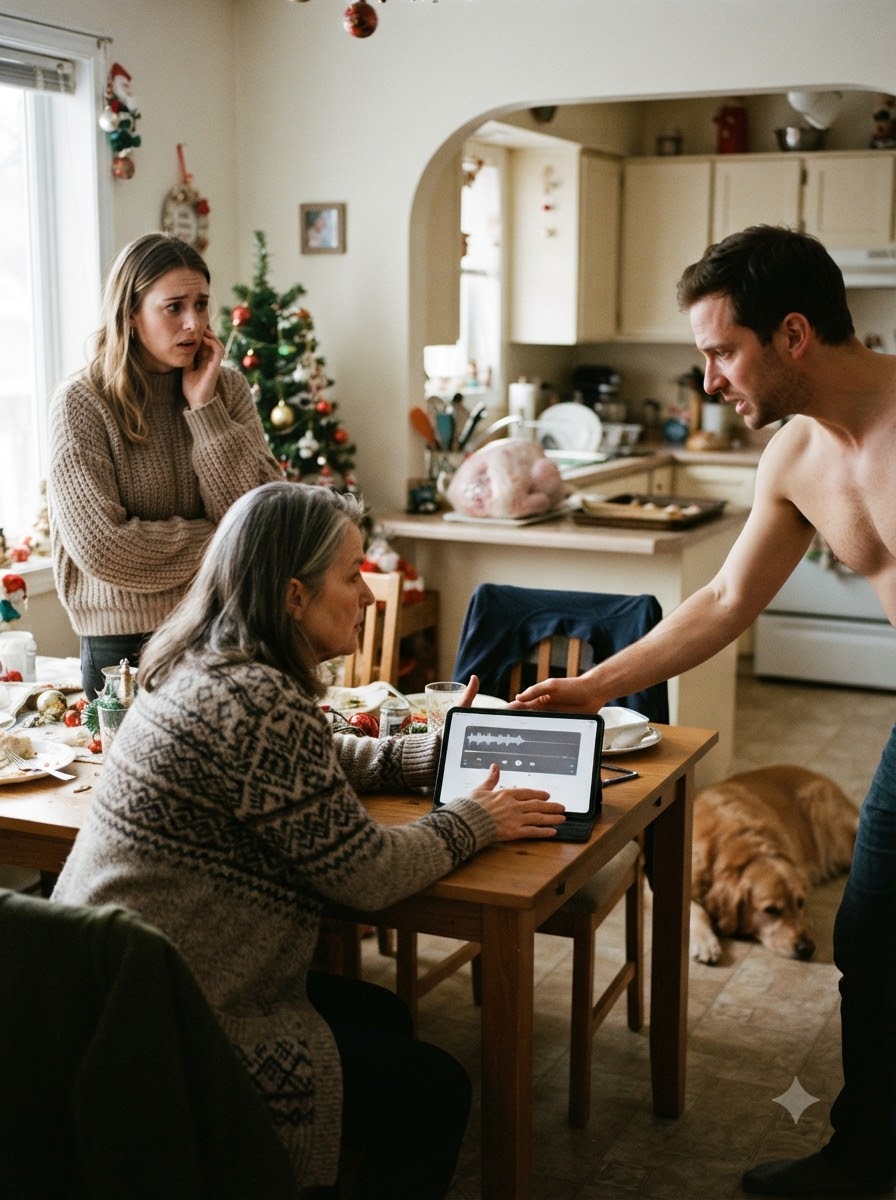
The gravy spoon hit the tile just as my family raised their glasses without me.
It landed with a bright crack, flinging brown streaks across my apron and my mother’s spotless kitchen floor. For one suspended second, I stared at the mess while laughter rolled in from the dining room.
They had started Thanksgiving dinner.
I had been cooking since five that morning. Shopping and preparing since Tuesday. I had brined the turkey, baked the rolls, peeled six pounds of potatoes, and made the gravy from drippings the way my grandmother taught me.
Yet nobody had waited.
Through the doorway, I could see my mother smoothing Adrien’s collar while my father filled his glass. Aunt Sarah leaned forward, listening to my brother describe a golf game as if national security depended on the outcome.
No one looked toward the kitchen.
I wiped the floor, carried in the gravy boat, and set it down hard enough to make the silverware jump.
Mom barely glanced up.
“Honey, bring Adrien some more ice.”
His glass still had three cubes floating in it.
“No,” I said.
The word was soft, but every face turned.
Mom’s smile stayed in place while the skin around it tightened.
“What did you say?”
“I said no.”
Dad lowered his fork. “Marin.”
That warning tone had governed my childhood. It meant stop talking, stop feeling, stop making the family uncomfortable.
“Your brother drove all the way from Tampa,” he said.
“Two hours,” I replied. “He drove two hours. I’ve been working for two days.”
Adrien gave an embarrassed laugh. “Nobody asked you to make a federal case out of ice.”
“No. You just expected me to get it.”
Mom pressed a hand to her chest.
“We appreciate everything you do.”
“Then why did you start without me?”
No one answered.
Their plates were already half empty. The turkey I had basted every thirty minutes had been carved by my father, though he’d never once checked whether it was done. My chair at the end of the table was blocked by a tray of dirty glasses.
They hadn’t merely forgotten me.
They had arranged the room as though I was never meant to sit down.
Mom recovered first.
“Adrien was hungry. Dinner was ready. There was no reason for everyone to wait while you fussed in the kitchen.”
“I was finishing your gravy.”
“You enjoy cooking,” she said.
There it was.
For seventeen years, my enjoyment had been the family’s favorite excuse.
I had cooked every Thanksgiving, Christmas, Easter, birthday, anniversary, and graduation dinner since I was twenty-four. At first, I did enjoy it. Then Grandma became ill and Mom said she was too overwhelmed. After Grandma died, they called cooking my “special role.”
I became more efficient each year, which only taught them I could handle more.
They praised Adrien for flying in, driving in, bringing wine, bringing a girlfriend, bringing nothing. They praised Dad for carving. They praised Mom for setting out candles.
I was thanked, if at all, while loading the dishwasher.
Adrien leaned back in his chair.
“Can we not ruin Thanksgiving over this?”
I looked at him. “You mean can I not ruin it.”
He shrugged. “You’re the one making a scene.”
Aunt Sarah stared at her plate.
I untied my apron.
Mom’s eyes narrowed. “What are you doing?”
“Leaving.”
“You can’t leave. We haven’t had dessert.”
“The pies are on the counter.”
“Coffee needs to be made.”
“Then make it.”
Dad stood so abruptly his chair scraped the floor.
“You will not speak to your mother that way in her house.”
Something in Aunt Sarah’s face changed at the words her house. It was only a flicker, but I caught it.
Then she looked down again.
I collected my purse and coat from the hall. Behind me, Mom followed, whispering fiercely so the neighbors, half a mile away, wouldn’t hear.
“If you walk out now, you will humiliate me.”
“Who will know?”
“We will.”
“You didn’t notice I wasn’t at the table.”
Her expression hardened.
“You’ve always been jealous of Adrien.”
I almost laughed.
That accusation was older than either of us. Whenever Adrien received something I wanted—attention, help with tuition, the better bedroom, Dad’s old car—my disappointment became jealousy, and jealousy made me guilty.
“I’m not jealous,” I said. “I’m tired.”
I walked out with gravy drying on my sleeve.
No one came after me.
The next morning, I discovered Grandma’s silver gravy boat in my tote bag.
I must have dropped it there while gathering my things. It sat wrapped in a dish towel, heavier than I remembered.
Mom called six times before noon. I ignored her. Her texts progressed from outrage to martyrdom.
You upset your father.
Adrien hardly ate after you left.
Sarah says you seemed exhausted. Maybe you should see someone.
The final message said, Please return the gravy boat. It belongs with the house.
That phrase bothered me.
Not to me. Not to the family.
With the house.
I turned the piece over. Beneath its tarnish was an engraving I had never noticed: M.V., my grandmother’s initials. Along the base, one corner of the felt lining had peeled away.
Something pale showed beneath it.
I used tweezers to pull out a folded scrap of paper.
It was not a note. It was a claim ticket from Coastal Safe Deposit Company, dated eleven years earlier, three months before Grandma died.
The name on it was mine.
MARIN VALE — BOX 417.
I read it repeatedly.
I had never rented a safe-deposit box.
Coastal Safe Deposit had closed years ago, but the phone number redirected to a records company. On Monday, a clerk told me Box 417 had been transferred to First Harbor Bank.
“The annual fee is paid from a trust account,” she said. “You’ll need identification and the access key.”
“What trust account?”
There was a pause.
“You’re listed as beneficiary of the Evelyn Vale Family Trust.”
My hand tightened around the phone.
“My grandmother had no trust.”
According to my parents, Grandma had died with the bay house and barely enough savings to cover medical bills. Mom inherited the house because she had cared for her. I had never questioned it.
The clerk wouldn’t say more without identification and the key.
I searched the gravy boat again.
The base looked solid, but when I pressed the engraved plate, it shifted. A tiny brass key slid into my palm.
At the bank, I signed three forms and was led into a windowless room. The box was narrow and surprisingly light.
Inside were a sealed letter, property records, and a copy of Grandma’s trust.
The first page left me unable to breathe.
Grandma had placed the bay house, her investment account, and a collection of jewelry into a trust for me. My parents were temporary trustees until my thirtieth birthday.
I had turned thirty nine years ago.
The letter was in Grandma’s hand.
Marin,
This house should belong to the person who filled it with warmth, not the people who only saw its price. Your mother will resent my decision. Your father may support her. That is why I created the trust.
Do not let them convince you that service is the same as love.