My Family Took Dad’s Shop—Then His Hidden Recording Exposed Everything
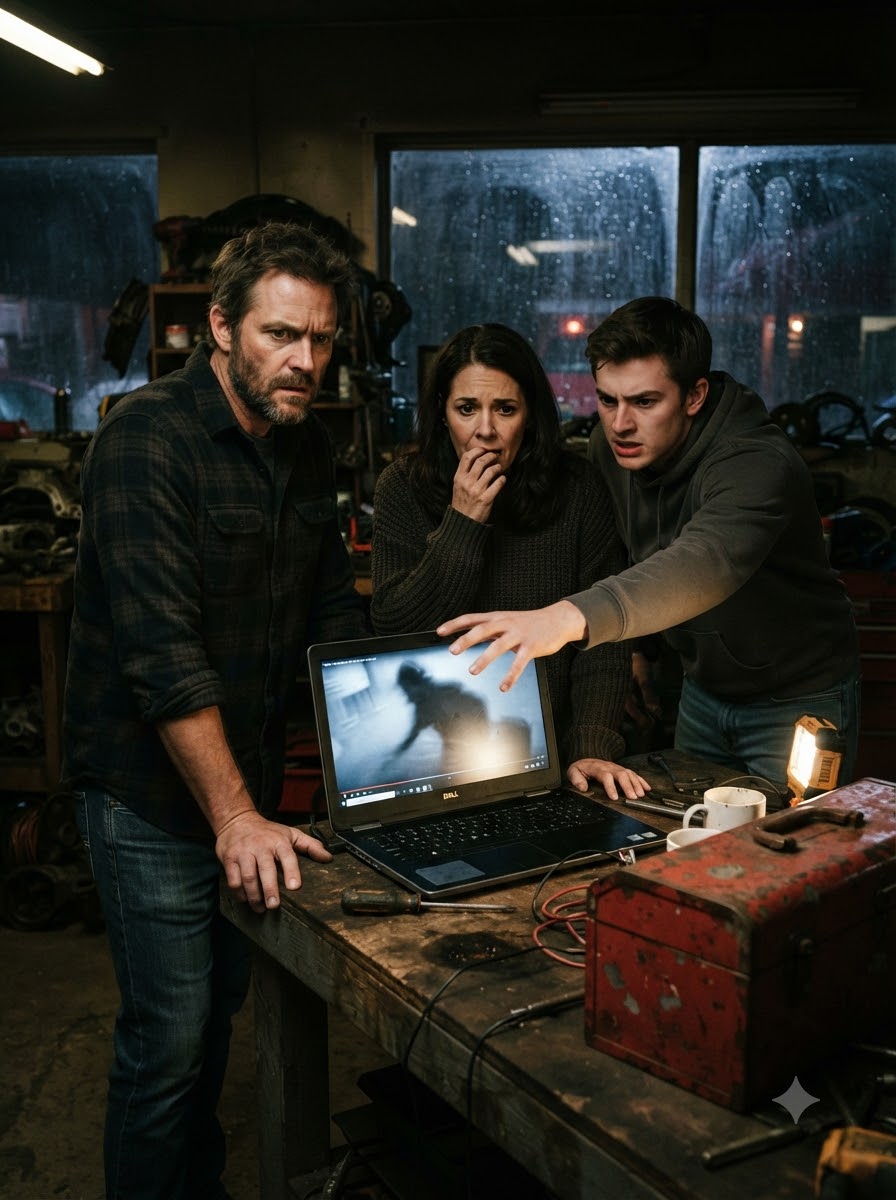
Ethan Walker was thrown out of the only home he had ever known with a duffel bag, a cracked phone, and thirty-eight dollars in his jeans.
It happened three weeks after his father’s funeral.
Rain blurred the windows of Walker Auto & Repair, turning the dirt shoulder outside into black mud. The shop lights glowed over the empty bays, reflecting off oil stains and puddles where Ethan had spent most of his life working beside his father.
He was sweeping the floor when Marlene walked in wearing her church coat.
Her son, Cole, followed her.
Cole had clean boots, a gold watch, and the satisfied expression of a man arriving to collect something that had never been his.
“Put the broom down,” Marlene said.
Ethan stopped. “What’s wrong?”
“Nothing is wrong,” Cole said. “Everything is settled.”
Marlene placed a folder on the counter.
“The estate has been handled,” she said. “Your father left everything to me.”
Ethan looked at the folder, then at the office where Tom Walker’s coffee mug still sat beside the register.
“That isn’t possible.”
“It’s legal,” Marlene replied.
Cole leaned against the doorway. “The shop will be mine now. I’ll be managing it.”
Ethan stared at him. “You’ve never managed anything except a fantasy football team.”
Cole’s face hardened.
Marlene slid a document from the folder. “Your father’s will is clear. The house, the land, the business—all of it belongs to me.”
Ethan read the paper. The language was formal, the signatures neat. His father’s name appeared at the bottom.
He knew that signature.
He also knew the way Tom had written the letter t in Walker. The long upward stroke. The slight hesitation before the final r.
The signature on the page looked correct.
Too correct.
“You were running the shop,” Marlene said, “but you were never the owner.”
“I kept it open after Dad got sick.”
“And we’re grateful.”
The words sounded like a door locking.
Cole pushed off the wall. “You have until tonight to clear out of the house.”
Ethan turned slowly. “What?”
“You heard him,” Marlene said. “The house belongs to my mother, and she wants you gone.”
Marlene’s mother had been dead for six years.
Ethan looked at her.
She did not blink.
“Pack your things,” she said.
The rain hammered the roof.
Ethan walked to the red toolbox beside Bay Three. It had belonged to Tom. The paint was chipped, and the handle was wrapped in black electrical tape. His father had given it to him when Ethan was sixteen, after Ethan rebuilt his first transmission.
Cole stepped in front of him.
“That stays.”
“My father gave it to me.”
“It belongs to the business.”
Ethan reached for the handle.
Cole grabbed the other side.
For a moment neither moved.
Then Ethan pulled.
Cole slipped in the oil beneath his boot and struck his hip against the workbench. He shouted as if Ethan had attacked him.
Marlene gasped. “You’re violent now?”
“Call the sheriff,” Ethan said.
Cole pointed at him. “Get out before I do.”
Ethan took the toolbox and left.
At the house, he packed in twenty minutes. Work shirts. Jeans. Socks. A photograph of Tom and him at a county fair. His mother’s silver cross, which Marlene had kept in a drawer because she said it made her uncomfortable to see reminders of Tom’s first wife.
Cole watched from the porch while Ethan carried his duffel bag to his truck.
“You can’t sleep in that thing,” Cole said.
Ethan looked at the rusted pickup. “I’ll figure it out.”
“You always do,” Cole said. “That’s the problem.”
Ethan drove without knowing where he was going. The truck’s heater worked only when it wanted to, and the windshield fogged whenever he slowed. He passed the closed diner, the church, the old sawmill, and the narrow road leading into the hills.
At the end of that road stood a cabin his father had bought years ago for almost nothing.
Nobody called it a house. The roof sagged. One window was covered with plywood. The porch leaned toward the creek. The county had condemned it after a tree fell through the back room.
Tom had used it for storage.
Ethan had not been there since the summer before his father died.
He parked beside the collapsed shed and carried the toolbox inside.
The cabin smelled of wet wood, mice, and rust. Ethan set the toolbox on a workbench beneath the window and sat in the dark until morning.
He expected anger to keep him awake.
Instead, he slept.
At dawn, he woke to water dripping onto his cheek.
The roof leaked in three places. A squirrel had shredded the insulation above the kitchen. The woodstove was full of dead leaves.
Ethan stood in the middle of the room and laughed once, bitterly.
This was what he had left.
Then he opened his father’s toolbox.
Under the wrenches and socket sets lay a folded envelope.
Ethan recognized the handwriting immediately.
For Ethan. When they try to make you doubt yourself.
His fingers went numb.
Inside was a key, a receipt from a storage facility in Mason County, and a short note.
I’m sorry I waited. Trust the dates, not the promises. —Dad
Ethan read it three times.
The storage receipt was dated four months before Tom’s death. The unit had been rented under Tom’s name, paid for in cash. The key had a number stamped into it.
Ethan called the facility.
The manager confirmed that the unit still existed.
“Your father listed you as the emergency contact,” the man said. “He told us not to release anything unless you came in person.”
Ethan drove there in the rain.
The unit contained boxes of old shop records, tax returns, bank statements, and several folders sealed with red tape. There was also a small digital recorder.
He found the first clue in the tax documents.
For years, the shop had paid Marlene a monthly “administrative fee.” At first it was six hundred dollars. Then eight hundred. Then twelve hundred.
The payments had continued even after she stopped doing bookkeeping.
Ethan turned pages until he found the bank statements.
The money had not gone to household expenses. It had gone to a company called Hollow Ridge Development.
He knew the name.
Two years earlier, Hollow Ridge had approached Tom about buying the shop property. They wanted to build luxury cabins along the creek. Tom had refused because the creek flooded every spring and because the development would block the only road into the lower valley.
Marlene had said Tom was being stubborn.
The payments to Hollow Ridge had begun three weeks later.
Ethan found another file containing copies of emails. Marlene had been corresponding with a man named Dennis Voss, the developer’s attorney.
The messages were short.
Once the property is transferred, Tom won’t be able to interfere.
He still refuses to sign.
Then make sure he understands what happens if he does.
Ethan’s throat tightened.
The newest message was dated two days before Tom’s stroke.
The will is ready. Cole will receive management authority, but Ethan must be removed entirely. He knows too much about the books.