My Sister Threw Grandma Out—Her Purse Held the Forged Proof
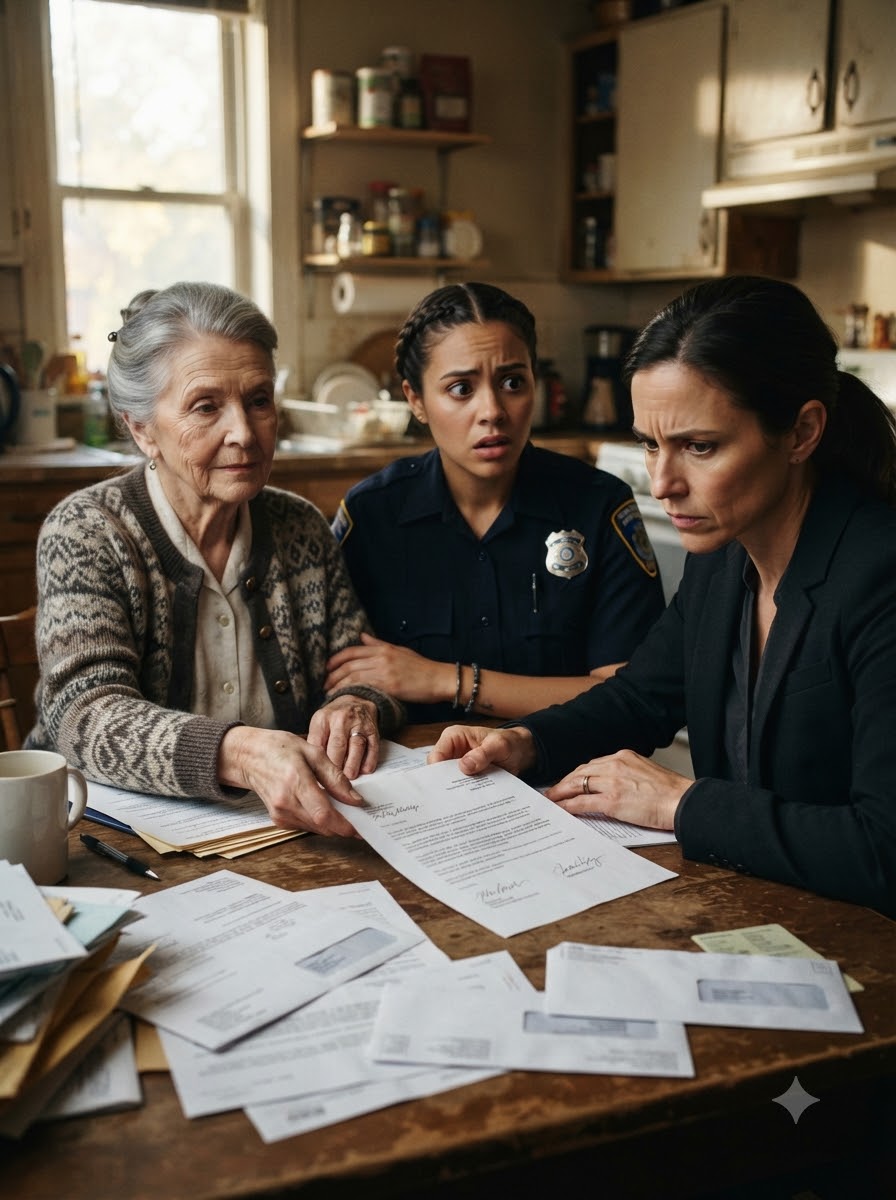
“If you won’t go to the nursing home I picked, then get out of my house!”
Vanessa’s voice cracked across the living room.
My grandmother stood beside the staircase with one hand resting on the banister and the other wrapped around the handle of a brown suitcase. She was eighty-two years old. Her silver hair was pinned neatly at the back of her head. Her cardigan was buttoned wrong by one button, but otherwise she looked composed.
Vanessa, forty-seven and perfectly dressed for a brunch she would never attend, stood in front of the white sofa with her arms crossed.
“I mean it, Grandma,” she continued. “I am finished. If you refuse to cooperate, you can pack your things and leave right now.”
The room went silent.
It was a beautiful room, if you did not look too closely. The floors gleamed. The glass coffee table held a vase of artificial tulips. Family photographs lined the mantel in silver frames, all carefully arranged to suggest closeness. The windows were spotless. The furniture looked untouched.
There was no smell of breakfast, no half-folded laundry, no newspaper on the armchair. Nothing in that room appeared to belong to a person who lived there.
Grandma looked at Vanessa for several seconds.
Then she nodded.
“All right,” she said. “I will pack.”
Vanessa blinked. She had expected an argument. She had expected tears, confusion, or a trembling apology.
Instead, Grandma turned toward the stairs.
That was when Vanessa called me.
She did not say hello.
“You need to come get Grandma,” she said. “She’s refusing the nursing home. If she won’t go, she can’t stay here.”
“You told her to leave?”
“I said she can’t continue making my life impossible.”
“Vanessa—”
“You’re the one who lives closest. Come get her.”
Then she hung up.
I had been looking forward to my first quiet weekend in months. I had just completed a twelve-week training cycle that had left me sleeping in fragments and eating most meals from plastic containers. My uniform was still on from an early briefing, and my truck was in the shop, so I borrowed a staff car to drive across town.
When I pulled up outside Vanessa’s house, she was already watching from the window.
The black government sedan reflected her pale face in the glass.
She opened the door before I reached it.
“You came fast,” she said.
“You told me to come get Grandma.”
“I said you needed to help.”
“No. You told me she had to leave.”
Her eyes flicked toward the car, then back to me. For the first time, she looked nervous.
“Can we not do this in the doorway?”
“I would like to know which part you want hidden.”
I stepped inside.
Grandma stood near the staircase with her suitcase beside her. It looked too small for a woman who had lived a full life. She had packed two blouses, three pairs of pants, her medication organizer, a Bible with a cracked leather cover, and the framed photograph of my mother.
She smiled when she saw me.
“I’m sorry to interrupt your weekend, baby.”
“You are never an interruption.”
I took the suitcase from her and reached for her coat.
Vanessa made an impatient sound.
“She cannot stay with you indefinitely,” she said. “You know that, Evelyn. I have been handling everything.”
“What everything?”
“Her appointments. Her bills. Her medications. The house. All of it.”
“You told me she was going to assisted living.”
“I found a place.”
“You picked a place.”
“It has an opening. Do you know how hard that is?”
Grandma’s expression changed slightly.
“She did not choose it for me,” she said. “She chose it because she wants my room.”
Vanessa’s face reddened.
“That is ridiculous.”
“Is it?” I asked.
“This is exactly what I’m talking about,” Vanessa snapped. “She has become suspicious and difficult. She forgets conversations. She accuses people of taking things. She refuses help, then complains that nobody helps her.”
Grandma said nothing.
I looked at her. “Did you forget something?”
“No.”
“Are you confused?”
“No.”
“Do you want to go to this facility?”
“I do not.”
That answer settled it.
I picked up her suitcase.
“Then she’s coming home with me.”
Vanessa’s lips parted.
“You can’t just take her.”
“She is an adult. She just told me what she wants.”
“She has dementia.”
Grandma looked directly at her.
“No doctor has ever said that.”
Vanessa’s face tightened.
“You don’t know what I’ve had to deal with.”
“Then show me,” I said.
She did not answer.
I took Grandma’s arm and walked her to the car. Vanessa followed us onto the porch.
“You’re making a terrible mistake,” she called. “When something happens, it will be your fault.”
Grandma stopped at the bottom step.
Without turning around, she said, “Something has already happened, Vanessa.”
Then she got into the car.
I thought she meant the argument.
I learned later that she meant everything.
At my house, Grandma moved slowly at first, as if she expected someone to appear and tell her she was only visiting. I put fresh sheets on the guest bed, carried her suitcase upstairs, and made scrambled eggs even though she insisted she was not hungry.
She ate every bite.
After breakfast, I asked what had really happened.
Grandma folded her napkin into a neat square.
“Your sister has been angry with me for several months.”
“Why?”
“She wanted me to sign some papers.”
“What kind of papers?”
“She said they were for managing my care if I became unable to make decisions.”
“That sounds like a power of attorney.”
“I already had one.”
“For whom?”
“Your mother was named first. You were named second.”
My mother had been dead for nine years.
“Did you update it?”
“I tried.”
She opened her handbag and removed a thin envelope. Inside was a copy of a power-of-attorney document naming Vanessa as her agent.
The signature at the bottom looked like my grandmother’s.
It was not.
Grandma placed the paper on the table.
“I never signed this.”
I stared at it.
The page was dated three months earlier. It gave Vanessa authority over Grandma’s bank accounts, property, medical decisions, insurance, and “all other financial affairs.”
“Where did you get this?”
“Vanessa brought it to me. She said the bank required it. I told her I would have my attorney review it first.”
“And then?”
“She became angry. Two days later, she told me I had forgotten agreeing to sign it.”
I felt the anger returning, sharp and controlled.
“What else?”
Grandma reached into the envelope again.
There were bank statements, pharmacy receipts, appointment notices, and a letter from the electric company.
One statement showed an overdraft of $1,842.67.
Grandma’s checking account had never been overdrawn in her life. She balanced it in a small notebook every Sunday evening. She had taught me how to reconcile a bank statement when I was twelve.
“What happened here?”
“I did not know,” she said. “Vanessa told me the bank made an error.”
I studied the transaction list.
There were repeated withdrawals from an ATM near Vanessa’s neighborhood. Each was between $400 and $800. There were payments to a furniture store, a luxury salon, a mortgage company, and a credit card account that did not belong to Grandma.