My Beach House Was Taken From Me—Until I Found Peter’s Conservatorship Petition
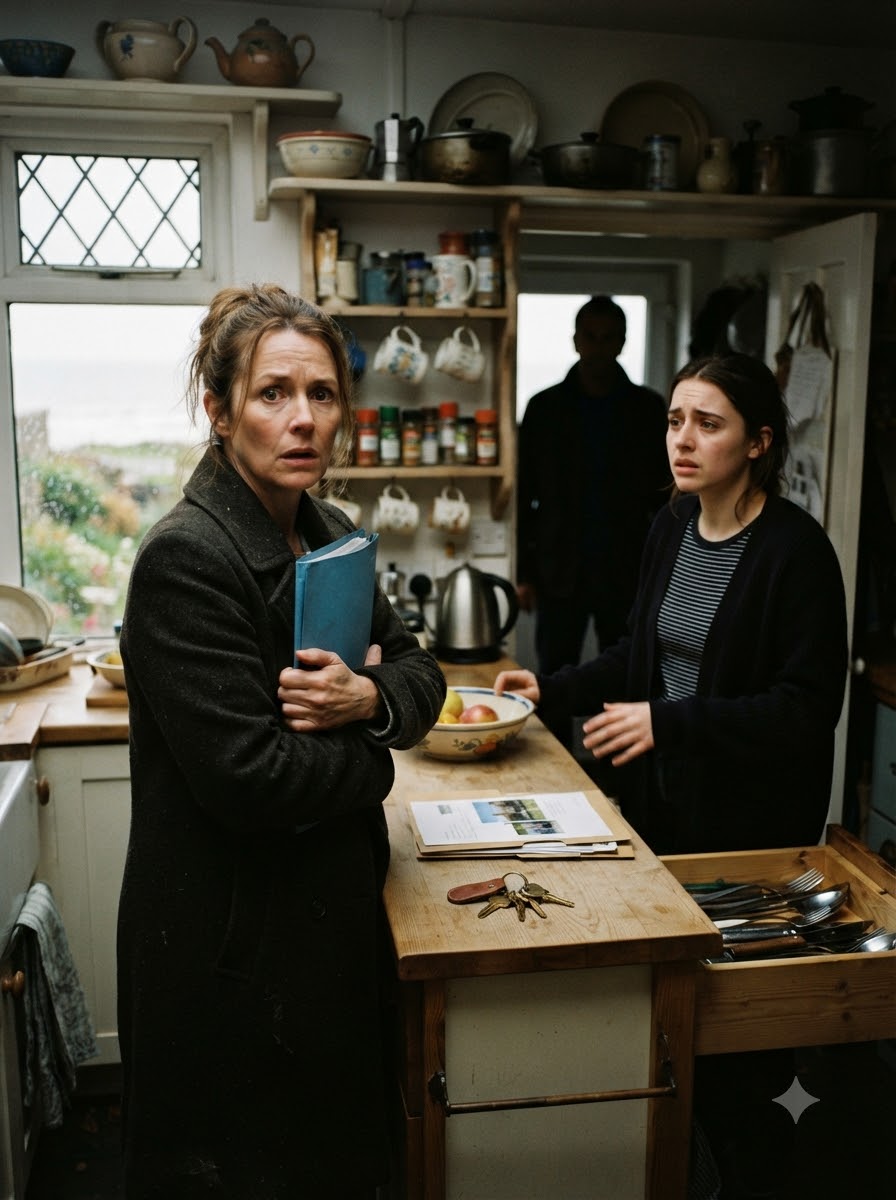
Rosalind Hale had driven nearly six hours through January rain for one thing: a week in the house she owned, the house she had built out of widowhood, exhaustion, and money saved one alteration at a time.
Instead, she found three unfamiliar SUVs parked along the curb, wet towels hanging over her wicker chairs, children running through her garden, and her daughter-in-law standing in the doorway wearing Rosalind’s embroidered apron.
Tiffany looked immaculate despite the chaos behind her. Her dark bob was smooth, her lipstick untouched, and one hand rested against the doorframe as if she were welcoming a delivery driver.
Rosalind stopped at the bottom step.
“Hello,” she said.
Tiffany glanced at the overnight bag in Rosalind’s hand. “Oh. You came.”
“I told Peter I was coming today.”
“I know.” Tiffany’s smile barely moved. “But there’s no space for extra guests.”
For a moment, Rosalind thought the wind had distorted the words.
Behind Tiffany, her house was packed with people Rosalind did not recognize. Tiffany’s mother was opening kitchen cabinets. Her sister had taken over the sofa with her shoes on. Two teenage boys thundered upstairs. A baby slept in a portable nest on Rosalind’s favorite reading chair, surrounded by bottles and diaper bags.
The television blared. Music played from the second floor. The air smelled of frying oil and damp towels.
Rosalind looked at the apron.
It was cream-colored linen, embroidered with tiny blue flowers. She had made it during the winter Winston was dying. She had stitched each flower while sitting beside his hospital bed, lifting her eyes every few minutes to make sure he was still breathing.
Tiffany had tied it around her waist like a costume.
“I’m sorry,” Rosalind said carefully. “Did Peter invite everyone here?”
“He said it was fine.”
“He knew I was coming.”
Tiffany gave a small shrug. “Peter is overwhelmed. He forgets things.”
“Does he?”
The smile on Tiffany’s face tightened.
“Rosalind, this isn’t a good time. My family needs the house this weekend. There’s no room for you, and frankly, we don’t want the inconvenience.”
The word extra hung between them.
Extra guest.
Extra person.
Extra woman in the home she had bought, repaired, painted, furnished, and paid taxes on for seventeen years.
Rosalind looked past Tiffany at the walls she had sanded herself. The blue throw pillows were scattered on the floor. Her framed photograph of Winston had been moved from the mantel and placed facedown on a side table. Mud streaked the runner in the hallway. Her rosemary planter lay broken beside the steps.
She could have pushed past Tiffany. She could have shouted. She could have called Peter and demanded an explanation.
Instead, she felt something inside her become very quiet.
“All right,” Rosalind said.
Tiffany blinked. She had clearly expected resistance.
“I’ll find somewhere else to stay.”
“Thank you for understanding.”
Rosalind carried her bag back to the car. She did not look over her shoulder, even when she heard the door close behind her.
The hotel was three miles inland, a faded coastal place with a navy awning and seashell prints on the walls. The young man at the desk gave her a sympathetic look when she checked in alone with one suitcase.
Rosalind smiled politely and took the key.
She did not cry in the room. She sat at the small desk, removed her coat, and wrote down everything that had happened.
The time she arrived. The vehicles. The damaged rosemary. Tiffany’s words. The people inside. The apron.
She wrote until her hand cramped.
Rosalind had spent forty years learning that details mattered. A hem could be wrong by half an inch. A missing receipt could become a missing payment. A casual promise could become a debt if it was not written down.
She had learned those lessons after Winston died.
At fifty, Rosalind had been left with a teenage son, hospital bills, and a sewing machine that jammed whenever she needed it most. She took every job that came through her apartment: wedding alterations, school uniforms, coat repairs, bridesmaid dresses, hems for women who cried in dressing rooms because nothing fit the way it used to.
She worked past midnight, slept in pieces, and put every spare dollar into a flour tin above the refrigerator.
Twelve years later, she bought the neglected seaside cottage.
It had rotten porch boards, mold behind the kitchen cabinets, cracked windows, and weeds taller than the back fence. Everyone told her it was too much work.
Rosalind bought it anyway.
She replaced the boards, stripped the floors, repaired the plaster, planted hydrangeas, and sewed curtains from discounted linen. She changed the locks herself. She kept a notebook of every repair and every payment.
The house was not a gift from Winston. It was not an inheritance. It was hers.
Peter had once understood that.
When he was twenty-four, he helped her paint the porch. He had hugged her when she signed the closing papers and whispered, “You did it, Mom.”
But after he married Tiffany, his voice changed. He began speaking about the house as if it belonged to the family rather than to Rosalind.
Tiffany invited friends there without asking. She rearranged Rosalind’s dining table and called the original setting “depressing.” Once, she looked at Rosalind’s callused fingers and joked that she could never work with fabric because desperate brides were exhausting.
Peter laughed.
That laugh had stayed with Rosalind longer than the insult.
At the hotel, she considered calling him. Then she imagined his response.
There had been a misunderstanding.
Tiffany was under pressure.
Why were Rosalind making such a big deal out of a family weekend?
He would talk about her tone instead of their actions.
So Rosalind did not call.
She slept badly and returned to the house the next morning.
The street was quiet. One SUV was gone. The music had stopped.
The front door lock had been changed.
Rosalind stood on the porch with her key pressed against the new brass cylinder. It would not turn.
That was when humiliation gave way to fear.
No one changed a lock for a casual visit.
She walked along the side fence to the mudroom. She had installed that door years ago and never replaced its old lock because almost nobody knew it existed.
Her key worked.
Inside, the house smelled of wet shoes, fried food, and fabric softener. The kitchen counters were crowded with dishes. Someone had put dirty bottles beside the sink. Her framed photograph of Winston was still facedown.
Then she heard Tiffany’s voice.
“I’m telling you, once it’s filed, the rest is easy.”
Rosalind stepped into the narrow space beside the pantry and listened.
Tiffany’s mother asked, “And if she fights?”
“Rosalind?” Tiffany laughed. “She hates conflict. Peter says she folds the second anyone raises their voice.”
“What exactly are you filing?”
“A conservatorship petition. Emergency temporary conservatorship first. Peter becomes responsible for her finances, and the realtor handles the property.”
Her mother hesitated. “That sounds serious.”
“It’s necessary. The house is worth nearly three times what she paid. Peter can’t keep cleaning up after her.”
“Does she really have memory problems?”