Aaradhya Returned With Twins—Then Opened the Document Her Husband Buried
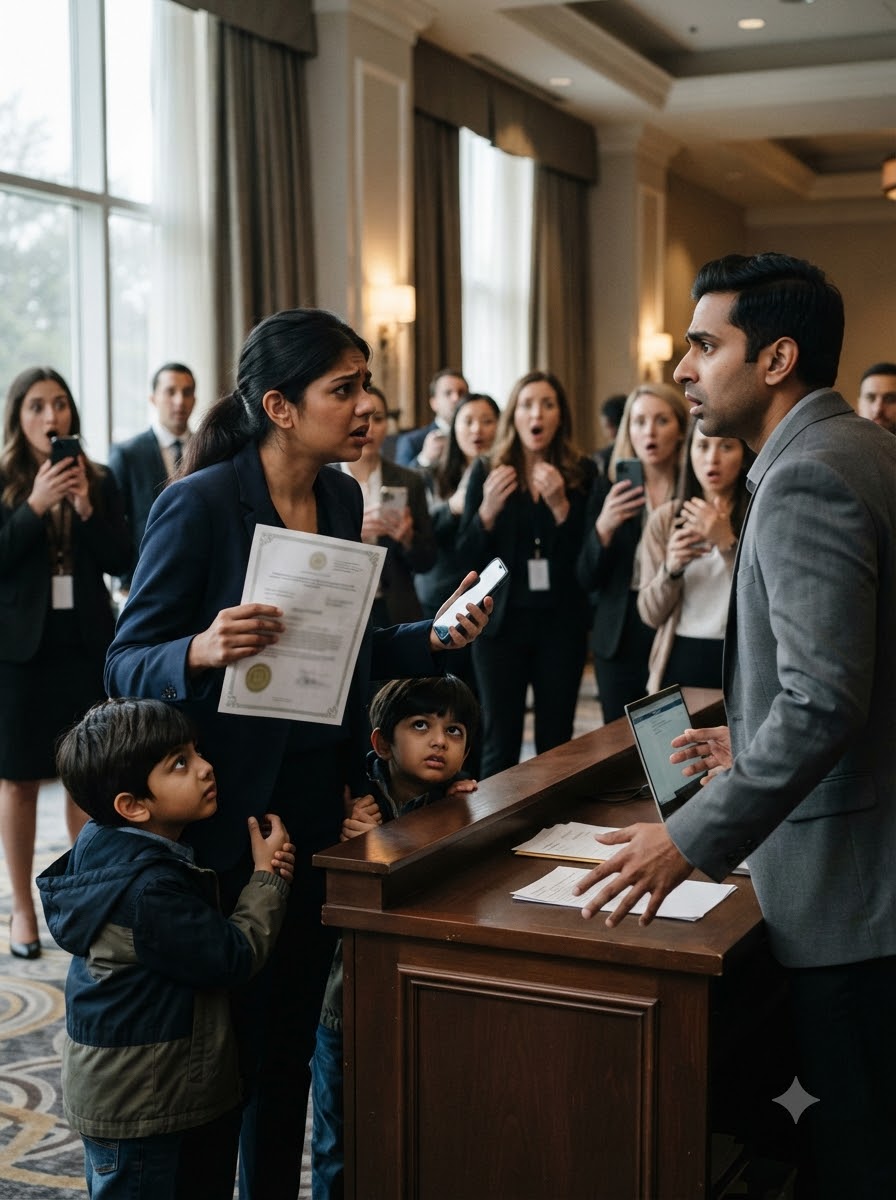
The contraction began just as Aaradhya set down her spoon.
Pain clamped around her abdomen and stole the breath from her lungs. She gripped the edge of the dining table until her knuckles turned white, waiting for it to pass.
Across from her, Raghav did not look up.
He was studying a message on his phone. The screen cast a cold blue light over his face, making him look like a stranger.
Aaradhya pressed one hand beneath her stomach. She was six months pregnant, though the secret she carried was larger than anyone knew.
There were two heartbeats inside her.
“Raghav,” she whispered.
He continued typing.
Another contraction twisted through her. This one was worse. She bent forward, breathing through her teeth.
At last, he lifted his eyes.
“What now?”
“I’m in pain.”
“You’ve been in pain for months.”
“I think something is wrong.”
He glanced at the clock, then back at his phone. “I have a meeting.”
“A meeting at ten at night?”
“With people who matter.”
The words landed harder than the pain.
Once, Raghav had rushed her to the hospital because she had cut her finger while opening a package. He had spent an entire night beside her bed, holding her hand and promising that nothing in the world would ever hurt her.
That man had disappeared slowly.
First came the late nights. Then the unexplained expenses, the expensive shirts, the sudden interest in private clubs and business dinners. Finally came Meera Vardhan, the daughter of Devendra Vardhan, one of the country’s most powerful real-estate developers.
Meera was beautiful, educated, and the sole heir to her father’s empire.
Raghav had begun speaking about her as if she were a business opportunity.
“She understands my ambition,” he had said once.
Aaradhya had asked, “And what do I understand?”
He had not answered.
Now he pushed his chair back.
“You need to end the pregnancy,” he said.
For a moment, she thought the pain had affected her hearing.
“What did you say?”
“Abort it.”
Her hand remained over her stomach.
Raghav stood and adjusted his cuff. “I’m not going to repeat myself.”
“This is your child.”
“It’s a burden.”
“Your child,” she said again, louder this time. “You looked at the scan. You heard the heartbeat.”
“I heard one heartbeat. The doctor said there might be complications.”
“There are two babies.”
He went still.
Aaradhya watched the color drain from his face, not with fear but irritation.
“Two?” he said.
“Yes.”
He walked to the liquor cabinet and poured himself a drink. His hand did not tremble.
“That makes it worse.”
She stared at him.
“I have spent years building a future,” he continued. “I finally have an opportunity to enter the Vardhan group. Devendra has made it clear that family matters. He wants Meera to marry someone who can stand beside her without baggage.”
“Baggage?”
“You. The children. This marriage.”
Aaradhya rose too quickly and had to grip the table. “You’re leaving me for her?”
“I’m choosing a life that isn’t buried under responsibilities.”
“You’re choosing money.”
“I’m choosing freedom.”
“You mean Meera.”
His silence was an answer.
She looked around the room. The house had once felt warm, filled with wedding photographs, plants, books, and the smell of tea. Now it felt like a hotel lobby where she had overstayed her welcome.
“If I refuse?” she asked.
“Then raise them yourself.”
He placed the glass on the counter.
“And don’t expect a single rupee from me.”
The next contraction came with such force that Aaradhya cried out. She lowered herself into the chair, but Raghav did not move toward her.
Instead, he picked up his phone.
“Do what you want,” he said. “Just don’t ruin my life.”
That night, after he left for his meeting, Aaradhya opened the drawer beside the bed and removed the envelope she had hidden beneath winter clothes.
Inside was the ultrasound report.
Twin pregnancy. Both fetuses healthy.
She had planned to surprise him with the news after he returned from a business trip. She had imagined his shock becoming joy. She had imagined him placing his hands on her stomach and apologizing for every lonely evening.
Now she folded the report and put it in her purse.
She packed three dresses, her documents, some cash, and the small gold chain her mother had given her. She left her wedding jewelry behind. She left the photographs. She left the keys on the kitchen counter.
Before stepping outside, she looked once at the house.
“I will not let you teach them that they were unwanted,” she whispered.
Rain fell in thick sheets. Aaradhya walked through the gate with one suitcase and two unborn children, while the man who had promised to protect her chased another woman’s inheritance.
She did not know where she would sleep.
She only knew she would not go back.
For the first two weeks, she rented a narrow room above a grocery shop in a southern city where nobody knew her name. The landlady, Sushila Tai, was a widow with sharp eyes and a soft heart. She recognized immediately that Aaradhya was frightened.
“You can pay when you can,” Sushila said.
“I’ll pay tomorrow.”
“You’ll pay when you can,” the older woman repeated.
Aaradhya worked until her body refused to let her continue. She sold used clothes online, packed orders for a neighborhood store, and cleaned a restaurant after midnight. She hid her pregnancy beneath loose cotton dresses and learned to sleep through the traffic below her window.
In the final month, her ankles swelled so badly that she could barely walk.
Then, one humid afternoon, she collapsed beside the bed.
Sushila found her and dragged a neighbor into the room. They carried Aaradhya to a small hospital, where the doctors performed an emergency procedure.
The twins were born just after midnight.
Kiaan arrived first, furious and loud. Kabir followed six minutes later, silent and watchful, his dark eyes fixed on the ceiling.
Aaradhya held them both against her chest.
“I’m here,” she whispered. “I chose you. I will keep choosing you.”
The years that followed were not gentle.
There were months when she ate one proper meal so the boys could have two. She studied after putting them to sleep. She learned skin therapy, business accounting, supply management, and marketing through a vocational program that offered evening classes.
Kiaan was curious and quick with numbers. Kabir was patient, observant, and able to remember every face he saw.
When they were five, Aaradhya opened a small wellness studio in South Bombay. It had one treatment room, two borrowed chairs, and a handwritten sign above the door.
The business grew because Aaradhya understood what many wealthy clients secretly wanted: not luxury, but trust.
She expanded carefully. She hired women who had been pushed out of other workplaces. She kept clean accounts. She refused to take loans from men who expected personal favors in return.
By the time the boys turned seven, the studio had become a respected spa with three branches.
Aaradhya never told them lies about their father.
When Kiaan asked where he was, she said, “He made a choice.”
“What choice?”
“To leave.”
“Because of us?”