Grandma’s Purse Exposed Vanessa’s Secret—Until the Judge Heard the Second Recording
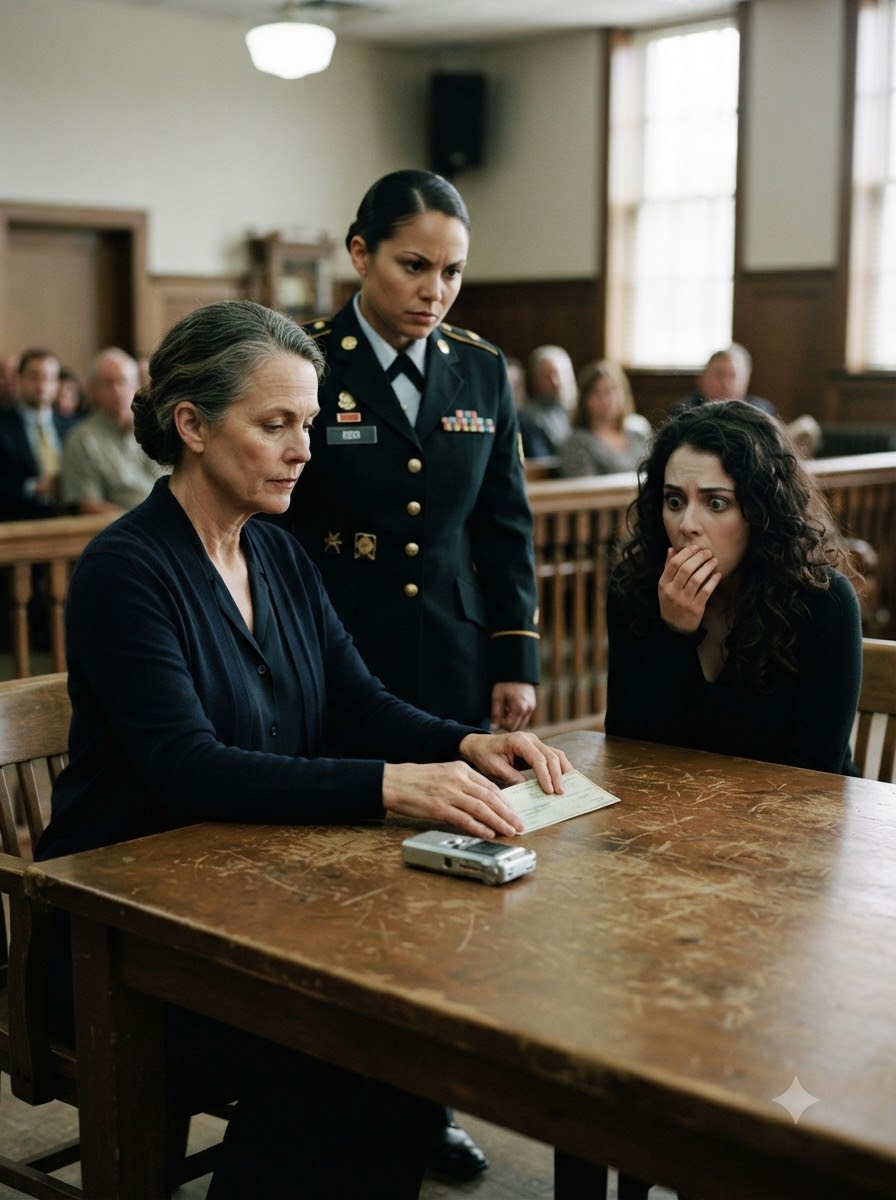
Vanessa threw the suitcase first.
It struck the polished wood floor and spun once before falling against the wall beneath a framed photograph of our grandfather.
Grandma Margaret watched it settle.
She did not flinch.
“Then pack your things and leave,” Vanessa shouted. “I’m done taking care of you.”
The house went quiet after that.
Not peaceful. Quiet in the way a room becomes quiet when everyone understands something irreversible has just been said.
Grandma was eighty-two years old. She had lived in that house for thirty-seven years, through two knee replacements, one hurricane, my grandfather’s death, and every family holiday anyone could remember.
Now she stood beside the staircase while Vanessa pointed toward the front door.
“I’m not arguing about this anymore,” Vanessa said. “The nursing home has a room available. You’re going there Friday.”
“I have not agreed to go,” Grandma replied.
“You don’t get to make that decision anymore.”
Grandma’s chin lifted slightly. “Who does?”
Vanessa’s face tightened.
“I do. Because I’m the one who has been doing everything for you.”
That part was true, at least on the surface.
After Grandpa died, Vanessa had moved into Grandma’s house with her husband, Mark. She said it was temporary. She would help with groceries, doctors’ appointments, medication, and repairs. Grandma had thanked her. I had thanked her too.
I was often away with the military, and when I was home, I tried to make up for my absence with long visits, expensive dinners, and whatever practical help I could provide.
Vanessa became the person everyone called first.
She arranged appointments. She picked up prescriptions. She spoke to the bank. She told us which bills had been paid and which ones still needed attention.
Gradually, she stopped asking Grandma what she wanted.
She began announcing it.
“The doctor says you need supervision.”
“The doctor never said that,” Grandma replied.
“He implied it.”
“He said I should have someone check on me after my fall.”
“And I’m someone.”
“You are my granddaughter, not my owner.”
Vanessa laughed sharply.
“There. That attitude is exactly why you can’t live alone.”
Grandma had fallen six months earlier while reaching for a box in the pantry. She had bruised her hip but broken nothing. Afterward, Vanessa moved into the spare bedroom. Within weeks, she had changed the locks, redirected Grandma’s mail, and started using a different bank card for household expenses.
At the time, I had considered it responsible.
Then Grandma began making small comments.
She had trouble getting her bank statements.
A checkbook had disappeared.
Vanessa had started answering questions meant for her.
Whenever I called, Vanessa often picked up.
“She’s resting.”
“She’s confused today.”
“She doesn’t remember that conversation.”
“She shouldn’t be handling money anymore.”
Grandma denied being confused, but she did so carefully, as though every objection could be used against her.
That morning, when Vanessa called me, she did not say hello.
“Come get Grandma,” she said.
I was coming off a brutal twelve-week training cycle. My truck was still at the repair shop on base, and I was staying in temporary quarters while waiting for my next assignment.
“You want me to come get her?” I asked.
“If she refuses the nursing home I found, she can get out of my house.”
“Did you just put her out?”
“I said she needs to leave.”
“Vanessa—”
“Don’t start acting noble. I’ve been doing this for months.”
The call ended.
The only vehicle available was the black staff car that had brought me back from a weekend briefing. An hour later, it pulled into Vanessa’s driveway.
I stepped out in uniform.
Through the front window, I saw Vanessa’s expression change.
Until then, she had probably expected an exhausted niece arriving alone, grateful for any explanation Vanessa offered. Instead, she saw a military driver waiting at the curb, a uniformed officer crossing the lawn, and two neighbors pretending not to watch from their porches.
She opened the door before I knocked.
She wore cream-colored slacks and a blue blouse. Her hair was arranged neatly. She looked as though she were preparing for brunch, not evicting an elderly woman.
“Evelyn,” she said brightly. “You came fast.”
“You told me to come get Grandma.”
“I said you needed to come help. There’s a difference.”
“No,” I said. “You said she could get out.”
Her smile vanished.
“Can we not do this in the doorway?”
“Which part are you worried the neighbors might hear?”
Her eyes flashed.
“Lower your voice.”
“I’m not the one who threw an eighty-two-year-old woman out of her own house.”
Behind her, Grandma stood beside the staircase with one worn brown suitcase.
That suitcase had traveled with her to my high school graduation, my first promotion ceremony, and my wedding. One of its corners was held together with black tape. Grandma refused to replace it because, she always said, “It still knows where it’s going.”
Now it looked absurdly small beside her.
She wore a lavender cardigan over a white blouse. Her silver hair was pinned at the back of her head. Her hands were folded over the handle.
“I’m sorry, baby,” she said. “I didn’t want to ruin your weekend.”
I crossed the room and took her hands.
They were cold.
“You are never an interruption.”
Vanessa closed the door behind me.
“Let’s be realistic,” she said. “She can’t stay here if she refuses assisted living. Mark and I have lives. We have responsibilities.”
“What assisted living facility?” I asked.
“The one I found.”
“Have you seen it?” I asked Grandma.
Grandma shook her head.
Vanessa’s nostrils flared. “I took her there.”
“You never took me,” Grandma said.
“I showed you the brochure.”
“You told me there was a room available.”
“Because there is.”
“You told me whether I liked it did not matter.”
Vanessa turned on her.
“You don’t remember half the things you say anymore.”
Grandma’s fingers tightened around mine.
That sentence landed differently from all the others.
Not because it was loud.
Because it sounded practiced.
Vanessa had used it before.
Maybe on doctors. Maybe on bank employees. Maybe on neighbors who noticed Grandma no longer went to church alone.
I looked at Grandma. “What happened to your bank account?”
Vanessa answered immediately.
“Nothing happened to it. She’s been making mistakes. She forgets what she spends.”
“I balance my account every Friday,” Grandma said.
“You used to.”
“I still do.”
“Then why did you overdraft it?”
Grandma looked at me.
“I didn’t.”
Vanessa laughed, but there was no humor in it.
“That’s exactly what I mean.”
Grandma released my hand and reached into her purse.
Vanessa moved toward her.
“What are you doing?”
“Showing Evelyn something.”
“There is nothing she needs to see.”
Grandma pulled out a folded envelope and handed it to me.
Inside was an overdraft notice from her bank.
The amount was not enormous by most standards, but it was shocking for Grandma. She had never overdrawn an account in her life. She kept a small cushion specifically to prevent it.
The notice showed three payments processed within five days.
One was made to a home-care company Grandma did not recognize.
Another was a transfer to an account ending in numbers I did not know.