My Father Claimed Mom’s House at Her Funeral—Her Lawyer Had Another Document
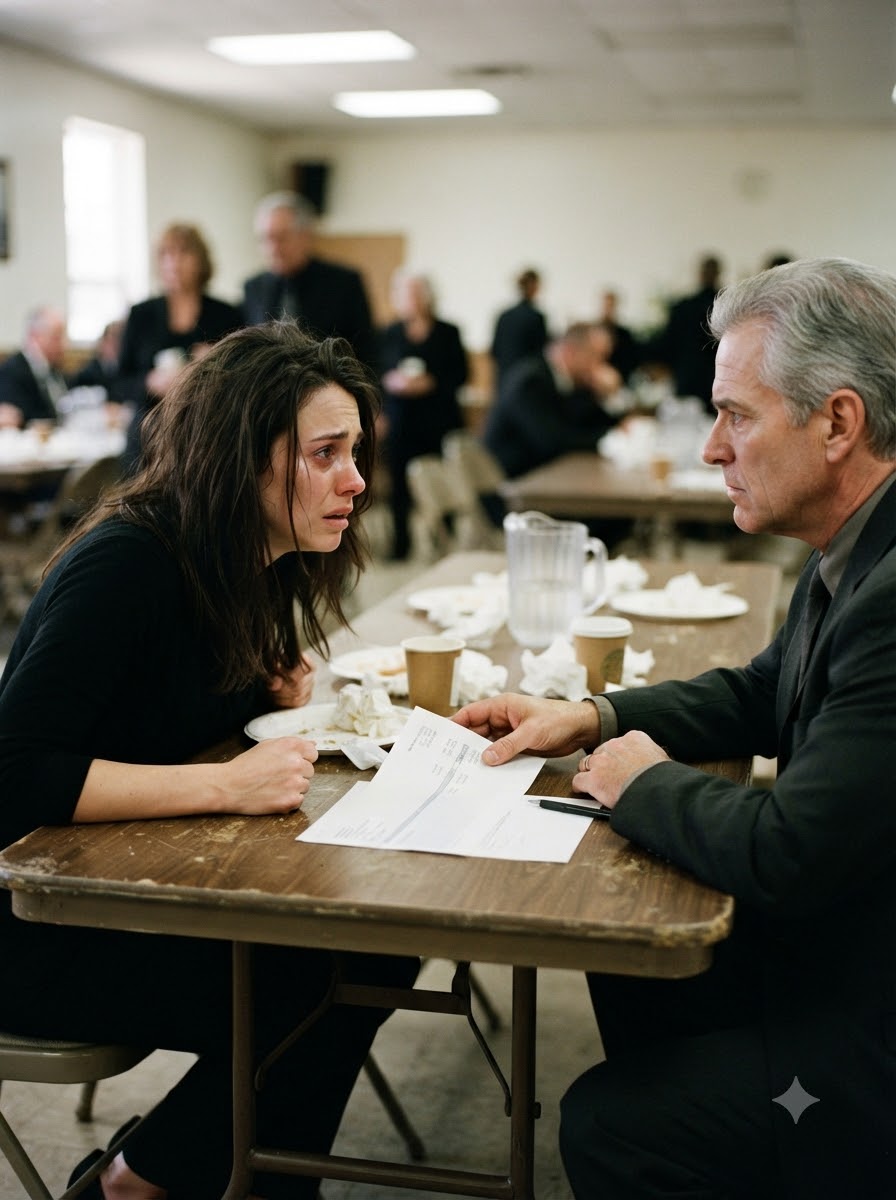
The first thing Arthur Dawson did at my mother’s funeral was claim her house.
He did not ask how I was holding up. He did not touch the coffin. He did not even pretend to mourn the woman he had abandoned twenty-two years earlier.
He walked into the church fellowship hall in a black suit, carrying a leather folder, with Tanya Mercer on his arm. Tanya had once been his secretary. She had been the reason he left.
Now she sat in the front row during my mother’s funeral, smiling beneath a wide-brimmed black hat as if she had been invited to a celebration.
I was standing near the coffee urn, accepting condolences from my mother’s neighbors, when Arthur raised his voice.
“As surviving spouse,” he announced, “I have the right to control the estate. The house will be listed on Monday.”
The room quieted.
Arthur looked directly at me.
“Maya can find herself a studio apartment,” he said. “Something she can afford.”
For a moment, I could not breathe.
My mother, Elaine Dawson, had lived in that house for twenty-six years. She had paid the mortgage, repaired the roof, replaced the plumbing, and planted every rosebush along the front walk. She had worked two jobs to keep it after Arthur walked away.
The house was not a gift from him.
It was the last thing she had managed to save.
“You can’t sell it,” I said.
Arthur gave me a tired, superior smile. “You’re grieving. You don’t understand the law.”
At his side, Tanya squeezed his arm.
“I’m sorry, Maya,” she said, though her expression suggested she was not sorry at all. “Arthur has to protect what’s his.”
My mother’s attorney, Daniel Brooks, stood several feet away. He had been her lawyer for nearly fifteen years. He was in his late sixties, thin, silver-haired, and usually so mild that people mistook his quietness for weakness.
He had been silent during Arthur’s announcement.
Then he adjusted his glasses.
“Actually, Mr. Dawson,” he said, “I was hoping you would sign a spousal declaration today.”
Arthur turned toward him. “What declaration?”
“It will make the probate process much simpler.”
Arthur’s face changed. Not much. Just a flicker of suspicion beneath the confidence.
Brooks opened his leather briefcase.
“I understand you are claiming to be Elaine’s legal husband.”
“I am.”
“You brought proof?”
Arthur pulled a folded document from his folder. “Our marriage certificate. Elaine and I married in 1996. We never divorced.”
The words struck me harder than I expected.
I knew they had married in 1996. I had been there, a little girl in a white dress, holding a basket of flowers. I also knew Arthur had left us in 2002 for Tanya.
What I did not know was that the divorce my mother had filed in 2004 had never been finalized.
My mother had always told me it was over. She had said the judge had signed everything. She had never spoken about the paperwork again.
Arthur held up the certificate.
“Twenty-two years of separation doesn’t erase a marriage,” he said. “Legally, I am still her husband.”
Tanya’s smile widened.
Brooks took the certificate and studied it. “That may be true.”
Arthur’s shoulders relaxed.
“But if you intend to claim surviving-spouse rights,” Brooks continued, “we will need you to sign a formal declaration confirming that you are making that claim.”
Arthur looked at the document Brooks placed on the table.
“What exactly does it say?”
“That you are asserting your legal status under the 1996 marriage.”
“That’s all?”
“That is the purpose of the document.”
Arthur glanced at me. His expression was almost gleeful.
He thought he had caught me unprepared.
He thought my mother had died defenseless, leaving me with nothing but memories and a house he could take.
He picked up the pen.
I wanted to stop him. I wanted to ask Brooks what he was doing. But Brooks gave me the smallest shake of his head.
So I watched my father sign.
Arthur wrote his name with an exaggerated flourish.
Then he slid the document back across the table.
“Now,” he said, “we can discuss the listing.”
Brooks did not answer.
He turned the page over.
A second document lay underneath.
Arthur’s signature appeared at the bottom of the first page. Above it was a statement he had not read carefully:
I, Arthur Dawson, hereby affirm that I am the surviving legal spouse of Elaine Dawson and claim all rights, interests, and benefits available to me under the law by virtue of that marital status.
Arthur stared at the page.
Brooks placed another document beside it.
“This,” he said, “is a certified copy of the trust instrument Elaine created ten years ago.”
The room seemed to contract around us.
Arthur picked it up, scanned the first page, and then flipped rapidly through the rest.
“What is this?”
“An irrevocable trust,” Brooks said. “Elaine transferred ownership of the house to the Elaine Dawson Family Trust in 2013. Maya is the sole beneficiary and successor trustee.”
Arthur’s face went pale.
“The house is still hers.”
“Legally, no. It belongs to the trust.”
“You’re lying.”
Brooks turned the document toward him. “The deed was recorded at the county courthouse on September 18, 2013. You would know that if you had ever checked the property records.”
Arthur slammed the trust papers onto the table.
“Elaine couldn’t create that without telling me.”
“She could and did.”
“If we were still married, she needed my consent.”
“Not for separate property acquired and maintained entirely by her,” Brooks replied. “And you had no financial interest in the home.”
Arthur laughed sharply.
“No financial interest? I’m her husband.”
“According to the declaration you just signed.”
Brooks reached back into his briefcase.
“Which brings us to the second matter.”
Arthur saw the envelope before Brooks opened it. His eyes dropped to the thick stack of papers inside.
“What’s that?”
“Your financial history.”
Tanya stepped closer. “This is harassment.”
“No,” Brooks said. “It is documentation.”
He removed a certified judgment from the envelope and laid it on the table.
“On May 14, 2003, the family court ordered Arthur Dawson to pay $600 per month in child support and $400 per month in temporary spousal support.”
Arthur’s jaw tightened.
“I paid what I could.”
“You paid nothing,” I said.
He turned on me. “Your mother poisoned you against me.”
“My mother showed me the bank statements.”
“You were ten.”
“I was ten when you left. I was old enough to remember you taking the television, the stereo, and the last hundred dollars from her purse.”
A few people in the room shifted uncomfortably.
Arthur pointed at me. “She made it impossible for me to see you.”
“You stopped calling.”
“She refused to let me visit.”
“You missed my birthday for six years.”
“That was because she moved.”
“She moved three streets away.”
Tanya touched his shoulder. “Arthur, don’t let them provoke you.”
Brooks turned another page.
“The support order remained enforceable. So did the marital debt allocation entered with the same judgment. Mr. Dawson was responsible for half of the credit card debt accumulated during the marriage and for the arrears on the mortgage he had co-signed.”