My Mother Returned With a Folder—Then Her Recording Exposed What My Father Stole
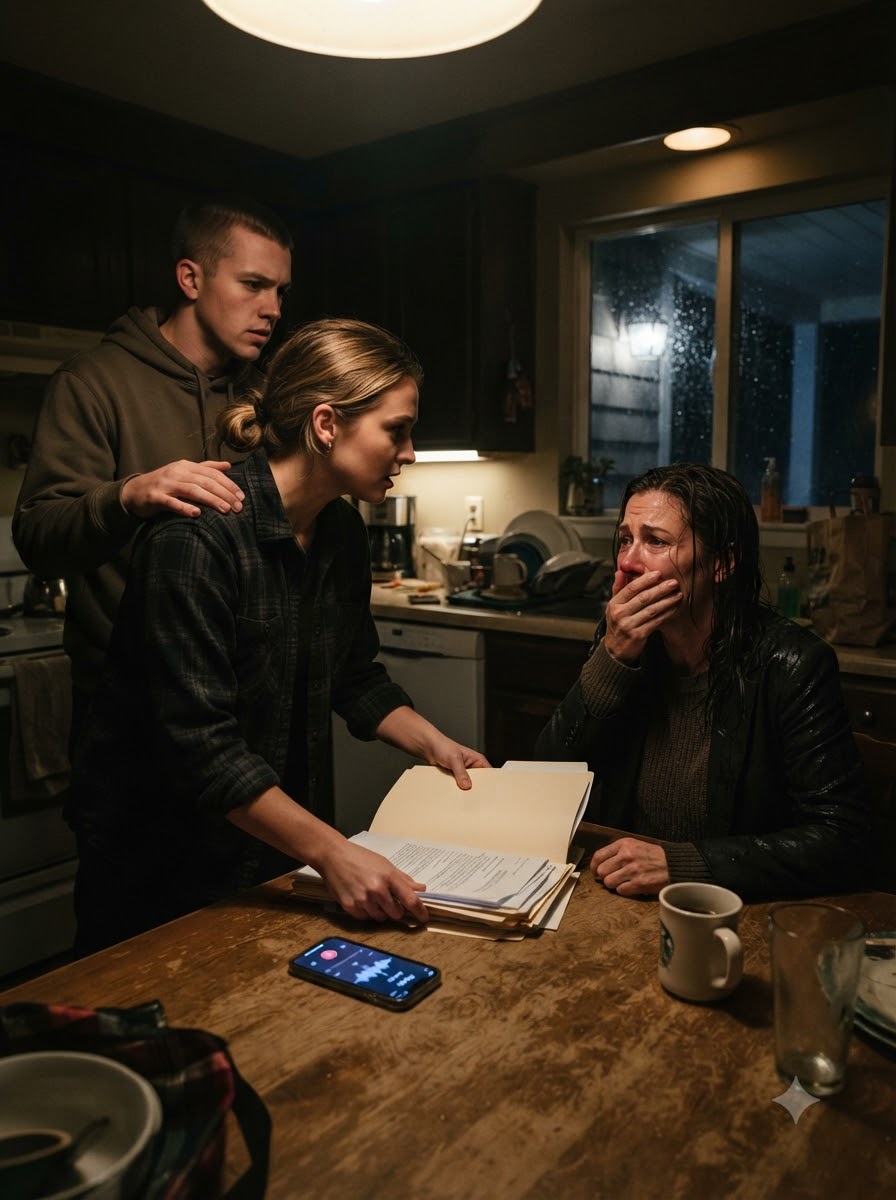
My mother stood on our porch in the middle of a November storm, holding a manila folder against her chest as if it were the only thing keeping her upright.
For a moment, I didn’t recognize her.
Dr. Rebecca Carlie had always been immaculate. Even when she was furious, her white coat had been pressed, her dark hair pinned neatly at the nape of her neck, her voice controlled enough to make cruelty sound like professional advice.
Now rain streamed from her sleeves. Her lipstick had bled at the corners. One of her shoes was split across the toe.
She looked eighteen years older than the woman who had handed me two black garbage bags and told me I was no longer her daughter.
“Reagan,” she whispered.
Tyler appeared behind me. He had been in the kitchen repairing a loose cabinet hinge, and he still held a screwdriver in one hand.
My mother saw him and flinched.
That small reaction told me she hadn’t come to apologize.
She had come because she needed something.
“Your father doesn’t know I’m here,” she said.
“Then you should probably leave before he notices.”
Her face crumpled, but I felt no satisfaction. I had imagined this moment for years—my parents standing outside my home, finally seeing what I had built without them. In those fantasies, I was calm and magnificent. I said exactly the right thing.
Instead, I felt only a cold, familiar tiredness.
My mother looked past me at the warm hallway, the framed photographs, the brass light fixtures Tyler had installed himself. She looked at the home they had once insisted we would never be capable of owning.
“He still thinks you have nothing,” she said.
“I don’t care what he thinks.”
“He’s wrong.”
Then she held out the folder.
“I need to speak with you.”
“You can speak in front of Tyler.”
Her gaze dropped to the screwdriver in his hand.
The last time she had looked at him, he had been twenty-two, soaked through a borrowed suit, standing beside a rusted Ford while I carried my clothes out in garbage bags.
She had called him an embarrassment.
Now he was the owner of a successful electrical contracting company, a man whose name appeared on buildings throughout the city. But he didn’t mention that. He didn’t smile. He simply stepped beside me.
“Come inside,” he said. “You’re freezing.”
My mother looked like she wanted to refuse the kindness. Then a gust of wind drove rain beneath the porch awning, and she stepped through the door.
Eighteen years earlier, I had been seven months pregnant when my family decided I was no longer worthy of their name.
It happened at Thanksgiving in my parents’ marble dining room. Twelve relatives sat around the table beneath a chandelier my father had imported from Italy. I remember the smell of rosemary and roasted onions. I remember my aunt laughing at something on her phone.
Then my mother tapped her wineglass.
“Reagan, stand up.”
I thought she wanted to make an announcement. I was nineteen, exhausted, and so large that rising from the chair required both hands.
When I stood, everyone looked at my stomach.
My father lowered his napkin. My uncle stopped chewing.
“How far along?” my mother asked.
“Seven months.”
“You told us you were gaining weight.”
“I was scared.”
“And the father?” my father asked.
I reached beneath the table and found Tyler’s hand.
He had been invited because I intended to tell them about our engagement. He worked as an electrician and had spent the afternoon helping my father repair a breaker panel, though my father had barely thanked him.
“Tyler and I are getting married,” I said.
My uncle laughed so hard wine came out of his nose.
My mother didn’t laugh.
She walked to the sideboard and returned with a manila folder.
I remember that folder more clearly than I remember the faces around the table. It was thick and labeled in my mother’s precise handwriting.
TYLER HOLT — BACKGROUND REVIEW.
She opened it.
“Trade certificate issued three years ago. No university education. Four employers in five years. Current business consists of irregular residential work.”
Tyler’s fingers tightened around mine.
She continued.
“Father abandoned the family when Tyler was twelve. Mother died of complications related to alcoholism.”
“That has nothing to do with him,” I said.
“It tells us where he comes from.”
“He’s a good man.”
My father’s expression hardened.
“A good man doesn’t get a nineteen-year-old girl pregnant before marriage.”
“I’m keeping the baby.”
The room went silent.
My father leaned back in his chair. He was a cardiologist, celebrated in every hospital fundraiser in Portland. Patients sent him holiday gifts. Local newspapers called him brilliant, disciplined, and exacting.
“You’ll terminate the pregnancy,” he said. “I’ll arrange it quietly.”
I stared at him.
“No.”
His eyes became flat.
“Then you’re not keeping this family.”
No one defended me.
Not my older sister, who had been my closest friend until that evening. Not my grandmother’s sister, who had held me as a baby. Not one of the relatives who had watched me grow up in that house.
My mother gave me two garbage bags.
She followed me upstairs while I packed. She said nothing as I pulled clothes from drawers. Nothing as I took the framed photograph of me at graduation. Nothing as I folded the knitted blanket my grandmother had made.
When I reached the foyer, she began removing photographs from the walls.
Mine came down first.
“Mom,” I said. “Please. I’m still your daughter.”
She wouldn’t look at me.
“You were,” she said. “Now you’re a cautionary tale.”
Outside, Tyler stood beside his rusted Ford in the November rain. His borrowed suit was soaked through, and he held a small ring box in one hand.
He took the garbage bags from me before asking what had happened.
He placed them beneath a tarp so my clothes would stay dry.
Then he opened the passenger door.
“I called the courthouse,” he said. “We can get married Friday.”
That was when I cried.
Not because my parents had thrown me away.
Because the man they considered beneath us was the only person treating me as though I mattered.
We married with two strangers as witnesses. A retired teacher named Mrs. Alvarez took our photograph with a Polaroid camera outside the courthouse. Tyler’s hand rested on my stomach. We were both terrified.
We were also smiling.
Emma was born three months later.
I nearly called my mother from the hospital. I had the number memorized. I even wrote it on the back of a receipt.
Instead, I sent one email to both my parents.
I told them their granddaughter was healthy. I said I wasn’t asking for money, an apology, or a place in their home. I only wanted them to know she existed.
The reply came from my father’s assistant.
Dr. and Dr. Carlie have asked me to inform you that they have no granddaughter. Please do not contact this address again.
I printed the message and placed it in a folder labeled Emma’s Story.
Then I stopped begging.