My HOA Tried to Tow a Coast Guard Boat—Until Diane’s Folder Opened
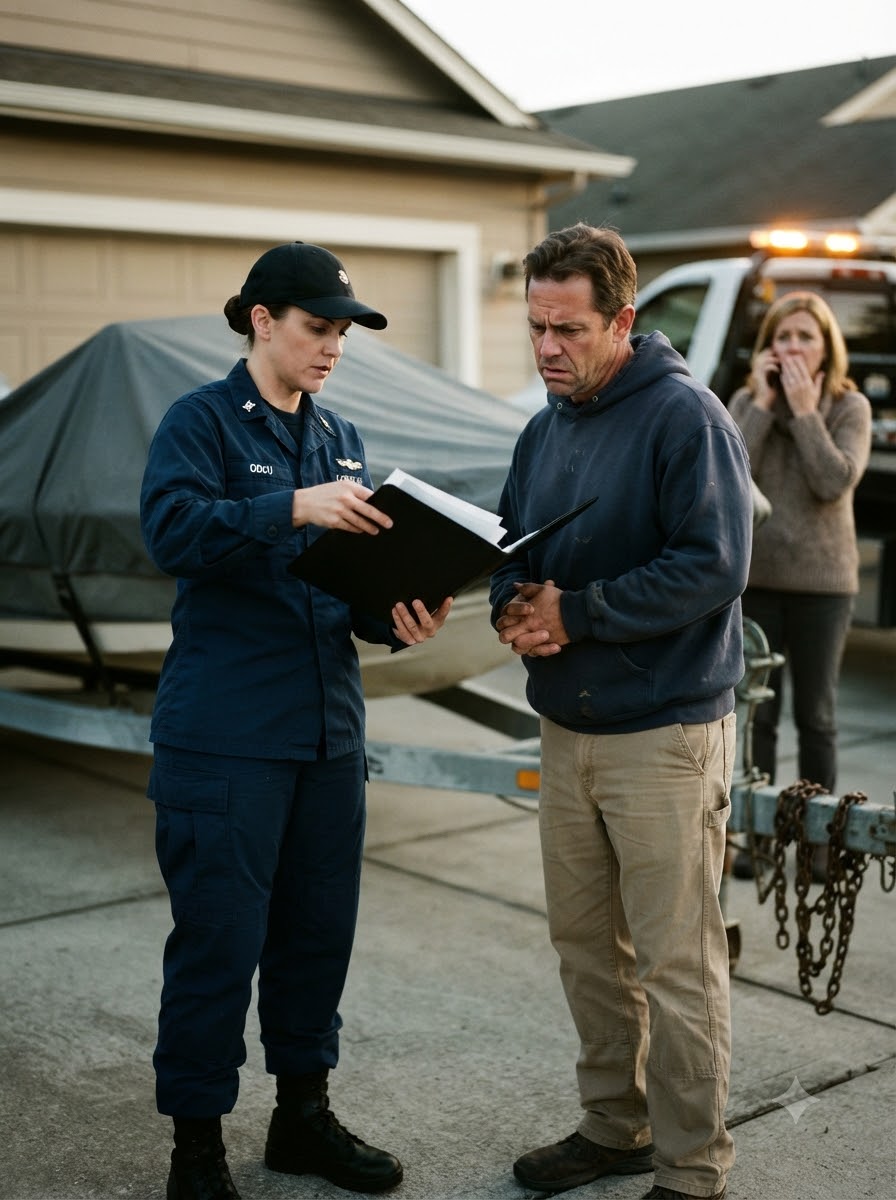
At seven in the morning, two tow trucks blocked my driveway while my wife slept upstairs, unaware that our neighborhood president was trying to steal a federal boat from beneath our bedroom window.
The first thing I heard was the low growl of diesel engines. The second was the slap of my own front door closing behind me as I stepped onto the porch with a coffee mug in one hand.
Amber lights flashed across the garage door.
A twenty-eight-foot response boat sat on its trailer behind my pickup, covered in gray canvas. Two tow operators were already walking around it with chains and wheel-lift equipment.
For one disorienting moment, I thought there had been some kind of emergency.
Then I saw the Cedar Ridge Estates logo on the work order clipped to the lead driver’s tablet.
My stomach tightened.
“Good morning,” I called. “Why are you on my property?”
The lead driver turned. He was broad-shouldered, red-faced, and built like a man who had spent his life lifting things heavier than himself.
“Rick Dawson,” he said, tapping the paper. “We’ve got a removal order.”
“For what?”
He pointed at the covered boat.
“Abandoned recreational vessel. HOA enforcement.”
I looked at the boat, then at him.
“That vessel has been here twelve days.”
Rick glanced toward the house.
“Work order says more than thirty.”
“Then the work order is wrong.”
He shrugged. “Take it up with the president.”
The younger operator had already picked up a length of chain.
I put my mug down on the porch railing.
“Stop. Nobody touches that boat.”
Rick’s expression hardened.
“Sir, we’re contracted to remove it.”
“It belongs to the United States government.”
That got a reaction from the younger man. He lowered the chain slightly.
Rick did not.
“Not my problem.”
“It becomes your problem if you damage it.”
He glanced at his phone. A call was still connected through the truck’s Bluetooth speaker.
Then a woman’s voice came through the morning air.
“Hook it up, Rick. He’s had enough chances.”
Diane Mercer.
President of Cedar Ridge Estates Homeowners Association. Chair of the architectural committee. Self-appointed guardian of every mailbox, flower bed, basketball hoop, and parking space in the neighborhood.
She had once issued me a violation notice because my trash cans were visible from the street for eleven minutes after pickup.
Now she was ordering a government vessel removed from my driveway.
“Diane,” I said loudly, “you received the federal storage authorization on Monday.”
There was a short pause.
Then she laughed.
“You received my violation notice on Tuesday.”
“That notice does not override federal ownership.”
“I am not discussing this with you. Remove the boat.”
“You know exactly what that boat is.”
“I know what your rules are,” she replied. “You keep a commercial vessel in a residential driveway. You were warned. You refused to comply.”
“It is not commercial property. It is a Coast Guard response boat assigned to my district.”
The younger operator looked from me to Rick.
Rick covered the phone with one hand and muttered, “Just do the job.”
I took out my phone and started recording.
That was a habit left over from fifteen years in the Coast Guard. Never rely on memory when a situation is becoming hostile. Record names. Record times. Record orders.
I had spent years inspecting marine systems, boarding vessels, and calming men who believed volume could change facts.
The trick was not to win the argument.
The trick was to let the other person reveal what they had already decided to do.
“I’m going to get the authorization,” I said. “Nobody moves anything.”
Rick rolled his eyes.
Inside the house, my wife, Julia, was still asleep. She worked nights at a medical billing office and had gone to bed after two in the morning. I moved quietly through the kitchen, past the stack of her paperwork, and opened the locked drawer beneath the counter.
The storage packet was exactly where I had left it.
The Coast Guard had approved my driveway as temporary secure storage because the district facility was still being repaired after the hurricane. The vessel needed inspections and maintenance before returning to active service. I had signed for it personally.
The first page identified the boat by hull number.
The second listed federal ownership.
The third stated that the vessel could not be moved, boarded, transferred, or impounded without written authorization from the district commander.
The fourth carried the signature of the operations chief.
And attached behind it was the certified delivery receipt showing that I had mailed a copy to the HOA office.
I had also emailed the packet to Diane because I knew she would complain.
She had replied with one sentence.
Received. This matter will be reviewed.
I brought the packet outside.
Diane was still on speaker.
I held the first page toward Rick.
“Read the hull number.”
He did not take it.
“HOA says it goes.”
The younger operator, whose name patch said LUIS, stared at the page from several feet away.
“Maybe we should verify it.”
Rick gave him a sharp look.
“You want to explain to the company why you refused a contracted removal?”
Luis looked uncomfortable.
“I want to know whether we’re touching federal property.”
Behind us, curtains moved in the houses along the street.
Mrs. Alvarez, my next-door neighbor, stepped onto her porch wearing a robe and slippers. Across the road, a retired Navy chief named Harold Bell stood beside his mailbox, holding a newspaper he had clearly forgotten to open.
Diane had chosen seven in the morning because she wanted an audience.
She wanted me standing in sweatpants with a federal boat behind me and two trucks in front of my house. She wanted the neighborhood to see what happened when somebody challenged her authority.
My phone buzzed.
A text from Diane appeared on the screen.
PAY TODAY. $2,500 SPECIAL ENFORCEMENT ASSESSMENT. NO EXCEPTIONS.
I stared at it.
The alleged towing order had suddenly become a demand for money.
I held the screen toward Rick.
“This is not a removal order. This is extortion.”
“Watch your mouth,” Diane snapped through the speaker.
“You’re demanding twenty-five hundred dollars to stop an unauthorized seizure.”
“It’s an enforcement assessment.”
“For a federal vessel?”
“For violating the covenants.”
“You knew what the boat was before you issued the notice.”
“I knew what you claimed it was.”
She had made one mistake.
She had denied knowing.
If she truly believed it was an abandoned private boat, she would have asked for proof. She would have contacted the Coast Guard. She would not have sent a text demanding immediate payment before the trucks even arrived.
I saved the message and sent it to myself.
Then I called the district duty officer.
Not 911.
The Coast Guard had given me a direct emergency number when the boat was assigned to my care. I provided my name, the vessel number, my address, and four words that changed the tone on the other end.
“They are attaching chains.”
The duty officer told me not to interfere physically.
“Are they aware it’s federal property?”
“Yes.”
“Can you prove that?”
“I’m holding the signed authorization. They refuse to read it.”