Leo Hid in My Pantry—Then the Recorder Exposed What Miranda Planned
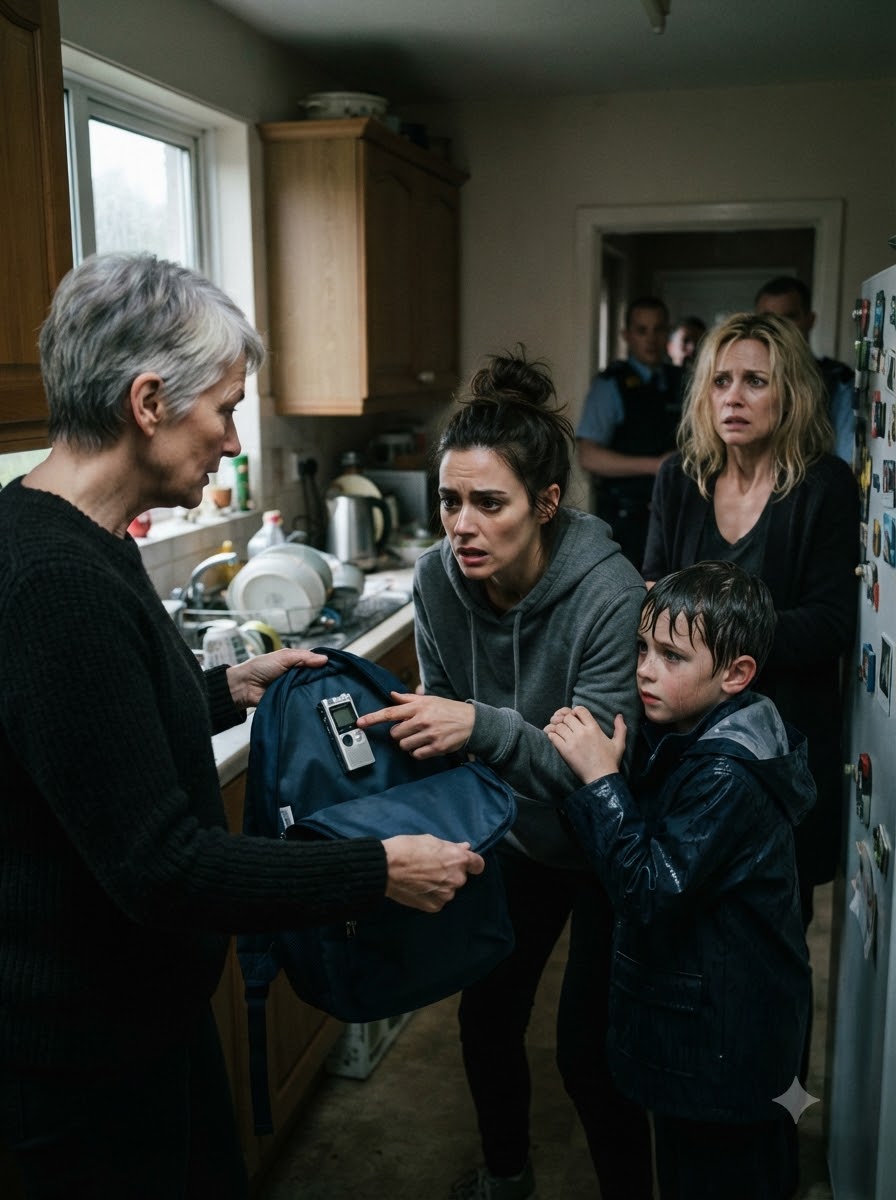
My grandson was hiding behind the flour when his stepmother came to my door with two police officers.
I could see the toe of Leo’s wet sneaker beneath the pantry door. Nine years old, soaked from a two-mile walk in the rain, and so frightened he had asked me to turn off the kitchen light.
“Eleanor!” Miranda shouted from the porch. “I know he’s in there. If you don’t open this door, I’m reporting you for kidnapping.”
Twenty minutes earlier, Leo had arrived with his backpack hugged to his chest. He had slipped past me without asking for a towel or a drink.
“Grandma,” he whispered, “please don’t make me go back.”
Then he climbed into the pantry, as if hiding in my house were something he had practiced.
Now Miranda was pounding hard enough to rattle the framed photograph of Leo and his father beside the door. Behind her, through the glass, I could make out the dark shapes of two patrol officers.
At my kitchen island sat Harriet Vance, my neighbor of thirty years and a retired family-court judge. She had come over when I called, bringing her glasses and the calm voice I had been trying to borrow since Leo showed me his back.
Harriet laid one hand on his backpack. Sewn into the padded shoulder strap was a small voice recorder. Leo knew it was there. We had put it in together three weeks earlier, after he told me he wanted a way to remember “the things I’m not supposed to tell.”
I hadn’t imagined what it would remember.
“Open the door,” Harriet said. “And let them hear him in his own words.”
I left the chain on at first. Miranda was standing between the officers, wiping at dry cheeks.
“There he is,” she said when she spotted Leo’s sneaker through the gap. “He ran away from home, and she’s been filling his head with lies.”
The taller officer introduced himself as Officer Ruiz. He asked me to remove the chain.
“I will,” I said, “but my grandson has reported being locked in a room. He has visible injuries. I’d like you to speak to him away from Miranda.”
Miranda’s expression changed for a second. Then she put a hand to her mouth.
“Leo has been having problems since his mother died,” she told Ruiz. “Eleanor refuses to accept that.”
Leo’s mother, my daughter-in-law Grace, had died when he was five. Miranda had never met her. Yet she had learned to use Grace’s death whenever Leo needed someone to believe him.
I opened the door. Miranda tried to step inside with the officers, but Ruiz held out an arm and asked her to wait on the porch.
Leo didn’t come out of the pantry until Harriet called his name. Even then, he kept his eyes on Miranda through the doorway.
Ruiz crouched in front of him. “You’re not in trouble. Can you tell me why you came here?”
Leo’s fingers closed around the strap of his backpack.
“Because Dad gets home tomorrow,” he said. “She said I had to stay in there until I could act grateful.”
“In where?” Ruiz asked.
“The laundry room.”
Miranda gave a sharp laugh from outside. “He means he lost his tablet. He’s exaggerating.”
Leo flinched at her voice. I watched Ruiz notice.
I had been noticing things for fourteen months, since my son Evan married Miranda. Leo had lost eleven pounds. At Sunday dinners he waited to see what Miranda served him before he took any food. He stopped telling the long, enthusiastic stories he used to tell about his classmates.
When I asked about the bruises around his wrists, Miranda said he was clumsy at soccer. Once she answered before I’d even finished the question.
Evan was away often, supervising installation jobs across the state. He believed Miranda when she said Leo was struggling with grief and needed firmer rules. I wanted to believe he was right. When I raised my concerns, Evan grew defensive, and Miranda began canceling our visits because Leo was “too tired.”
Three weeks before that Tuesday, Leo had left a drawing at my house. It showed our family at a table: me, Evan, Grace in the way he still pictured her, and Leo. Miranda stood by a square box with a black circle on its door.
“What’s the box?” I asked him.
He folded the paper at once.
Harriet was visiting that day. She waited until Leo had gone to fetch his coat, then said, “Ask him what he needs from you. Don’t make him defend a story before he’s ready to tell it.”
So I did. The following Sunday, while Miranda took a call in my garden, I asked Leo what would help him feel safe.
“A recorder,” he said. “She says things and then says she didn’t.”
I had an old one I used to record notes for my book club. I showed him how it worked. He pressed the button himself, spoke his name, and played it back. Then he asked if we could put it somewhere Miranda wouldn’t see. I stitched a cloth pocket into his backpack strap.
I wish I had insisted on more answers then. I wish I had taken him straight to a doctor. Instead, afraid of cutting off the little access I still had, I told him he could always come to me.
On Tuesday, he did.
He got off the school bus in the rain and walked past his own street to mine. When I helped him out of his sweatshirt, I found red abrasions across both shoulder blades. His wrists were marked again. He took off one shoe and peeled a small key from beneath the insole, where it had been taped.
“It opens the laundry door,” he said. “I got it from her purse. I was going to give it back.”
I asked why he had taken it.
“Because yesterday she forgot I was in there when she went to get her nails done.”
Harriet had arrived a few minutes later. She persuaded Leo to eat half a banana while I called Evan. His phone went to voicemail.
Now, in my kitchen, Ruiz asked if Leo would show him the injuries. Leo looked at me before nodding. Ruiz examined them without touching him. His partner, Officer Chen, stepped outside to ask Miranda for her account.
Harriet picked up the recorder. “There are files from this morning,” she said. “Leo has identified the voices for us, but you should hear them.”
Ruiz asked Leo if he wanted to play one.
Leo nodded. “The one from breakfast.”
Harriet pressed the button. There was a rustle of fabric, a cupboard closing, and Miranda’s voice, thin but unmistakable.
“Your father called. He wants to hear that you’re being good when he gets home.”
“I was good,” Leo said on the recording.
“You took food last night.”
“I was hungry.”
“You know the rule when Dad’s away. Laundry room until you remember how this family works.”
A scrape followed. Leo said, “Please don’t put the chair against the door again.”
“You’re making me late,” Miranda snapped. “Get in.”