My Birthday Box Held Forged Papers—Until the Detective Found Erin’s Second Plan
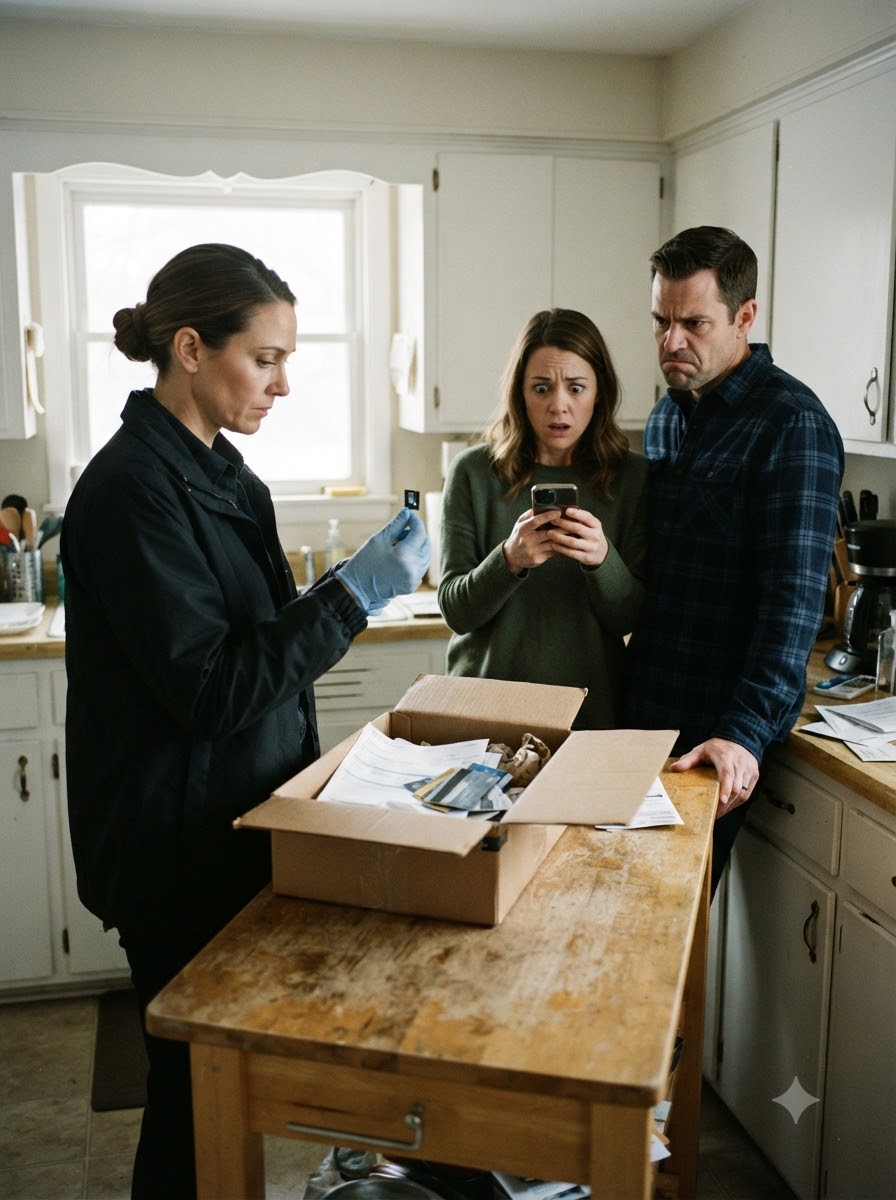
My husband saw the split in the cardboard before I did.
He had already carried the box from the porch to our kitchen. It sat between my coffee mug and the little grocery-store cake he had bought for my birthday.
Then Jason leaned closer to the shipping label and stopped breathing.
“Don’t open it.”
I laughed because I thought he was being dramatic.
“What, you think my mother mailed me a bomb?”
“I think your mother didn’t mail this from her house.”
He pointed to the return address.
It was a post-office box in Bellweather, nearly eighty miles from where my parents lived. The sender’s name was printed as M. Ward.
No one in my family was named Ward.
The cardboard had split beneath the clear packing tape. It was barely an inch long, but something shiny was visible inside.
Jason crouched without touching it.
“That looks like a bank card.”
I put down my coffee.
There was a stack of papers under the card. Through the tear, I could see one typed line.
POWER OF ATTORNEY.
My full legal name appeared below it.
For a few seconds, all I could hear was the refrigerator humming.
The month before, my sister Erin had called and asked if she could use my address for “something important.”
I had said no.
She cried. Then she became angry. Then my father called and told me I had forgotten what family meant.
After that, the questions started.
Dad asked whether Jason and I had refinanced our mortgage.
Mom wanted to know if we still banked at Harbor Federal.
Erin asked if I kept old tax returns.
I had dismissed each question separately. Seeing that paper inside the box pulled them together into something sharp.
Jason touched my wrist.
“Photograph it before we move it.”
I took pictures of every side, including the label, the crushed corner, the tear and the tape. Jason put on the disposable gloves he used for staining furniture and carried the box back to the porch.
Then I called the police.
The dispatcher became serious the moment I said “bank card,” “power of attorney” and “signature I didn’t authorize.”
She told us not to touch the package again.
Officers were on their way.
My mother texted less than a minute later.
Did it arrive yet?
I didn’t answer.
Another message came.
Bring it inside right away. Don’t leave it where anyone can see it.
Jason read it over my shoulder.
“She knows what’s in there.”
Twenty-seven minutes later, two patrol cars pulled up. A detective arrived soon afterward in an unmarked sedan.
Detective Lena Ortiz was small, gray-haired and so calm that everyone around her seemed louder by comparison.
Her first question was whether we had opened the box.
“No,” I said.
Jason showed her the photographs and explained that he had moved it with gloves after we noticed the damaged seam.
Ortiz nodded once.
“That was smart.”
An officer photographed the package where it sat. Then, wearing gloves, he cut the tape.
There was no gift inside.
No card. No tissue paper. Nothing that suggested my birthday except the timing.
Three credit cards were bound together with a rubber band. All carried my name.
Beneath them were copies of my driver’s license, Social Security card and birth certificate.
There was a prepaid phone still sealed in plastic.
There were change-of-address confirmations from the postal service, applications for two personal loans and paperwork for a home equity line of credit secured against a property I did not own.
At the bottom lay the power of attorney.
The signature looked like mine if you had seen my name only twice.
I had seen it every day of my life.
The final curve of the last letter was wrong. The date was also wrong. According to the document, I had signed it in front of a notary on a Tuesday when Jason and I had been in Denver for his aunt’s funeral.
The person I had supposedly appointed to act for me was my sister.
Erin Louise Mercer.
I gripped the back of a kitchen chair.
“She scanned documents here last spring,” I said. “She asked to use our printer. I was making lunch.”
Detective Ortiz studied the paperwork.
“Who had the original birth certificate?”
“My mother. She kept all our records in a metal box.”
“Did your sister have financial trouble?”
Jason made a bitter sound.
Erin was always having financial trouble.
A failed online boutique. A leased SUV she could not afford. Medical bills she blamed on her former boyfriend, although he had shown me receipts proving he paid half. Then there were the cash advances, the payday loans and the money she borrowed from relatives who eventually stopped inviting her to holidays.
Before I could explain, Ortiz’s phone rang.
She walked to the edge of the yard to answer.
When she returned, her expression had changed.
“We received an anonymous tip at seven fourteen this morning,” she said. “The caller claimed fraudulent credit cards and forged financial documents were being delivered to this address.”
I looked at the unopened box.
“To me?”
“The caller said a woman at this address was preparing to use false documents to obtain loans.”
My stomach dropped.
This was not simply evidence of someone stealing my identity.
Someone had packaged that evidence, sent it to my house and called the police before I received it.
Jason understood at the same moment.
“They were setting her up.”
My phone vibrated.
Mom again.
I read the first line, and the kitchen tilted.
If the police show up, tell them Jason ordered the cards and made you sign everything.
Detective Ortiz saw my face.
“Don’t answer.”
I handed her the phone.
The rest of the message read:
You need to stick to that no matter what. Erin says the call cannot be traced. Once they take him out of the house, burn the papers and break the little phone. This is the only way to keep everybody safe.
Ortiz read it twice.
Then she reached for her own phone.
She had an officer photograph the message on my screen, preserving the time stamp and contact information. She asked whether I would consent to my phone being placed in airplane mode and retained temporarily as evidence.
I agreed.
My birthday cake sat unopened while they carried the box away.
By noon, we knew the first layer of the truth.
Erin had opened the cards over the previous six months.
One had a balance of $8,700. Another showed cash advances totaling $4,000. The third was new and had not yet been activated.
The loan applications sought more than $90,000.
The home equity paperwork concerned my parents’ house.
My parents had fallen behind on their mortgage. Rather than sell, they had tried to borrow against the remaining equity. Their credit was too damaged to qualify.
So they used mine.
The forged power of attorney would allow Erin to represent me during the loan process. The fake change of address sent correspondence to a mailbox near her apartment. The prepaid phone was intended to become “my” contact number when lenders called.
At first, it looked like the package had been mailed by mistake.