My Drowned Son Left A Hidden Letter In His Teacher’s Desk Drawer
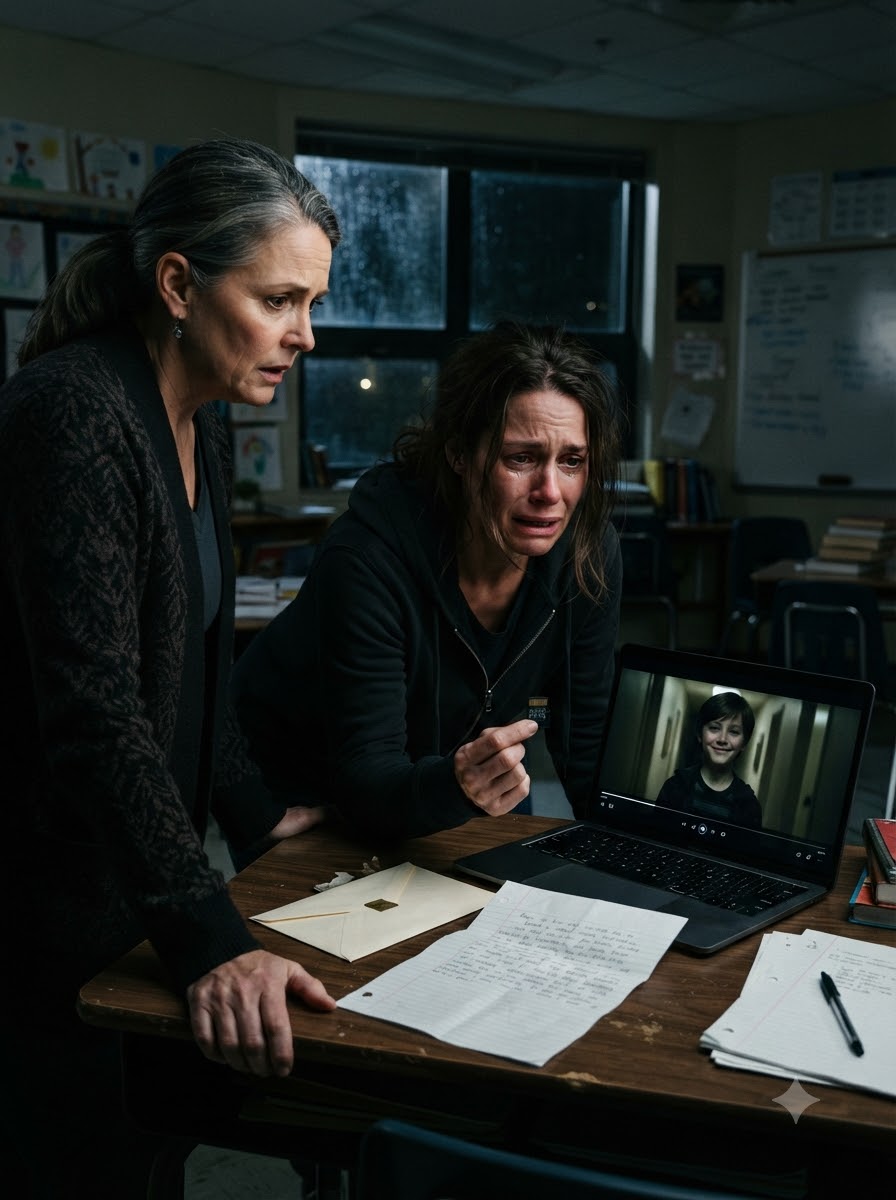
My knees nearly buckled as I stared at the date written in fresh blue ink at the bottom of page three: July 22, 5:45 AM—this very morning.
For twenty-two agonizing days, I had woken up choking on grief, believing my thirteen-year-old son’s small body was trapped somewhere beneath the cold, dark timber at the bottom of Blackwood Lake. I had stood beside an empty mahogany casket while nurses held my elbows so I wouldn’t collapse into the wet grass. I had watched my husband Richard toss Owen’s algebra medals and his favorite navy hoodie into black contractor trash bags as if erasing our child was nothing more than weekend housework.
Yet right here in my trembling hands, written on the lined graph paper Mrs. Dilmore kept in Classroom 204, was Owen’s unmistakable left-handed slant—pressed into the page less than nine hours ago.
Before I could even read the rest of the postscript, heavy boots echoed up the empty stairwell at the end of the second-floor corridor.
The brass handle of Room 204 rattled violently against the deadbolt.
Through the narrow wire-glass panel in the classroom door, I saw Richard’s furious face beside Principal Hayes, who was fumbling with a brass master key ring in the hallway light.
“Open the door, Principal Hayes!” Richard barked, his voice laced with that counterfeit concern he had used on the hospital doctors for three weeks. “My wife has been suffering severe delusions since we lost our son. She left the house without her prescribed sedatives, and her psychiatrist needs her brought in before she hurts herself!”
My blood turned to ice. That was why my car had been so easy to follow—Richard had been tracking the GPS on my phone from the moment I pulled out of the driveway.
Mrs. Dilmore didn’t panic. For a fifty-eight-year-old seventh-grade math teacher whose hands had been shaking two minutes earlier, her eyes suddenly hardened like flint. She grabbed my wrist, pulled me silently behind the tall oak supply cabinet that divided her classroom from the narrow science prep lab, and pointed to the heavier steel fire door at the back of the lab.
“He doesn’t know the prep room connects to the boiler stairwell,” Mrs. Dilmore whispered urgently, snatching her laptop bag and the micro-SD card adapter off her desk. “My nephew Mark is a detective with the State Bureau of Investigation—not the county sheriff’s office where Paul Sutton’s brother works. I called him the second I saw Owen’s handwriting in my lockbox. He’s ten minutes away. Come on!”
Just as Principal Hayes’s master key clicked inside the front classroom lock, Mrs. Dilmore eased the back steel door shut and engaged the interior slide latch from the stairwell side, wedging a heavy rubber doorstop beneath the frame for good measure.
We hurried down the concrete maintenance stairs and slipped out the delivery entrance into the faculty courtyard, climbing straight into Mrs. Dilmore’s silver Subaru parked behind the greenhouse hedges.
From the second-floor window above us, I saw Richard’s silhouette storming past the chalkboards inside Room 204, shouting my name as he realized the classroom was empty.
Mrs. Dilmore kept the engine idling behind the thick cedar hedge, locked all four car doors, and opened her laptop across the center console. Her fingers worked quickly as she slotted the tiny black waterproof micro-SD card into the side reader.
“Read the rest of his letter while the video files load, Clara,” she said softly, keeping watch in the rearview mirror. “Every single word.”
With my heart hammering in my throat, I unfolded the first two pages—the ones Owen had written on June 14, the night before Richard drove him up to Blackwood Lake.
“Mom,” Owen had written in careful, cramped lines, “if Mrs. Dilmore is giving you this envelope, it means I didn’t come back from the fishing trip. Please don’t let Dad tell the doctors you’re crazy. You aren’t crazy, Mom. For the last two years, Dad has been crushing pills from a white bottle hidden inside his tackle safe and stirring them into your chamomile tea whenever he wants you asleep early.
“It started two summers ago when Grandpa Arthur passed away and left the Blackwood Lake estate and the timber trust in your name and mine, instead of Dad’s company. I woke up one night to get water and heard Dad arguing in the basement office with Uncle Greg. Dad’s contracting firm lost almost a million dollars on the riverfront condo build, and Greg said if Dad didn’t pay back the private lenders by August, they were both going to federal prison for forging bank appraisals.
“When I accidentally knocked over a fishing rod on the stairs, Dad caught me listening. He locked me in the furnace room until morning and swore that if I ever breathed a word to you, he would put triple the dose in your evening tea while I was at school and make it look like your bad heart gave out in your sleep. He made me watch him stir the powder into your mug that night just so I knew he meant it. I was only eleven, Mom. I was so scared for you that I stayed quiet and started checking your pulse every morning before I got on the school bus.”
A sob tore out of my chest, hot tears spilling onto the graph paper as two years of dizzy spells, memory gaps, and sudden afternoon collapses snapped into horrifying focus. Every time I had begged Owen to tell me why he looked so pale and quiet around his father, my thirteen-year-old boy had forced a smile and stayed silent to keep me alive.
I turned to the second page with trembling fingers.
“Two weeks ago,” Owen continued, “Dad asked me to scan his insurance receipts for his accountant because I’m fast with spreadsheets. Inside the back pocket of his leather ledger, I found two documents that made me sick. The first was a juvenile accidental-death rider for $900,000 that Dad took out on me in January—with your signature traced onto the consent line using the lightbox in his workshop. The second was a mental incapacity petition already drafted by Greg’s brother-in-law, waiting for a tragedy big enough to put you in a hospital so Dad could become sole trustee of Grandpa’s lake land.
“Then on Thursday night, while I was cleaning my fishing reels behind the garage, I heard Dad, Greg, and Paul Sutton talking by the boat trailer. Dad said the Saturday storm front would force the county to open the north dam floodgates at two o’clock, and if the skiff tipped near the spillway markers, nobody would ever question why a boy who couldn’t swim against a current disappeared. Paul said his brother on the marine patrol would steer the sonar boats toward the south reeds for three days until the trail went cold.