The Thirty-Day Intimacy Challenge Was Supposed to Be Private. On Night Seven, I Found the Audience.
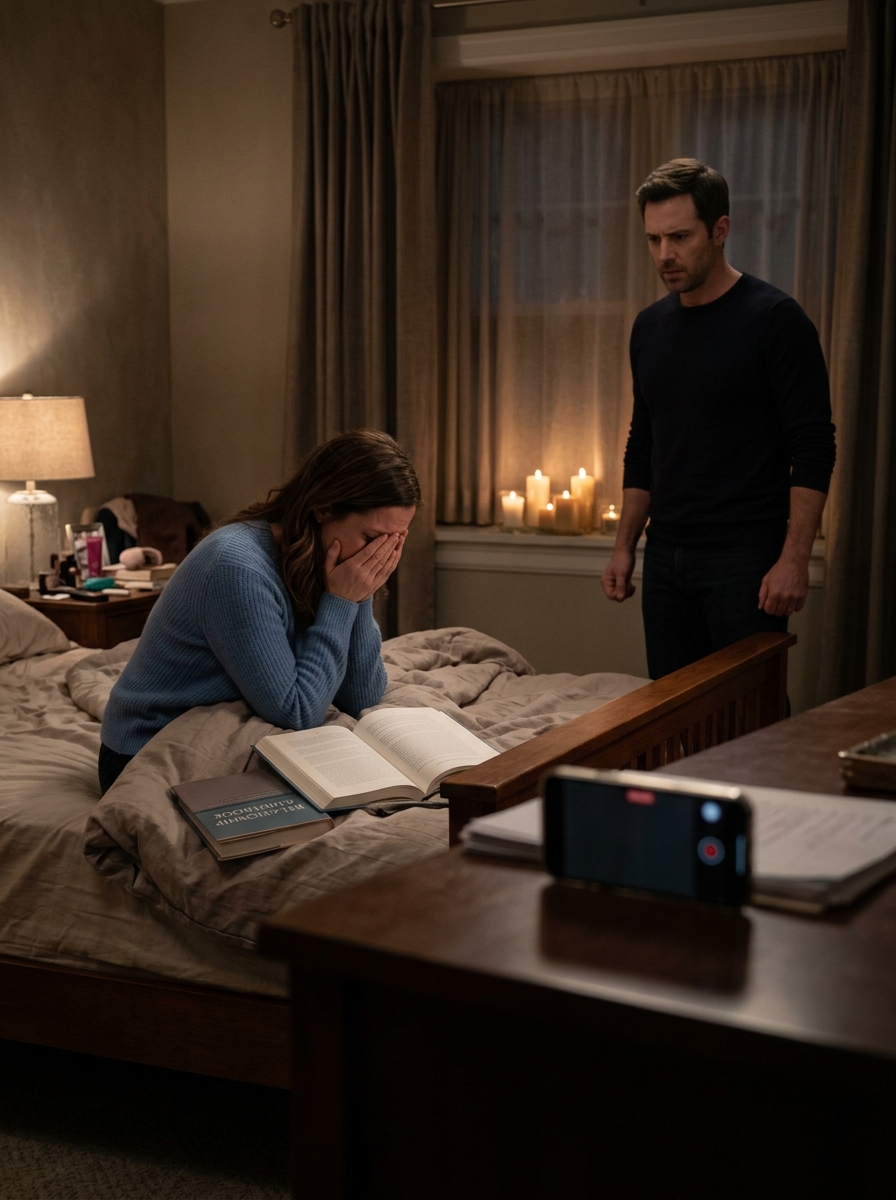
On night seven of our thirty-day intimacy challenge, I found my wife’s phone recording us from the dresser.
The screen was dark except for the small red light near the camera. Under the video files were six drafts labeled by date, each one no longer than a minute. Day One. Day Two. Day Three.
The seventh had already been scheduled.
DAY SEVEN: We stopped trying to fix our marriage and finally found our way back to each other.
I read the sentence twice before I understood what hurt about it.
It wasn’t that the words were untrue. We had stopped trying to fix things, sometimes. We had also spent the last six days attempting something that looked a lot like finding our way back.
What hurt was the certainty.
The post spoke as if the ending had already happened.
Sloane stood beside the bed in a blue sweater, her hair pinned up, her mouth pressed into a thin line. A candle burned on the windowsill. The book that had started all of this lay open between us, its seventh prompt circled in her handwriting:
Create a ritual that belongs only to the two of you.
“What is that?” I asked.
She followed my gaze to the phone.
For three seconds, neither of us moved.
Then she crossed the room and picked it up.
“It isn’t live,” she said.
“That wasn’t my question.”
Her thumb hovered over the screen. She looked at the camera, then at me.
“I wasn’t going to post it tonight.”
“But you were going to post it.”
“I don’t know.”
“You wrote the caption.”
“I know what I wrote.”
The radiator knocked inside the wall. It made the same three-note clank it had made every winter since we moved into the apartment. I had always liked the sound. It made the building seem old in a comforting way, as though its flaws had been there longer than we had and would remain after us.
Sloane sat on the edge of the bed.
“I can’t do night eight,” she said.
I thought she meant she didn’t want to continue the challenge. I thought she was telling me that whatever fragile closeness we had managed to find had disappeared.
Then she covered her face.
“I can’t keep performing that we’re getting better,” she whispered. “Not for you. Not for them. Not even for myself.”
***
Sloane was thirty-eight and had built a career out of making ordinary rooms feel intentional.
Her online work began with photographs of our first apartment: a narrow galley kitchen, a sagging bookshelf, two mismatched chairs she found beside a dumpster behind a theater. She wrote about making a home without waiting to become the kind of people who owned one.
I was forty-one and scheduled bus routes for the city. I liked her work because it had once been about small solutions. A lamp moved closer to a chair. A shelf lowered so somebody could reach it. A room rearranged to fit the life already happening inside it.
Then the audience grew.
People started writing to her about their marriages, their anxiety, their divorces, their bodies, their loneliness. Sloane answered them. At first, she answered privately. Later, she began turning their questions into posts.
Our marriage entered the work gradually, almost politely.
She mentioned that I hated overhead lighting. She told a story about how I alphabetized the spices. She described my habit of making coffee for both of us even when we were angry.
None of that bothered me.
What bothered me was the post she wrote three years ago after we had our worst fight.
At the time, we had gone several months without sleeping together. Neither of us could identify the exact moment the distance began. We were busy, tired, and irritated by the way every conversation about intimacy seemed to become a conversation about who was failing whom.
During the fight, I said, “I don’t know how to be close to someone who keeps asking me to prove I’m close.”
It was not a polished sentence. I said it while standing barefoot in the kitchen, holding a dish towel, with a pan burning on the stove.
Two days later, Sloane published an essay about the difference between being desired and being evaluated.
She didn’t use my name. She changed the kitchen to a dining room. She called the speaker “my partner.” But the sentence was mine.
A coworker sent me the link with a message that said, This sounds like you.
The essay went viral.
People praised Sloane for her honesty. They said she had articulated what so many couples were afraid to admit. Someone called her brave. Someone else wrote that her marriage made them believe in marriage again.
She deleted the piece after I asked her to.
By then, it had been copied, quoted, and discussed in places I couldn’t reach.
When she apologized, she said she hadn’t understood that a sentence could still belong to me after she had changed the details.
I believed that she hadn’t understood.
I also understood that she had liked what happened afterward. She had liked being told that our private pain meant something.
That was the part we never repaired.
By the following year, we had stopped sleeping together altogether.
Not dramatically. There was no slammed door or ultimatum. There were just more nights when one of us said, “I’m exhausted,” and the other said, “Of course,” with a relief neither wanted to examine.
We still kissed goodbye. We still shared grocery lists and dentist appointments. We still watched the same television shows, though Sloane often answered comments on her laptop while I watched.
I started turning away when she changed clothes.
She began asking whether I was upset in a voice that made every answer sound like a trap.
“Nothing is wrong,” I would say.
“Nothing?”
“Nothing I want to discuss right now.”
That sentence became a wall. It protected me from becoming material, but it also kept her outside.
The intimacy book appeared on our kitchen table in February.
It was called Thirty Days to the Middle, written by a therapist named Dr. Elian Voss. The cover showed two hands resting on opposite sides of a wooden table. The title promised daily exercises for couples who were not in crisis, exactly, but had begun living as if closeness were a room they had misplaced.
Sloane set it beside the fruit bowl.
“I bought something,” she said.
“That sounds ominous.”
“It’s a book.”
“That sounds less ominous.”
She pushed it toward me. “I think we should try it.”
I looked at the cover. “Is this the part where you ask me to fill out a questionnaire?”
“No.”
“Rate our communication from one to ten?”
“No.”
“Photograph our progress?”
Her expression tightened.
“No,” she said again. “Thirty days. One prompt a night. We can stop whenever either of us wants. Nothing has to happen physically. We don’t share anything. We don’t use it in my work. We don’t turn it into a story.”
She had answered the questions I hadn’t asked yet.
That was why I agreed.
I also agreed because I missed her.