I Thought “Backstock” Was a Household Chore—Until I Learned What My Wife Had Been Scheduling
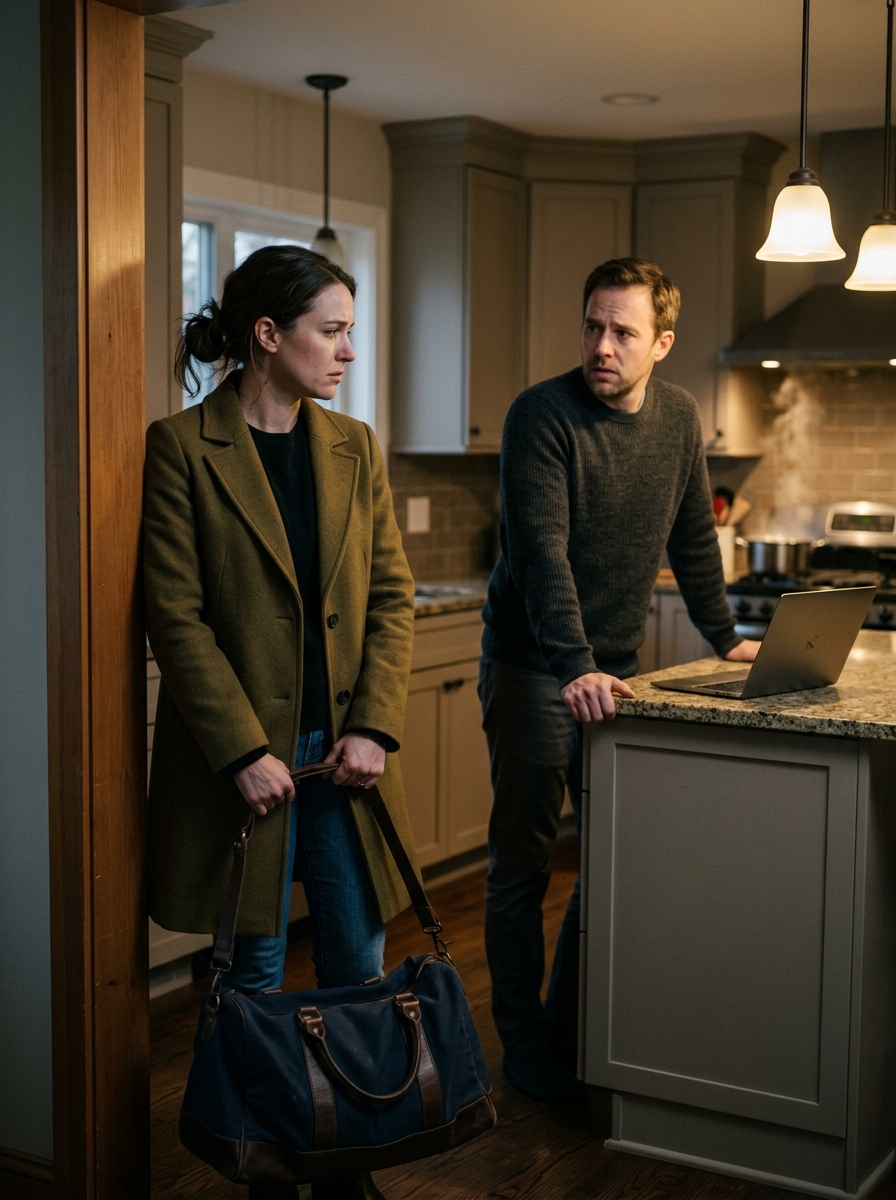
Martin did not touch the navy overnight bag.
He moved it away from the kitchen doorway only because he needed to get past it to turn off the burner beneath the soup. The bag belonged to Elise, and Elise belonged, at least technically, to the house: to the bookshelves they had argued over, the yellow mug with the chipped handle, the narrow upstairs hallway where their shoulders still brushed when they passed.
But the bag had the unmistakable authority of an object that had already made a decision.
At forty-two, Martin had learned that people rarely packed an overnight bag because they wanted to discuss the weather.
Elise stood by the sink in her museum clothes, one hand resting on the counter. She was thirty-nine, with a streak of gray beginning at her left temple that she refused to cover. The day’s rain had darkened the shoulders of her coat. She looked tired enough to be honest.
“Are you going to ask me to stay?” she said.
“I don’t know.”
“That’s probably better than begging.”
“I wasn’t going to beg.”
“No.” She gave him a small, sad smile. “You were going to make a practical argument.”
He turned off the stove. “The soup is going to be ruined.”
“That’s the argument?”
“It’s what I could think of.”
Elise nodded, as though this confirmed something she had already written down.
Martin wiped his hands on a dish towel. “When did you start putting those on the calendar?”
“Last September.”
“Last September?”
“The first one was September fourteenth.”
He looked at the laptop. The calendar was still open to the year view, all those pale blue squares distributed across months. BACKSTOCK appeared every few weeks, sometimes twice in one month. It had been hiding in plain sight because he had never wondered what the word meant.
He had assumed it was a museum deadline. Elise worked as a registrar for the Harbor City Museum, a job that involved accession numbers, climate reports, shipping forms, and long stretches of time spent deciding whether an object was a vase, a vessel, or an unidentified ceramic fragment. She used strange professional language at home without noticing. Intake. Deaccession. Condition report. Backstock.
When Martin had first seen the word, he had thought it referred to storage.
In a way, it did.
“Why didn’t you call it what it was?” he asked.
Elise’s fingers tightened around the counter’s edge. “Because then it would have been an appointment.”
“It was an appointment.”
“It was a protected evening.”
“For what?”
She looked at him.
He regretted the question before she answered.
“For us.”
***
She left at seven-thirty.
Martin carried the bag to the front steps because the handle was digging into her palm. He did not kiss her goodbye. He almost did, then remembered that she had just told him she was leaving partly because every gesture between them had become a question with a correct answer.
Nora lived fifteen minutes away in a brick apartment above a florist. Elise’s older sister had a way of making her home feel temporary and safe at the same time. There were no matching dishes, no framed wedding photographs, no evidence that anyone was supposed to stay forever.
At the bottom of the steps, Elise took the bag from him.
“Tomorrow,” she said.
“Tomorrow.”
She waited.
Martin knew what she was waiting for. Not a promise. Not an apology. A question.
“Do you want me to call you later?”
“No.”
“Do you want me to text?”
“Only if something is on fire.”
He nodded.
“That wasn’t a joke,” she said.
“I know.”
She walked toward her car. Martin watched her unlock it, put the bag on the passenger seat, and sit for a while before starting the engine.
The soup had gone too soft by the time he returned to the kitchen. He ate two spoonfuls standing up, then poured the rest into a container. He washed the pot. He wiped the counter. He put away the bread.
At nine, he opened the calendar again.
The Backstock entries were still there. He clicked one from October.
**BACKSTOCK**
**8:30–10:30 p.m.**
**No laundry after eight. Tea first. Stop by 10:30.**
Another said:
**BACKSTOCK**
**No screens. If tired, don’t turn tired into a verdict.**
A third had only one sentence.
**Do not ask what this means.**
Martin sat back from the laptop.
He understood, with a slow and humiliating clarity, that the calendar had not been a record of what Elise owed him. It had been a record of how much preparation she needed to risk wanting anything at all.
That did not make the discovery painless.
He opened his phone and typed: I’m sorry I made you feel like you had to—
He deleted it.
He typed: I didn’t know.
He deleted that too. It sounded like an accusation directed at her.
Finally, he wrote: I’ll wait until tomorrow.
Elise responded almost immediately.
**Thank you.**
Two words. No heart. No explanation.
Martin put the phone facedown.
***
The next morning, Elise came home at eleven.
Martin had been awake since five. He had gone to the restoration shop before dawn, unlocked the side door, and spent three hours sanding the frame of an old theater poster case. He had made the same mistake twice and ruined a strip of trim.
When he came home, Elise was sitting at the kitchen table with a mug of tea.
Nora’s mug, he realized. It was white with a blue line around the rim.
“You could have told me you were coming,” he said.
“I could have.”
He set his keys down.
There were a hundred things he wanted to ask. Had she slept? Was she still angry? Did she still love him? Had she told Nora everything? Had she ever told anyone?
Instead he said, “Did you eat?”
Elise looked at him.
“Sorry,” he said. “Practical argument.”
“I had toast.”
He sat across from her. The table was the same table where they paid taxes, opened mail, wrapped birthday presents, and once spent an entire Sunday assembling a bookshelf that leaned slightly to the left.
“I’m not asking you to explain every entry,” he said.
“That’s good, because I couldn’t.”
“Couldn’t?”
“Not accurately.” She tucked one leg beneath her. “I know what I was trying to do. I don’t know that every night meant the same thing.”
“Were you trying to have sex with me?”
She closed her eyes.
He regretted it again, but this time he stayed silent.
“Sometimes,” she said.
The answer should have been a relief. Instead it felt like standing in a room with several doors, none of them marked.
“Sometimes you weren’t.”
“Sometimes I wanted to sit beside you and have you touch my hair. Sometimes I wanted to kiss you and see what happened. Sometimes I wanted to feel close without going any farther. Sometimes I wanted sex. Sometimes I thought I should want sex because we had made time for it.”
“And you came upstairs anyway.”
“Yes.”
“Why?”
“Because I loved you.”
Martin’s jaw tightened.
“That isn’t an answer.”