She Put Our Intimacy on the Calendar as “Project Cedar”—Then She Told Me What It Was Really For
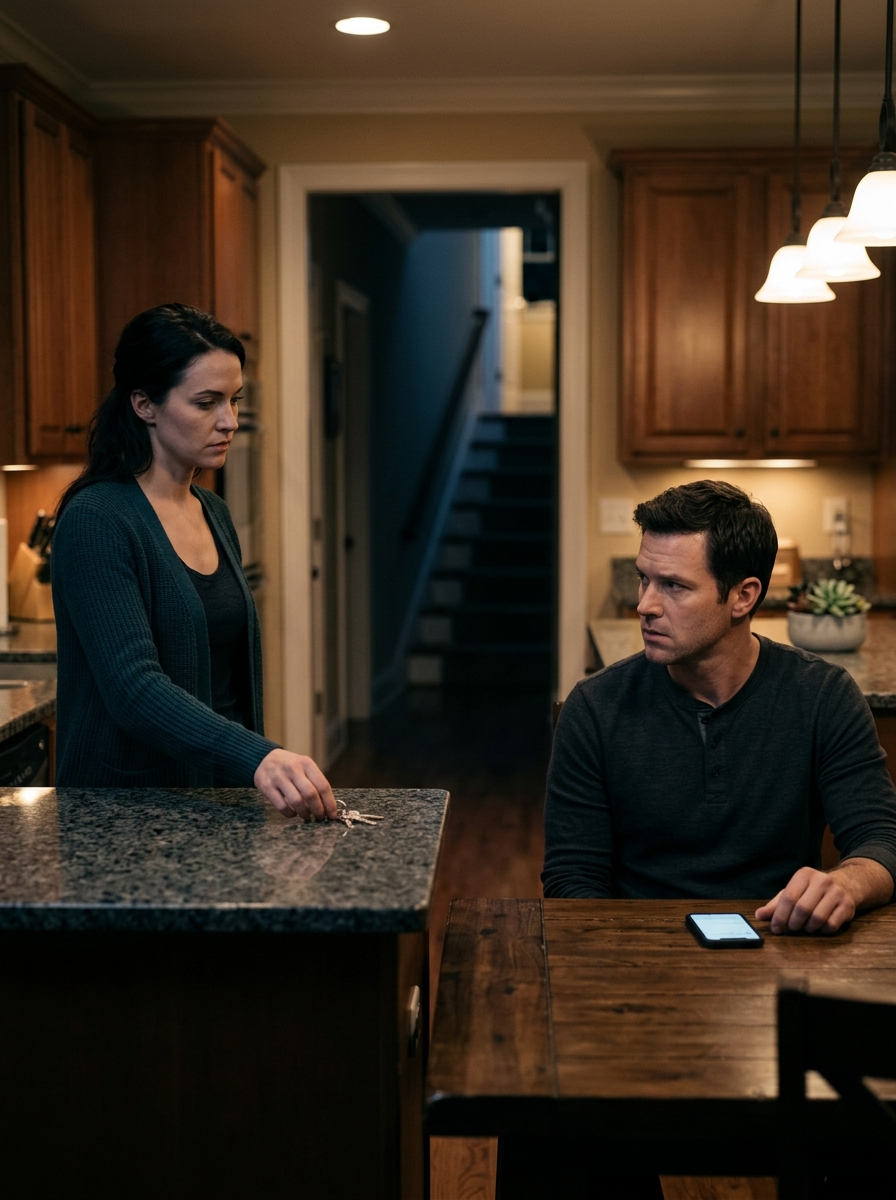
At 8:30 the next night, Nolan sat on the rug at the foot of their bed while Iris sat in the chair by the window.
The distance between them was deliberate.
Their daughter, Willa, was asleep in the room across the hall. The dishwasher had finished its cycle. A late bus sighed at the corner, then moved on. Everything in the house had settled into its usual nighttime rhythm except the two people who had built their lives around one another and suddenly did not know where to put their hands.
Iris had changed out of her work clothes. Her hair was still damp from the shower, and she wore the soft gray sweatshirt Nolan had bought her at a museum gift shop six years earlier. He had always liked seeing her in it. Tonight, the familiarity made him feel unsteady.
“Before we start,” she said, “I don’t want you to touch me.”
Nolan nodded.
“And I don’t want you to agree in a way that makes me responsible for how difficult this is.”
His mouth opened, then closed.
“I’m trying to listen,” he said.
“I know. I’m telling you what listening needs to look like.”
He folded his hands between his knees. “Okay.”
Iris took a breath.
“Project Cedar started in February.”
“I saw.”
“I mean, I started it because I was tired of waiting for the perfect moment. We kept saying we were going to find time. Then one of us was tired, or Willa had a fever, or you had an early meeting, or I had spent all day answering other people’s questions. The perfect moment never came.”
“So you put us on the calendar.”
“I put a possibility on the calendar.”
“The event didn’t say possibility.”
“It couldn’t.”
“Why not?”
She looked down at her hands. “Because you would have seen it.”
Nolan stared at her.
“That’s a strange answer, Iris.”
“I know.”
“And it’s a shared calendar.”
“I know that too.”
“Then what did you think would happen?”
“I thought you’d see ‘Project Cedar’ and assume it had something to do with the garage.”
They had been planning to build cedar shelving along the garage wall for almost four years. They had bought the boards, measured the space, and even printed instructions. The lumber was still stacked behind the lawn mower beneath a tarp.
Nolan had forgotten that Iris knew the project’s name.
“I used Cedar because it was boring,” she said. “And because it didn’t make my stomach clench.”
He looked at her. “The word intimacy makes your stomach clench?”
“Sometimes the word sex does too. Not because I don’t want it. Because the minute it’s said out loud, I can feel you waiting for me to tell you what kind of night it’s going to be.”
“I don’t wait like that.”
“You do.”
“I ask.”
“That’s what I mean.”
Nolan leaned back against the bed frame. He felt defensive, then ashamed of feeling defensive, which made him more defensive.
“I thought asking was better than assuming.”
“It is better than assuming. But asking doesn’t erase the weight of the answer.”
He remembered those questions. Do you want to? Are you sure? Is now okay? He had believed each one was proof of care. He had not noticed how carefully Iris listened for disappointment beneath them.
“I wanted to make room for us,” she continued. “I thought if we had a protected hour, I might arrive in the room as myself instead of as the person who had to decide whether to disappoint you.”
Nolan looked at the calendar on his phone. The recurring events seemed absurdly small now. Forty-five minutes. Ninety minutes. A few notes. A neutral color.
“How many times?” he asked.
Iris shut her eyes.
“Don’t.”
“How many, Iris?”
“You’re already counting.”
“I’m trying to understand.”
“No. You’re trying to find the number that tells you how bad this is.”
He could not argue with that.
She reached for the glass of water on the nightstand but didn’t drink from it. “There were twenty-one Cedar entries.”
Nolan’s chest tightened.
“Twenty-one?”
“Since February.”
“How many times did we—” He stopped.
Iris waited.
“How many times did we actually have sex?”
“Eight, maybe.”
“Maybe?”
“I didn’t keep a scorecard.”
“But you put the dates on the calendar.”
“The dates were for the chance. Not the result.”
He looked away.
“On some nights, I wanted you,” she said. “On some nights, I wanted to want you. On some nights, I wanted the closeness but not the expectation that closeness had to become sex. And on a few nights, I said yes because I knew what would happen if I said no.”
Nolan heard the sentence as an accusation, though Iris delivered it without one.
“What would happen?”
“You’d say it was fine.”
“It was fine.”
“You’d become quiet.”
“I was trying to give you space.”
“You’d wash dishes like they had personally betrayed you.”
He almost smiled because the image was so specific. Then he remembered doing exactly that: scraping plates into the trash with unnecessary force, slamming the cabinet, rinsing the same glass twice.
“I never pressured you,” he said, but the words sounded thin.
“I know you never forced me.”
The distinction landed harder than he expected.
“I’m not saying you forced me,” Iris continued. “I’m saying I learned that my no had a cost. You didn’t demand anything. You just made the air change.”
Nolan stared at the floorboards.
Three years earlier, after Willa had started kindergarten, Iris had turned him down on a Wednesday night. She had been exhausted and had spent the whole day at school dealing with a child who had thrown a chair. Nolan had asked if she wanted to come upstairs. She had said no, gently.
He had said, “Of course.”
Then he had slept facing the wall.
The next morning, when Iris asked if he was upset, he had said, “No. You don’t owe me anything.”
He had considered that sentence mature.
He had not considered what came after it: the silence at breakfast, the careful politeness, the way he had withdrawn his hand when she reached for the coffee pot.
“I thought I was respecting your answer,” he said.
“You were respecting the word no,” Iris replied. “You weren’t respecting me enough to let me have it without making it a referendum on whether you were wanted.”
He rubbed both hands over his face.
“What am I supposed to do with being disappointed?”
“Have the feeling. Just don’t hand it to me like a bill.”
For a few seconds, neither spoke.
Then Nolan said, “Did you hate it? The nights you said yes?”
Iris looked at him with sudden pain.
“No.”
That answer hurt more than if she had said yes.
“I didn’t hate being with you,” she said. “That’s why this is complicated. Sometimes I was happy we had made time. Sometimes I felt close to you. Sometimes I felt like I had completed the part of marriage I was afraid I was failing at.”
Nolan swallowed.
“I loved you in those moments,” she said. “But love and desire aren’t identical. I kept thinking if I showed up enough, desire would return in the form you were waiting for.”