They Rented a Remote Cabin to Save Their Sex Life—Then She Admitted Why Their Best Nights Always Began With a Fight
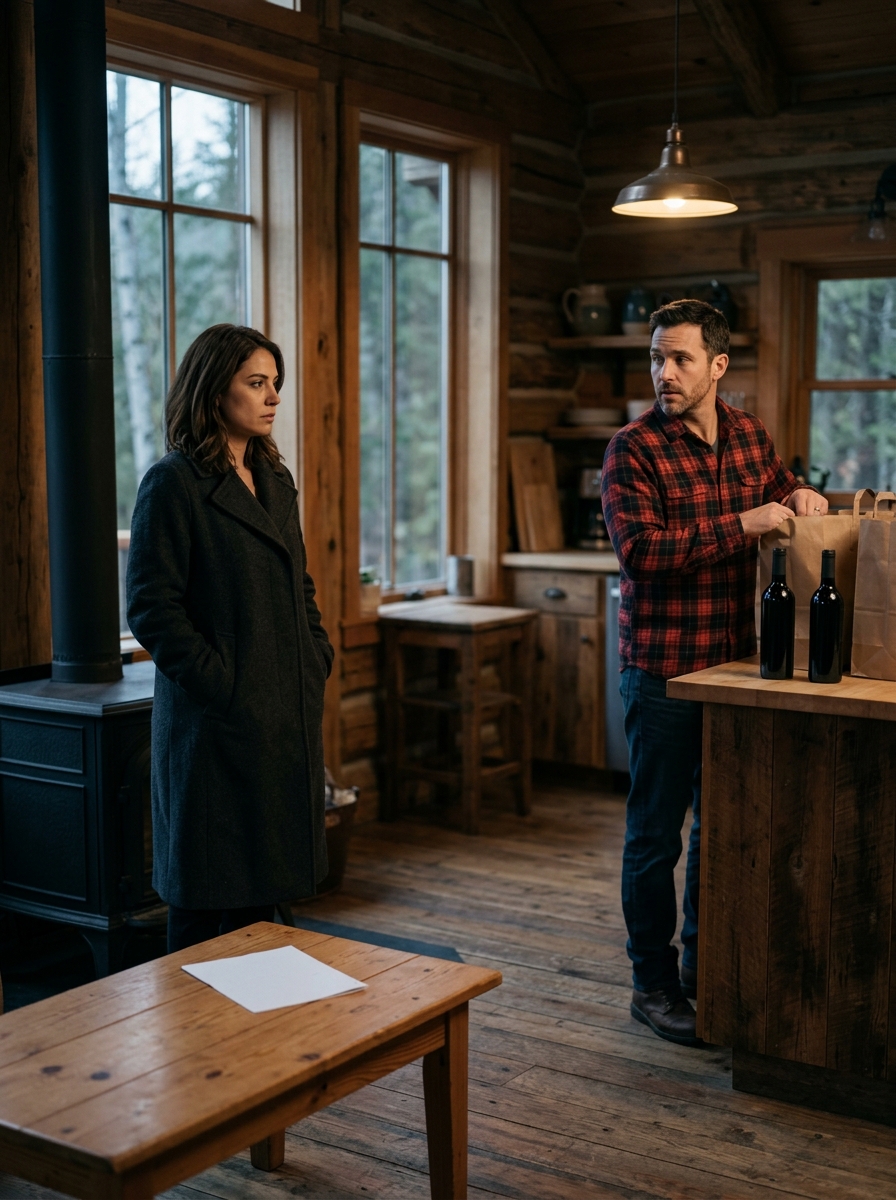
When Kara and I drove four hours into the mountains to save our sex life, she made me promise not to start a fight just to make the weekend feel like one of our “good nights.”
By sunset, she admitted she had been starting those fights herself.
She stood beside the cold woodstove with her coat still on while I unpacked groceries, two bottles of wine, and the hopeful stupidity of a man who thought a different view might make him different.
The cabin belonged to a retired couple named Helen and Mark, who had left instructions in a laminated folder: use the blue towels, keep the porch door latched, and never burn pine in the stove. There was a stream behind the house and a stack of split wood under an awning. The nearest town was twenty-five minutes away, provided the mountain road stayed clear.
There were no neighbors close enough to hear us.
There was no cell service.
There was one bedroom.
Kara had chosen it because those facts sounded romantic when she booked the place.
Now they sounded like witnesses.
She took a folded paper from her bag and placed it on the table between us.
“What’s that?” I asked.
“A sublease.”
I unfolded it. The studio was above a bakery in town. Furnished. One month, beginning Monday.
“You found a place?”
“I signed for it Tuesday.”
I looked at her, waiting for the explanation that would make the paper less real.
She didn’t give me one.
I was forty-four years old. Kara was forty-two. We had been married eleven years and together for fifteen. We had no children, no current crisis, no obvious villain. Our jobs were stable. Our house had two bathrooms and a mortgage we paid on time. From the outside, we were the sort of couple other people assumed had figured out the difficult parts.
But we had not had sex in seventeen weeks.
Not once.
We had kissed. We had slept beside each other. I had rubbed her shoulders after a long day of teaching pottery classes, and she had tucked her feet beneath my legs on the sofa while we watched a documentary neither of us remembered. We had touchedeach other in ways that had become almost bureaucratic: a hand on the small of the back while one of us passed behind the other, a kiss before leaving for work, her fingers finding mine under a blanket when the movie got sad.
The gestures were affectionate.
They were also carefully limited.
Neither of us wanted to be the person who turned a goodnight kiss into a question.
Kara watched me read the first page of the lease.
“You can stop looking at it like it’s a restraining order,” she said.
“Are you leaving me?”
“I’m leaving the house.”
“That’s not what I asked.”
“No.” She folded her arms. “It isn’t.”
The room seemed to contract around us. Outside, the last of the daylight drained from the trees. The windows reflected our shapes back at us, two dark figures standing in a room designed for people who had come there to be happy.
“Did you sign it?” I asked.
“Yes.”
“For how long?”
“One month.”
“Just one?”
“I wanted to be honest about what I could commit to.”
I laughed once, though nothing was funny. “You can commit to renting a place, but not to staying married?”
“I can commit to paying rent. That’s a different skill.”
The old version of me would have heard that as an attack and reached for a defense. I would have told her she was being cruel. Then she would have apologized for her tone, and I would have apologized for making her angry, and within an hour we would have arrived at the familiar, exhausted tenderness that had carried us through nearly a year of not knowing how to be married.
Instead, I looked again at the lease.
The studio was above a bakery in a town called Bellwether. It had a kitchenette, a private entrance, and a month-to-month option after the first thirty days.
“You’ve been planning this for a while.”
“I started looking three weeks ago.”
“While we were talking about this trip?”
“Especially while we were talking about this trip.”
The answer hurt more than I expected. I had imagined the cabin as a last shared effort. She had imagined it as a place to find out whether she needed to leave.
“Did you bring me here to break up with me?”
“No.”
“Then why bring me?”
Kara looked toward the cold woodstove. “Because I wanted one weekend where you couldn’t leave the room every time I said something uncomfortable.”
“I don’t leave the room.”
“You become busy in it.”
That was accurate enough to make me angry.
“I booked the cabin,” I said. “I made reservations. I bought the food. I drove us four hours into the mountains. How exactly am I avoiding you?”
“You’re doing it very efficiently.”
The silence after that was not dramatic. It was worse. It was ordinary.
The refrigerator clicked on. A log shifted in the woodstove’s empty grate. Somewhere beneath the porch, water moved over stones.
Kara picked up her bag.
“Where are you going?”
“To unpack.”
“There’s nowhere else to go.”
“That’s the point.”
She carried her bag into the bedroom and closed the door.
I stood with the lease in my hand until the paper softened at the folds.
***
I built the fire badly.
The pine logs smoked, then caught all at once, sending sparks up the chimney. The cabin filled with a sharp, green smell that reminded me of Christmas trees left too long in stands.
Kara emerged in a sweater and socks. She had changed out of the clothes she’d worn in the car, which made the evening feel more intimate than anything else could have.
“You’re not supposed to burn pine,” she said.
“I know.”
“The instructions say not to.”
“I know.”
She took the poker from me and shifted the logs with a competence I found irritating.
“You’re going to choke us out.”
“Then you can put that on the list of reasons to move out.”
She glanced at me. “I’m not trying to punish you.”
“I’m aware.”
“No, you aren’t.”
I set the poker down. “What am I supposed to be aware of?”
“That I’m not moving into the studio to make you chase me.”
“Then what are you moving for?”
“To find out what I feel when you aren’t standing in front of me asking me to stay.”
I looked toward the windows.
She sighed. “See? You’re gone again.”
“I’m right here.”
“You’re looking at the trees like they have a better answer.”
“I don’t know what answer you want.”
“I don’t want an answer. I want you to be with me while you don’t have one.”
I had no idea how to do that.
At home, a conversation like this would have ended with one of us finding a task. I would wash dishes. Kara would sort mail. One of us would ask whether the other wanted tea. We had built an entire marriage out of small exits.
Here, the cabin offered us nowhere to go.