After Her Design Firm Collapsed, She Couldn’t Want Him—So They Had to Stop Using Desire as Proof
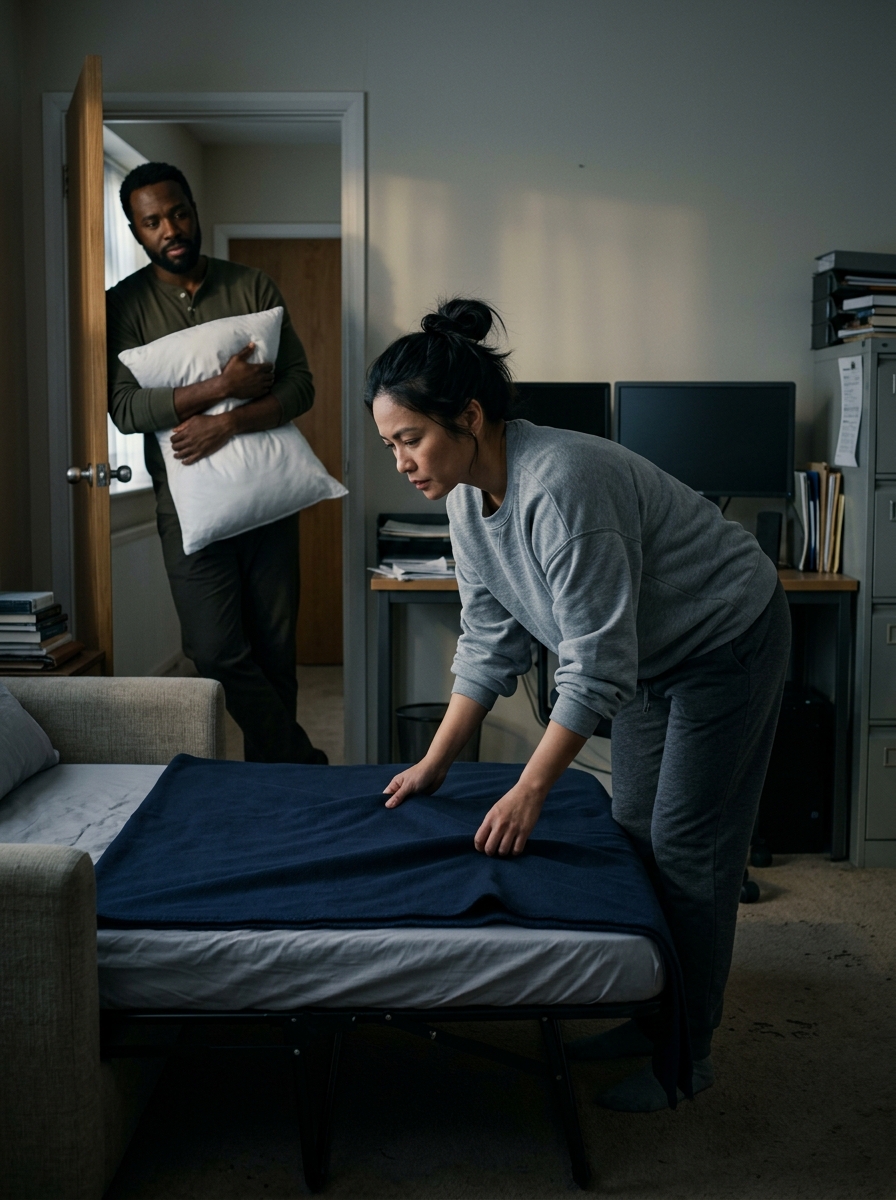
By the time Seth carried his pillow into the small office, Maren had already unfolded the sofa bed.
The office was really a room with a desk, two metal filing cabinets, and a window that faced the brick wall of the building next door. Seth had always complained that the room made him feel like a clerk in a basement, even though they lived on the fourth floor.
Now he stood in the doorway holding the pillow against his chest.
“Do you want the fan?” he asked.
“No.”
“Extra blanket?”
“I’m okay.”
He nodded, as if she had given him useful information. As if they were organizing a trip instead of dividing a home into territories.
At the kitchen table, Maren took the back of a grocery receipt and wrote down the rules.
Seth watched her. “You’re making a list.”
“If I don’t, we’ll make up new rules every time one of us gets scared.”
“That sounds romantic.”
She looked at him.
“Sorry,” he said. “That was cheap.”
“Yes.”
The word sat between them. A small, clean thing. Not a punishment. Not forgiveness.
Maren wrote:
**No initiating physical intimacy without asking.**
Seth added, “Including kisses?”
“If we don’t know what we’re asking for, then yes.”
He stared at the receipt. “What if I want to hug you?”
“Ask.”
“What if you say yes and then change your mind?”
“I can change my mind.”
“What if I get hurt?”
“You probably will.”
He leaned back. His face looked older than it had at dinner, the exhaustion around his eyes more visible now that neither of them was pretending to be occupied.
Maren put down the pen.
“I’m not saying your feelings don’t matter,” she said. “I’m saying they can’t become a bill I pay with my body.”
Seth looked toward the bedroom. “And mine can’t become a bill you pay by letting me stay?”
She had no answer that didn’t sound like another version of yes.
They added a weekly conversation on Sunday evenings. Thirty minutes. No asking whether Maren had started wanting sex again. No interpreting a hug as progress. No pretending the absence of desire was a temporary weather pattern if neither of them knew that was true.
When they finished, Seth folded the receipt in half and tucked it under the salt shaker.
Then he went to the office.
Maren lay alone in the bedroom, listening to him drag the sofa bed open. Springs complained through the wall. A cabinet door shut. Water ran briefly in the bathroom.
For six years, she had known Seth by the sounds he made without thinking: the soft grunt when he lifted a laundry basket, the impatient sigh when he read an email, the small laugh he made when he was trying not to laugh. Now every noise seemed to belong to someone who had moved a few inches out of reach.
She waited for relief.
It came.
That was the worst part.
***
Maren had not always been difficult to reach.
In the early years of their relationship, she had possessed a kind of reckless attention. She noticed everything: a change in Seth’s posture, a new shirt, the way he grew quiet when someone else spoke over him. She could make him feel selected in a crowded room.
Seth once told her that being loved by her felt like being brought into focus.
Maren had laughed and said, “That’s because you’re blurry.”
“See?” he’d said. “You insult me beautifully.”
They met at a neighborhood meeting about a vacant lot. Seth worked in payroll for the county hospital. Maren was still a project manager at a large design firm and had come to argue that the lot needed shade, seating, and a public restroom instead of another locked pavilion.
Seth had not understood half of what she said. He remembered her hands moving over the site plan, rearranging the future with absolute confidence.
Afterward, he followed her to a coffee shop.
“You know,” he said, “most people don’t get this passionate about benches.”
“Most people have never sat on a badly designed bench.”
He stayed for three hours.
By their second year, Maren had started her own studio. She called it Lowline because she liked the idea of working close to the ground, where a room had to serve the people actually inside it. She designed restaurants, small hotels, clinics, and occasionally houses for clients who wanted to be told what their homes were missing.
Seth teased her about becoming “the dictator of light fixtures.”
She teased him about knowing everyone’s paycheck but not his own bank balance.
They were not wealthy, but they had been comfortable. They had a modest apartment, a shared emergency fund, and enough room in the budget for a long weekend away once or twice a year. Maren paid for more when her studio was doing well. Seth paid for more when it wasn’t. They had never kept a strict ledger.
That changed when the hotel project failed.
The developer had hired Lowline to redesign twelve floors of a converted factory. Maren hired two additional designers and a project coordinator. She paid them before the developer paid her because that was what responsible owners did, or what she had been taught responsible owners did.
Then the developer delayed the first invoice.
Then the second.
The project manager stopped returning calls. The developer blamed financing. Financing blamed the market. Everyone continued to speak in calm, professional language while Maren moved money from one account to another and watched the balance fall.
She borrowed against the business line of credit. When that disappeared, she used a personal card. She began answering emails at four in the morning. She skipped meals, then ate standing over the sink. Her shoulders hardened into a permanent brace.
Seth tried to intervene.
“We can pause the studio,” he said one night.
“It’s not a television show.”
“I’m saying we can look at the numbers.”
“I am looking at the numbers.”
“You’re looking at them until they become different.”
She had snapped at him so sharply that he went silent.
Two weeks later, she laid off the staff over a video call because she couldn’t afford to pay for the train tickets to bring them into the office. She apologized to each person individually. One of them cried. One got angry. One said she had known for months that the company was dying.
Afterward, Maren sat in the empty studio and stared at the drafting table she had bought with her first profitable year.
She couldn’t remember driving home.
She remembered Seth opening the door.
She remembered his face when he saw hers.
She remembered saying, “Don’t ask me anything.”
He didn’t.
He made tea. He called the landlord. He moved money from their savings to cover the last payment on the business line. He handled phone calls with the accountant while Maren sat on the floor beside the sofa, unable to make herself stand.
She loved him for doing it.
She also began to feel that every kindness had acquired a shadow price.
***
The first time Seth asked before touching her, it was three weeks after the studio closed.