Sadie Hid Behind the Fence—Then Pixie Found What St. Catherine’s Erased
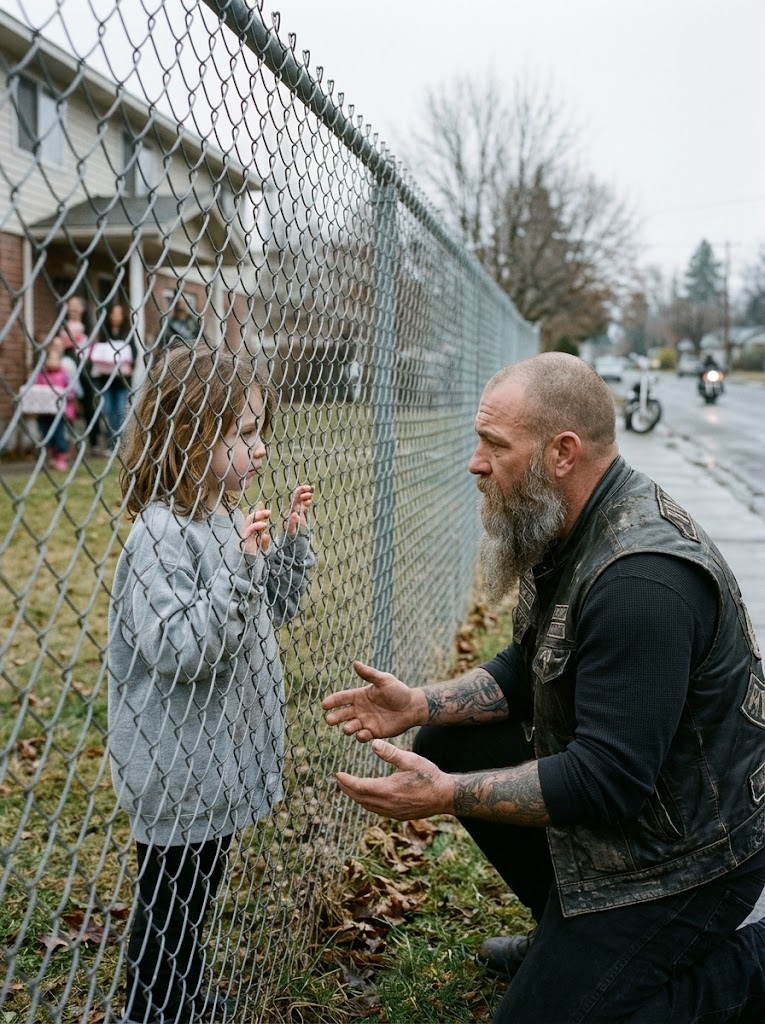
At 1:47 on a freezing Sunday afternoon in December, six-year-old Sadie stood alone beside the side fence of St. Catherine’s Children’s Home while thirty Harleys thundered past the front gate.
Every other child was pressed against the chain link.
There were forty-three of them, bundled in donated coats and mismatched gloves, waving signs they had colored in red and green crayon. They had been waiting since eleven. They screamed whenever a motorcycle appeared at the end of Boone Avenue.
“Over here!”
“Look at me!”
“Please, this way!”
They knew the routine. The Spokane Valley Riders MC had been making its Christmas Toy Run for sixteen years. The bikers would slow their formation in front of St. Catherine’s, and members would toss wrapped presents over the fence. The children would scramble after them.
Then the engines would roar away.
That year, I was standing near the side gate with my clipboard, counting heads, when I saw Sadie.
She wore a faded gray sweatshirt with sleeves too long for her arms. Her hands were flat against the fence. Her pale face was completely still.
She wasn’t crying.
She wasn’t watching the motorcycles with excitement or fear.
She was watching them like someone waiting for a car accident.
The last biker in the formation noticed her.
He turned his head as he passed. Even from across Boone Avenue, I saw the exact moment her eyes met his.
He pulled out of line.
His Road King drifted to the curb. He killed the engine, lowered the kickstand, and took off his helmet.
The other twenty-nine bikes kept going. Their engines faded toward Hamilton, leaving a strange, ringing silence behind them.
The biker crossed the street.
He was enormous. Six feet three, at least two hundred forty pounds, with a shaved head, a long salt-and-pepper goatee, and tattooed arms disappearing beneath a worn black leather cut. The patches on his back read SPOKANE VALLEY RIDERS MC. Above his pocket, in stitched white letters, was his road name.
PIXIE.
He crouched on the grass so his eyes were level with Sadie’s.
“Sweetheart,” he said gently, “why ain’t you up at the front?”
Sadie looked at me first.
That was what made my stomach tighten.
Not at the director. Not at the other children.
At me.
Then she looked back through the fence at the biker.
“Because if they see me,” she whispered, “they’ll know I told.”
Pixie’s face changed.
“What did you tell, sweetheart?”
Sadie pressed her lips together.
I walked toward them, but she flinched so sharply that I stopped.
The flinch hurt worse than any accusation.
I had worked at St. Catherine’s for four years. I knew every child’s favorite cereal, every nightmare, every allergy, every lie they told to avoid bedtime. I knew Sadie had been removed from a home in northern Idaho after both parents died of overdoses within seven weeks of each other. I knew her grandmother had refused placement, saying there was “too much of her father in her face.”
I knew she had been returned by three foster families for attachment difficulties.
What I didn’t know was that she had learned to hide from us.
Pixie kept his voice low.
“Who’ll know?”
“The lady with the shiny shoes,” Sadie said. “She told me not to talk to the police. She said if I talked, they’d send me someplace worse.”
Behind us, the children began shouting. A few staff members had noticed Pixie standing at the side fence. The director, Marlene Voss, came hurrying across the yard in her camel-colored coat.
Marlene was fifty-eight, polished, soft-spoken, and beloved by the St. Catherine’s board. She had run the home for eleven years. Donors called her a saint.
She stopped several feet away.
“Sadie,” she said, smiling too brightly. “Why don’t you come help your friends with the presents?”
Sadie moved closer to the fence.
Pixie rose slowly.
He did not threaten Marlene. He did not even raise his voice.
But something in his size and stillness made her stop.
“What did she tell the police?” he asked.
Marlene’s smile vanished.
“I’m sorry?”
“She said she told the police something.”
“This is an internal matter,” Marlene said. “You need to return to your group.”
Pixie looked at me.
I had a choice. I could take Sadie by the hand, bring her inside, and let the organization handle it quietly. Or I could admit that a child in our care was afraid of the people assigned to protect her.
I set my clipboard down.
“Sadie,” I said, “you can tell us here. No one is going to punish you.”
Her eyes filled, but she still didn’t cry.
“They put the presents in the closet,” she said.
Marlene’s expression hardened.
“What presents?”
“The ones from the men. They don’t give them to us.”
She pointed toward the administration building.
“They take the boxes upstairs.”
Marlene gave a short, humorless laugh.
“Children misunderstand things. The donations are sorted and distributed appropriately.”
“Then why are you scared?” Pixie asked.
Sadie stared at Marlene’s shoes.
“Because Mrs. Voss said she’d move me to the basement room if I talked.”
There was no basement room at St. Catherine’s.
I knew that.
So did Marlene.
For one second, something flashed across her face—not confusion, not outrage.
Calculation.
Pixie saw it too.
He reached through the fence, but stopped before touching Sadie.
“Can I come inside?” he asked her.
Sadie nodded.
Marlene stepped forward. “Absolutely not.”
That was when I understood the danger wasn’t only in Sadie’s words.
It was in Marlene’s certainty that she could still control the room.
The next morning, I called my supervisor, but Marlene got there first.
She told the board that I had “overreacted to a confused child’s fantasy.” She said Pixie had trespassed, frightened the residents, and encouraged Sadie to make allegations against the home. By noon, I was placed on administrative leave pending an investigation.
My access badge stopped working before I left the building.
Marlene stood beside the reception desk as I emptied my locker.
“You’ve always been too emotionally involved,” she said.
I looked at her.
“Where are the presents?”
“Excuse me?”
“The Toy Run presents.”
“They were distributed.”
“Sadie says they weren’t.”
Marlene leaned closer. Her perfume smelled like roses and rubbing alcohol.
“You should be careful,” she whispered. “People who create trouble for children’s homes don’t usually get hired elsewhere.”
I went home shaking.
At six that evening, someone knocked on my apartment door.
Pixie stood in the hallway with two other men from the Spokane Valley Riders. One was a broad, gray-haired man named Dutch. The other, younger and quiet, was called Mercy.
Pixie held a paper grocery bag.
“I brought you coffee,” he said.
“I’m suspended.”
“I know.”
“Did Marlene call you?”
“She called everybody. Told us you manipulated Sadie.”
“And did you believe her?”
“No.”
He handed me the bag. Inside was coffee, a ham sandwich, and a small digital recorder.
“I’m not asking you to do anything illegal,” he said. “But Sadie said something else before we left.”
“What?”
“She said the presents weren’t the only things in the closet.”
I stared at him.
Pixie glanced at my apartment door.