My Sister Entered My ER—Her Hidden Tablet Exposed Our Parents’ Choice
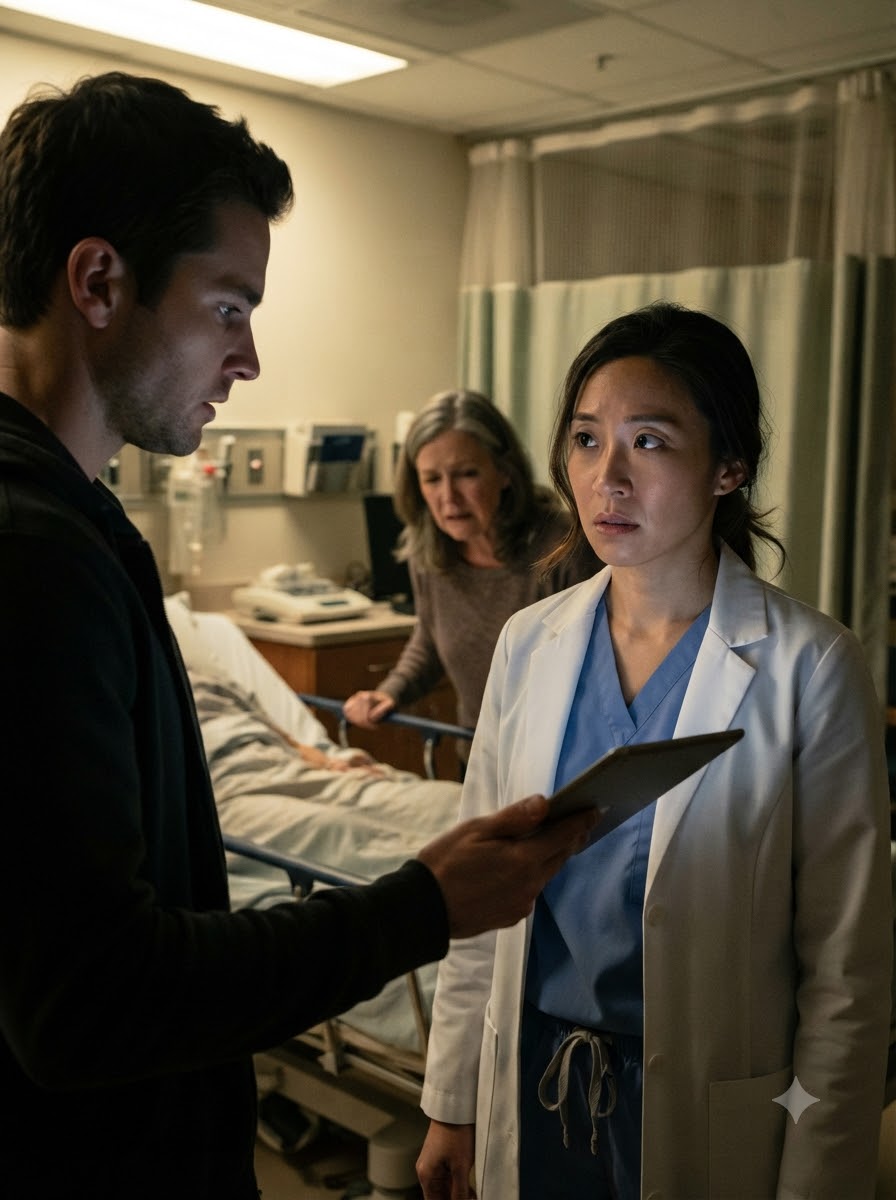
The first thing my mother said when she recognized me in the emergency room was not my name.
It was, “Don’t let her die.”
Five years after she returned my letters unopened, Diane Wulette stood six feet away from me with blood on her sweater, begging me to save the daughter she had chosen over me.
Behind her, my father stopped shouting for a doctor.
His gaze dropped to the name embroidered on my white coat.
IRENE WULETTE, MD
TRAUMA SURGERY
Jerry Wulette looked as if the floor had shifted beneath him.
“You’re a doctor,” he whispered.
There was no time to answer.
My sister Monica lay on the stretcher between us, unconscious and bleeding internally after her car had crossed the median on an icy stretch of I-84. Her blood pressure was collapsing. One pupil was sluggish. Her left leg was twisted beneath a vacuum splint.
I had imagined seeing my family again in a hundred different ways.
In some versions, they apologized.
In others, I walked past them without a word.
I had never imagined meeting them under fluorescent lights while a nurse cut Monica’s clothes away and my mother sobbed into the hands that had once sealed my letters and sent them back.
“Dr. Wulette?” the resident beside me prompted.
Training took over.
I assessed Monica’s airway, called for blood, ordered scans and paged neurosurgery. When the ultrasound showed blood collecting in her abdomen, I summoned the attending surgeon.
Then I stepped back.
“She’s my sister,” I said.
The room went briefly still.
Dr. Adrian Patel understood immediately. He took command while I removed my gloves.
My parents stared at me through the glass as the team rushed Monica toward surgery.
Dad moved first.
“Irene, wait.”
I kept walking until I reached the consultation room. My hands were steady, but my lungs felt too small.
My husband, Daniel, arrived twenty minutes later. He was an emergency medicine physician at another hospital, and I had texted him only four words: Monica is my trauma patient.
He found me sitting alone.
“You don’t owe them anything,” he said.
“I know.”
But knowing and feeling are different systems in the body. One is clean and rational. The other bleeds wherever it wants.
Monica survived the first operation. Dr. Patel removed her ruptured spleen and repaired a torn liver vessel. Neurosurgery placed a monitor for swelling in her brain. Her condition remained critical, but she was alive.
My parents waited through it all.
At dawn, I entered the consultation room with Dr. Patel. He explained Monica’s injuries and prognosis. Mom clutched a paper cup between both hands.
When he finished, she looked at me.
“You saved her.”
“The team saved her.”
“But you were here.”
“Yes.”
Dad’s face had gone gray. “Monica told us you left school.”
I felt Daniel’s hand touch the center of my back.
“I know what she told you.”
“She had messages,” Mom said quickly. “She showed us messages where you said you couldn’t handle it. She said you were drinking and lying about a sick roommate.”
“My roommate was named Sarah Mitchell. She died of pancreatic cancer on December nineteenth, five years ago. I took one approved semester of caregiver leave. I returned in January.”
Neither of them spoke.
“I sent you the approval letter,” I continued. “I sent the dean’s contact information. I sent Sarah’s obituary.”
Mom’s mouth trembled.
“I never saw those.”
“You wrote ‘Return to Sender’ on the envelope.”
Her cup collapsed in her grip.
“I did that because Monica said you were trying to manipulate us.”
There it was. Not an apology. An explanation designed to make their cruelty sound reasonable.
Dad leaned forward. “Why didn’t you come home and prove it?”
“I was caring for a dying woman in Oregon. Then I was burying her. I called forty-three times. I emailed both of you. I sent certified mail. You blocked me.”
“We thought—”
“You chose not to think.”
The door opened before he could answer.
A state trooper entered carrying a clear evidence bag.
“I’m looking for the next of kin of Monica Wulette.”
Dad stood. “We’re her parents.”
The trooper introduced himself as Trooper Alvarez. Monica’s car had been alone when it spun across the median. No other vehicle appeared to be involved. He needed information about medication, alcohol use and where she had been traveling from.
He placed the evidence bag on the table.
Inside were Monica’s cracked phone, wallet, keys and a small black flash drive.
My mother pointed at the drive.
“That isn’t hers.”
Dad frowned. “Yes, it is. It has the old plant logo.”
The logo belonged to the manufacturing company Dad had managed before retiring. He used to bring those drives home by the handful.
Trooper Alvarez said the items had been scattered across the passenger-side floor. The phone would remain evidence until investigators determined whether distracted driving had contributed to the crash.
As he turned to leave, the phone lit up inside the bag.
The screen was cracked, but the notification was readable.
ARCHIVE UPLOAD FAILED: IRENE FILES
All four of us saw it.
Dad’s chair scraped backward.
“What Irene files?”
I felt something cold move through me.
Monica had spent years insisting I was a failure. Why would she still have a file named after me?
The trooper looked from my parents to me. “Is there a reason this might be relevant?”
“I don’t know,” I said. “But my sister impersonated me five years ago. Or I believe she did.”
That was the first time I had said it so directly.
Until then, I had only known Monica had lied. I had assumed the messages she showed our parents were invented screenshots—easy enough to create.
The drive suggested something more deliberate.
Trooper Alvarez documented what we told him. Because Monica was unconscious, he said the contents could not simply be searched by family. But if there was evidence of a crime, he could refer it to the digital forensics unit.
Dad rubbed his forehead.
“There was money,” he said.
Mom snapped her head toward him. “Jerry.”
“What money?”
He stared at the evidence bag instead of at me.
“After Monica told us you’d dropped out, she said you owed the school money. She said they were threatening collections and that you were too ashamed to speak to us.”
My skin prickled.
“How much?”
“First it was eighteen thousand. Then more.”
“How much altogether?”
Mom began crying again.
Dad answered. “Eighty-four thousand dollars.”
For a moment, even the hospital sounds beyond the door seemed to disappear.
They had cut me off while quietly paying Monica to fix the disaster she claimed I had created.
“Where did you send it?”
“To an account Monica said belonged to a student debt service.”
“Did you verify the company?”
“She had invoices.”
Daniel spoke for the first time. “Do you still have them?”
Dad nodded slowly.
That afternoon, Monica remained sedated while my parents drove home to retrieve the paperwork. I did not go with them. I spent the hours checking on patients and trying not to imagine my sister constructing an entire counterfeit version of my life.
They returned with a banker’s box.