I Found Sophie Locked in a Freezing Cottage—Then the Hidden Tablet Played
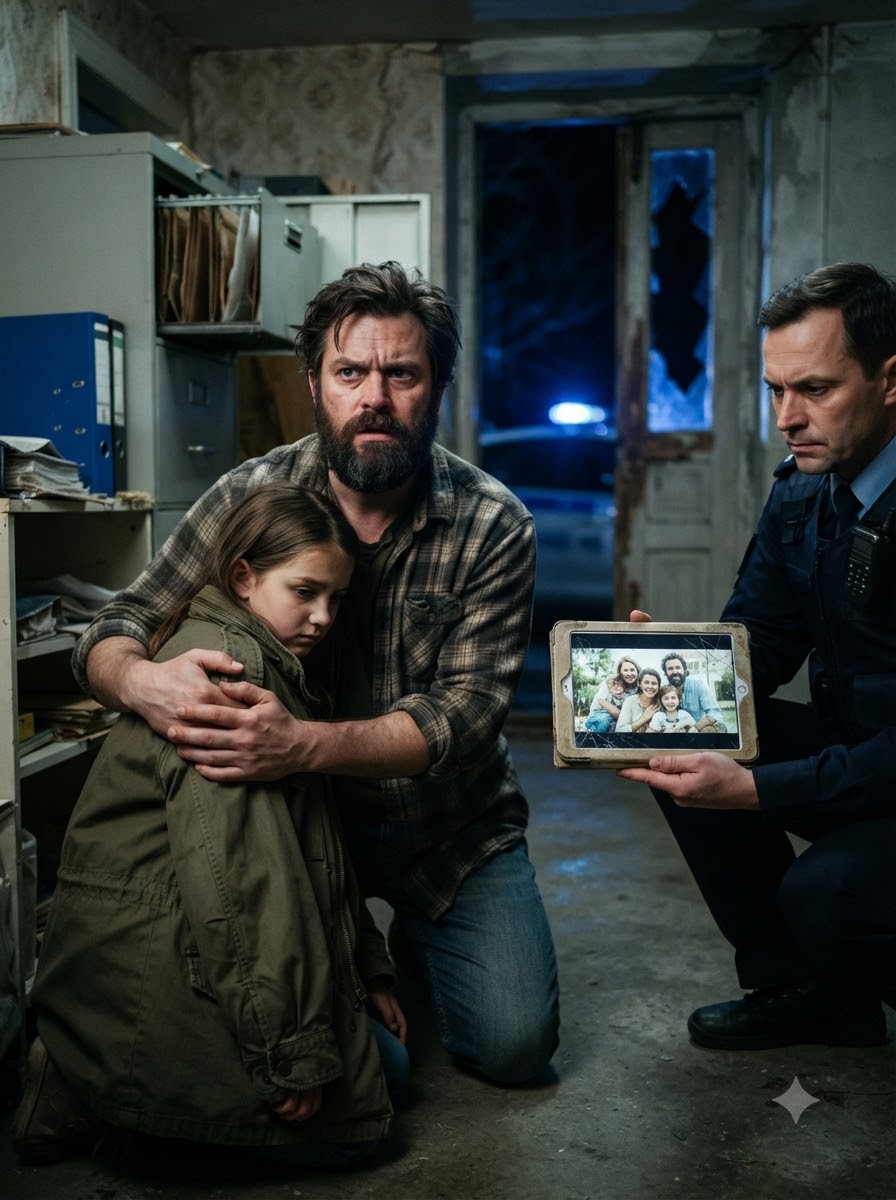
The padlock broke on the third strike.
It skittered across the frozen ground as I dragged open the guest-cottage door and shouted my daughter’s name.
“Sophie?”
A small shape moved in the darkness.
My eight-year-old daughter sat curled beneath a thin blanket, wearing pink pajamas and one sock. Her lips looked pale. Her whole body shook so violently that her teeth clicked together.
“Dad?”
She said it as if she didn’t trust her own eyes.
Then she crawled toward me.
I dropped the crowbar and lifted her into my arms. She clung to my neck, sobbing against my uniform jacket.
“I knew you’d come,” she whispered. “I kept saying you would.”
The cottage was barely more than a storage shed. There was no heat, no food, and no working light. The temperature outside was four degrees Celsius and falling. Cold air slipped through gaps around the windows.
“How long have you been here?”
“Since breakfast.”
It was almost midnight.
I pulled off my jacket, wrapped it around her, and carried her toward my rental car. Behind us, Evelyn’s large brick house stood dark and silent.
“Where’s your grandmother?”
“She went to Denver. She said she’d come back tomorrow.”
My mother-in-law had locked a child in an unheated building and driven away.
I buckled Sophie into the back seat and turned the heater on full. I had just reached for my phone when she grabbed my wrist.
“Dad, don’t look in the filing cabinet.”
I stared at her.
“What filing cabinet?”
“The gray one in the cottage.”
Her eyes filled with fresh tears.
“Grandmother said if anybody looked inside, you’d go away forever.”
Three hours earlier, I had walked into my own house expecting joy.
My deployment had ended three weeks early. I had imagined Sophie racing down the hallway and throwing herself into my arms. Instead, I found a silent living room and my wife standing in the kitchen with a wineglass in her hand.
Laura’s face had drained of color when she saw me.
“You’re home.”
“That’s generally how surprises work.”
I smiled then. I even opened my arms.
She hugged me stiffly.
When I asked where Sophie was, she answered too quickly.
“At Mom’s. They’re having a sleepover.”
Evelyn had never been Sophie’s idea of fun. She corrected posture at the dinner table, called tears manipulative, and believed children should obey adults without question. I had repeatedly asked Laura not to leave Sophie alone with her.
But Laura claimed things had improved.
Then her phone began buzzing.
Each time, she turned the screen away.
Finally, I said I was driving to Aurora.
Laura nearly dropped her glass.
“It’s late, Daniel.”
“That’s why I want to make sure she’s settled.”
“She’s fine.”
The panic in her voice told me Sophie was anything but fine.
Laura tried to stand between me and the door. When I asked her to call Evelyn, she claimed her phone battery was dying, though it showed seventy-two percent.
I left anyway.
Now Sophie sat shivering in my car while an empty cottage waited behind me.
I called emergency services first. I reported a child found locked in an unheated outbuilding and requested medical help and police.
Then I returned to the cottage.
The gray cabinet stood against the far wall, partly hidden behind boxes of Christmas decorations. Its top drawer was labeled TAX. The second said PROPERTY. The bottom had no label.
It was locked.
The key was taped beneath the desk.
Inside the bottom drawer were six hanging folders.
The first had Sophie’s name on it.
I opened it and found photographs.
Sophie facing a wall.
Sophie kneeling on uncooked rice.
Sophie holding a handwritten sign that read, I LIE FOR ATTENTION.
Dates and times were written on the backs. Some photographs had notes in Evelyn’s sharp handwriting.
Correction successful after 47 minutes.
Food restriction effective.
Isolation produced apology.
I had seen enough combat damage to know how the body responds to danger. Yet nothing prepared me for the clinical neatness of those pages. This was not a single act of cruelty committed in anger.
It was a record.
A program.
I opened another folder.
Inside were copies of emails between Evelyn and Laura.
Laura: Daniel cannot know. He’ll overreact.
Evelyn: He has made the girl weak.
Laura: Just don’t leave marks where school can see.
The words blurred.
I read them again.
Laura had known.
Not merely suspected. Not merely failed to ask questions.
Known.
The first betrayal was what they had done to Sophie.
The second was that my wife had helped hide it.
Sirens approached in the distance, but I kept searching.
A folder marked MEDICAL held forms bearing my forged signature. They authorized Evelyn to seek treatment for Sophie and make educational decisions during my deployment.
One form claimed I was unreachable due to “behavioral instability following military service.”
Another suggested Sophie suffered from a compulsive lying disorder.
She had never been diagnosed with any such condition.
Then I found bank statements.
A joint education account I had created for Sophie had once held just over sixty-eight thousand dollars, much of it saved during years of deployments. The newest statement showed a balance of $412.
Transfers had gone to an LLC called ELC Family Services.
The registered address was Evelyn’s house.
There were also insurance applications on my life.
One listed Laura as the beneficiary. That was expected.
A newer policy listed the LLC.
It carried a forged version of my signature and described Evelyn as trustee for Sophie because Laura had supposedly been declared financially incompetent.
None of it made sense until I found a typed document titled Family Transition Plan.
It laid everything out.
Laura intended to file for divorce two weeks before my scheduled return. She would claim that I suffered violent episodes after deployment. Evelyn’s notes about Sophie were meant to establish that my daughter had become unstable because of fear of me.
The cottage punishments served two purposes: force Sophie to repeat the story, then document her distress as proof.
If Laura obtained temporary custody, Evelyn would control the money they had moved into the LLC. They planned to sell our house, argue that I was unsafe, and restrict me to supervised visits.
At the bottom of the plan, Laura had written one sentence by hand.
Once he’s out, Sophie will adjust.
I photographed every page before touching anything else.
Red and blue lights swept across the cottage walls.
Two Aurora police officers entered with a paramedic behind them. I kept my hands visible and explained exactly what I had found.
Officer Maya Chen listened without interrupting.
Then she put on gloves.
“Do not remove anything from this cabinet,” she said. “We’ll secure it as evidence.”
The paramedic examined Sophie in the ambulance. Her temperature was low, but not yet dangerously so. She was dehydrated and had bruising on both knees consistent with kneeling on a hard surface.
At the hospital, Sophie refused to let go of my hand.
A nurse brought her heated blankets and warm apple juice. A child-welfare investigator named Denise Harper arrived shortly before two in the morning.
Denise spoke softly.
“You’re not in trouble, Sophie. Nobody is angry with you.”