Ernest Left Maria a Torn Pillow—Then She Found Proof His Children Betrayed Them
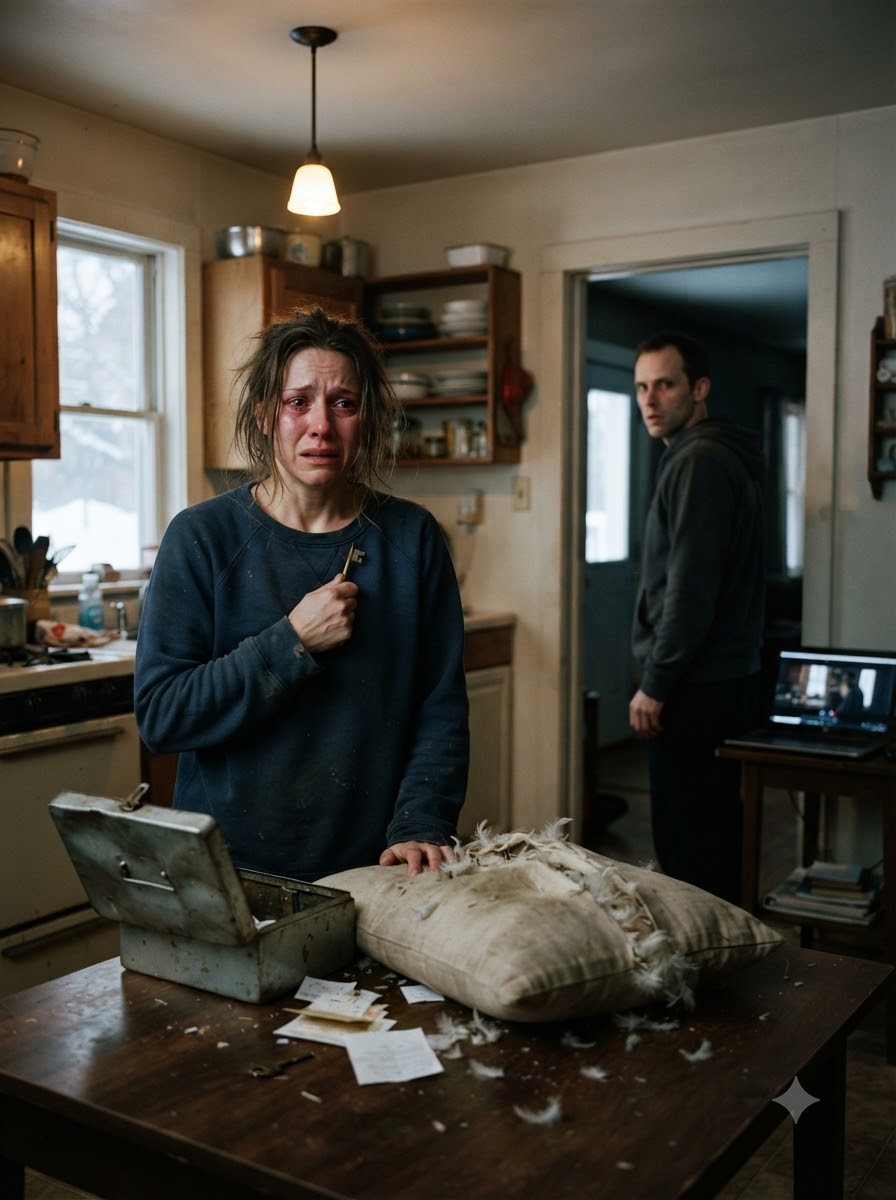
The betrayal began before Ernest’s body was cold.
My husband’s oldest brother, Wade, stood in the bedroom doorway with a trash bag in his hand and said, “Don’t touch anything else.”
I was sitting beside Ernest’s bed, still holding the old man’s lifeless hand. His skin had already begun to lose its warmth. The sheet was pulled to his chest. His mouth was slightly open, as if he had been interrupted in the middle of a sentence.
“What are you talking about?” I asked.
Wade stepped into the room and looked past me at the dresser, the medicine bottles, the framed photograph of Ernest’s late wife.
“I’m talking about the house,” he said. “And the things inside it.”
His sister, Carol, stood behind him, crying loudly enough for the neighbors to hear. Their younger brother, Neil, was on the phone with someone, pacing beside the window.
My husband, Daniel, had not arrived yet. His truck had broken down outside Chicago, or so he had texted me. I had spent twelve years caring for his father mostly alone, but even now, as Ernest lay dead, his children had arrived before Daniel.
Wade reached toward the old pillow behind Ernest’s head.
That was when I took it from him.
“Not that one.”
He frowned. “It’s garbage.”
“No.”
“You want a torn pillow?”
Ernest had pointed to it just before he died. He had summoned all the strength left in his body, lifted one trembling hand, and whispered, “For you, Maria. Only for you.”
Then his breathing had stopped.
I didn’t know why he had given me that pillow. I only knew it was the last thing he had chosen for me.
Carol wiped her face with the back of her hand. “Maria, don’t make this harder than it already is.”
Wade’s eyes narrowed. “We’re cleaning out Dad’s room. You’ve had twelve years to take whatever you wanted.”
The words struck harder than any slap.
I looked at him. “Take whatever I wanted?”
He shrugged. “You know what I mean.”
“No,” I said. “I don’t.”
For twelve years, I had washed Ernest, fed him, changed his clothes, lifted him from bed to wheelchair, and sat beside him when his lungs rattled through the night. I had missed my son Lucas’s school plays because Ernest was feverish. I had spent money on medicine when Daniel’s pay was late. I had learned to sleep lightly so I could hear Ernest call from the hall.
And now Wade was suggesting I had been waiting for Ernest to die so I could rob him.
“He was my father,” Wade said.
“Then you should have visited him while he was alive.”
The room went silent.
Carol stopped crying.
Neil lowered the phone.
Wade’s face hardened. “Careful.”
I hugged the pillow to my chest. “You’re not throwing this away.”
He laughed once, without humor. “Fine. Keep it. It’s the only thing in this house you can prove he gave you.”
That sentence stayed with me.
By nightfall, the house was full of relatives, casseroles, wet coats, and accusations disguised as grief. Daniel finally arrived close to midnight. He embraced me for less than a second before Wade pulled him aside.
I heard their voices in the kitchen.
“She’s already taken the jewelry,” Wade said.
“There isn’t any jewelry,” Daniel replied.
“Then ask her where Dad’s papers are.”
I walked in. “What papers?”
They turned toward me.
Daniel looked exhausted, but not surprised. That frightened me more than Wade’s anger.
“What papers are you talking about?” I asked again.
Wade folded his arms. “Dad told us there was a safe deposit box.”
“I never heard him mention one.”
“Of course not.”
Daniel rubbed his forehead. “Maria, this is not the time.”
“It became the time when your brother accused me of stealing.”
Carol entered behind them. “Nobody is accusing you. We just need to make sure everything is accounted for.”
“Accounted for by whom?”
“By the family,” Wade said.
Ernest had no pension. No retirement account. No life insurance. The only thing anyone had ever said he owned was the farmhouse and the forty acres surrounding it. Even that land had been mortgaged twice during bad harvests.
I had never cared about inheriting it. I assumed it would go to Daniel and his siblings equally.
But the next morning, Wade arrived with a lawyer.
His name was Peter Harlan. He wore a gray overcoat and carried a leather folder. He sat at Ernest’s kitchen table while we were still eating breakfast and announced that Ernest’s most recent will left the farm to his four children.
“Nothing to Maria?” I asked.
Peter glanced down at the document. “There is a provision allowing her to remain in the residence for thirty days after Mr. Hill’s death.”
Thirty days.
After twelve years, I was being granted thirty days in the home where I had nursed him.
Daniel stared at the table. “Dad must have changed it.”
“When?” I asked.
No one answered.
Peter explained that Ernest had signed the will eight months earlier at a small law office in town. Wade, Carol, Neil, and Daniel were named equal beneficiaries. I was not mentioned except in the thirty-day occupancy clause.
The document was clean, formal, and properly witnessed.
Still, something felt wrong.
Ernest’s hands had been too weak to hold a spoon eight months earlier. He had been confused about the day of the week. He had asked me three times in one afternoon whether his wife was coming home.
“How did he sign it?” I asked.
Peter’s expression tightened. “With assistance.”
“Whose assistance?”
“His children were present.”
All four.
I looked at Daniel.
He did not meet my eyes.
That afternoon, Wade began marking furniture with small pieces of blue tape. The dining set. The tractor. Ernest’s tools. The antique clock he had repaired himself. Even the quilts his wife had sewn.
Carol opened drawers and placed items into boxes.
When I protested, Wade said, “You’re making an emotional scene over property that doesn’t belong to you.”
I went into Ernest’s room and shut the door.
The pillow lay on the bed.
Its case was yellowed and torn along one side. Feathers pushed through the opening in clumps. It had been Ernest’s pillow for as long as I knew him. I had offered to replace it several times, but he always refused.
“Your mother made that,” he had told me once.
I had assumed he meant the pillowcase.
That evening, after everyone left, I took it into the kitchen. I set it beneath the light and examined the seam. The fabric smelled of mothballs, old medicine, and the cedar chest in Ernest’s room.
I almost put it in a cupboard.
Then my fingers slipped through the torn opening.
Something hard pressed against my knuckle.
I froze.
The object was small and flat. I pulled it free and found a brass key tied to a strip of blue thread. Beneath it was a plastic sleeve containing a folded piece of paper.
My heart began to pound.
The paper was brittle, but the writing was unmistakable.
Maria—
If you are reading this, I am gone, and they are already asking what I left behind.