He Stopped Initiating Because His Wife Kept Disappearing—Then She Told Him Where She Went
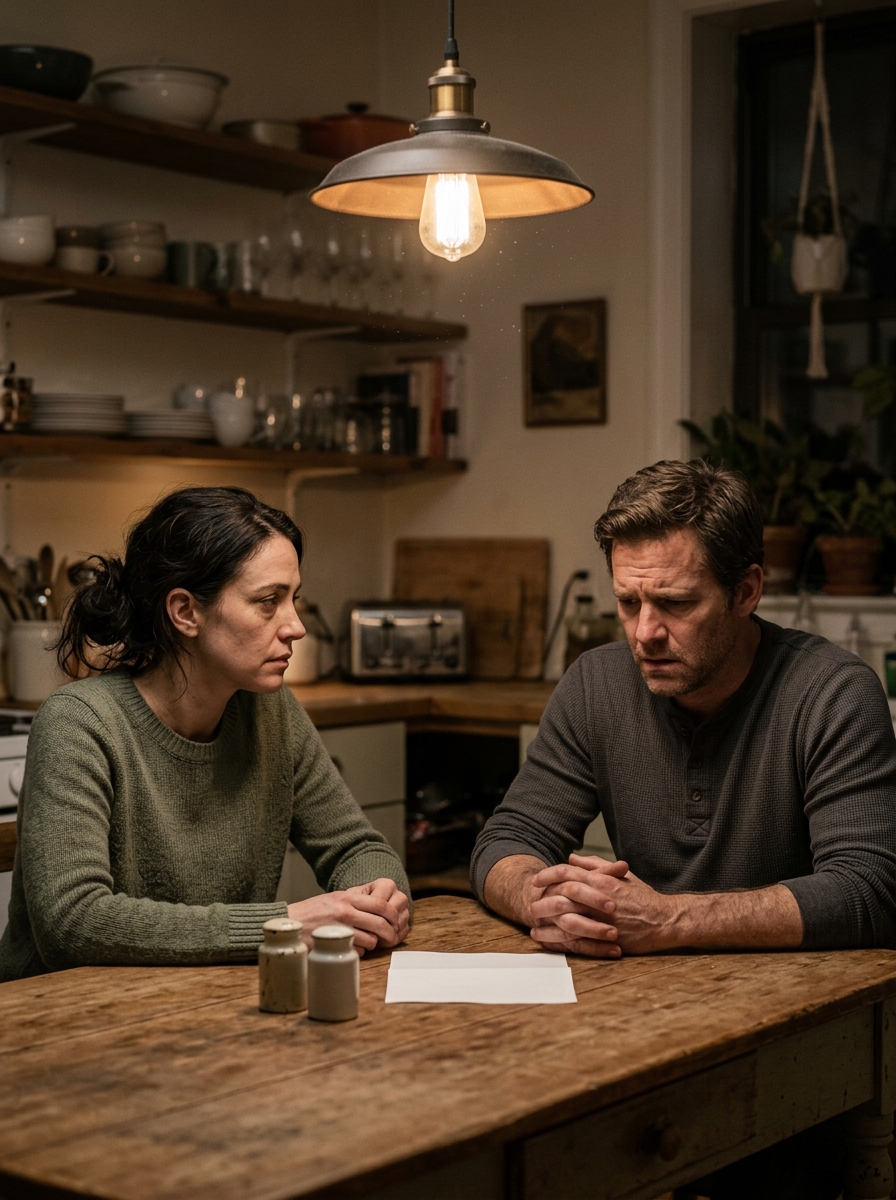
Mara had put the lease between the salt and pepper shakers, as if a furnished studio apartment were an ordinary item to be discussed over leftover soup.
Harlan kept looking at the first page. The address was three blocks from the museum where she worked, above a tailor’s shop on Linden Avenue. The rent was high enough to hurt and low enough to be temporary.
“Thirty days,” she said. “Maybe more. I haven’t signed yet.”
At forty-one, Harlan had spent most of his adult life learning how to repair things without announcing that they were broken. He restored old furniture in a narrow workshop behind their house. He could match a stain across a hundred-year-old tabletop, replace a split tenon, make a drawer glide as if it had never known resistance.
Mara had once told him that this made him feel calm to be around.
Tonight, it made him feel accused.
“You were looking at the ceiling,” he said. “Not at the ceiling, exactly. At the smoke detector. You weren’t blinking much. Your body was there, but it had stopped making choices.”
Mara’s mouth tightened. “That’s a strange thing to say about someone.”
“I know.”
“Did you see it once?”
“No.”
“How many times?”
He looked down at the lease again. “Enough that I should have said something sooner.”
“That is not a number.”
“Four times after November.”
“And before?”
“I noticed it before. I didn’t know what I was noticing.”
Mara picked up her mug, though she had stopped drinking from it. “You initiated before that.”
“Yes.”
“Then you stopped.”
“Yes.”
“And you never told me why.”
“I thought I was being careful.”
She laughed once. There was no humor in it. “You thought silence was careful?”
“I thought if I asked you whether you were okay, you’d say yes because you thought I needed you to say yes.”
“Maybe I would have.”
“That was what I was afraid of.”
“What were you afraid of, Harlan? That I’d lie? Or that I’d tell you the truth?”
He had no answer that did not make him look worse.
Mara looked toward the dark window. Their reflection floated over the glass: two people seated at the same table, angled away from each other like strangers on a train.
“I thought you were tired of me,” she said. “I thought you had finally figured out that I wasn’t the kind of woman you wanted.”
His chest tightened. “That’s not what happened.”
“It’s what the silence said.”
He had been telling himself for almost a year that he had withdrawn out of respect. The cleaner version was that he could not bear to be the person she endured. The uglier version was that he wanted her to notice his withdrawal and come toward him, wanting him clearly enough to erase the doubt.
He had called that hope.
It had been a test.
“I did want you to notice,” he said.
Mara’s gaze came back to him.
“I didn’t want to punish you,” he continued. “But I wanted you to ask why I wasn’t reaching for you anymore. I wanted you to tell me you missed it. I wanted to feel wanted without having to risk asking for that.”
“You made your silence my assignment.”
“Yes.”
“And when I did initiate?”
“I was watching you.”
She flinched.
“I wasn’t judging you,” he said quickly.
“You were studying me.”
“Yes.”
The honesty landed harder than a denial would have.
Mara placed the mug down. “I have spent months thinking every time you touched me, you were wondering whether I was about to disappear.”
“I was wondering.”
“Then why didn’t you stop?”
“I didn’t know how to stop without making you explain yourself in the middle of it.”
“Stopping doesn’t require a dissertation.”
“I know that now.”
“No,” she said. “You know it because you have had eleven months to think about it. I needed you to know it while I was there.”
He absorbed that without defending himself. The kitchen clock clicked once. Somewhere upstairs, a pipe knocked inside the wall.
Mara folded the lease and slid it back toward herself.
“I’m going to sign it tomorrow,” she said.
Harlan looked up. “You’ve decided?”
“I’ve decided I need a room that isn’t waiting for us to solve this.”
“I don’t want you to leave.”
“That’s not the same as knowing how to be with me.”
“Tell me what to do.”
Her expression changed—not softer, exactly, but more tired.
“That sentence makes me want to leave too.”
***
The next morning, Mara went to work and Harlan opened the workshop.
He stood in front of a walnut side table for nearly an hour without touching it. A previous owner had tried to repair one of the legs with construction adhesive. The adhesive had dried pale and brittle around the joint, a hard crust disguising a weak connection.
At noon, Mara texted him.
Can we meet somewhere that isn’t our kitchen?
He suggested the café near the river. She arrived ten minutes late in a long gray coat, her hair pulled back, her museum badge still clipped to her pocket.
“I signed the lease,” she said.
He nodded. “When do you move?”
“Saturday.”
The café was crowded with people working on laptops and talking over one another. It gave them privacy by making privacy impossible.
Harlan wrapped his hands around his coffee. “I keep thinking there must have been a moment where I could have asked the right question.”
“There wasn’t one magic question.”
“What happened, then?”
Mara studied him. “Do you want the long answer, or the answer that lets you apologize?”
“The long answer.”
She looked through the window toward the river. Late winter had stripped the trees bare. The branches made a dark net against the sky.
“When I was twenty-seven, I was with someone named Colin,” she said. “He treated reluctance like an argument. If I said I was tired, he wanted to know why. If I said I didn’t feel like it, he wanted to know what had changed. If I went quiet, he acted relieved, like we had finally reached the part where I stopped making things difficult.”
Harlan said nothing.
“He never hit me,” she continued. “I used to think that detail meant I wasn’t allowed to call the relationship harmful. But he didn’t need to hit me. He could wear me down with questions. He could make a no feel temporary and a pause feel insulting.”
She pressed her thumb against a damp ring on the table.
“Eventually, I learned how to leave without moving. I would picture a hallway. White walls. A door at the end. Nothing in the hallway wanted anything from me.”
Harlan felt his throat tighten. “And you went there with me?”
“Not at first.”
“When did it start?”
“I don’t know. It wasn’t because you were like him.”
“That doesn’t make it better.”
“It isn’t supposed to make you feel better.” Her voice stayed level. “You were kind. You asked if I was okay. You stopped when I said stop. You were not him.”
“But?”
“But my body didn’t always understand the difference between being wanted and being expected to want back.”