I Mourned Sofía for Five Years—Then Mateo’s Phone Exposed the Basement
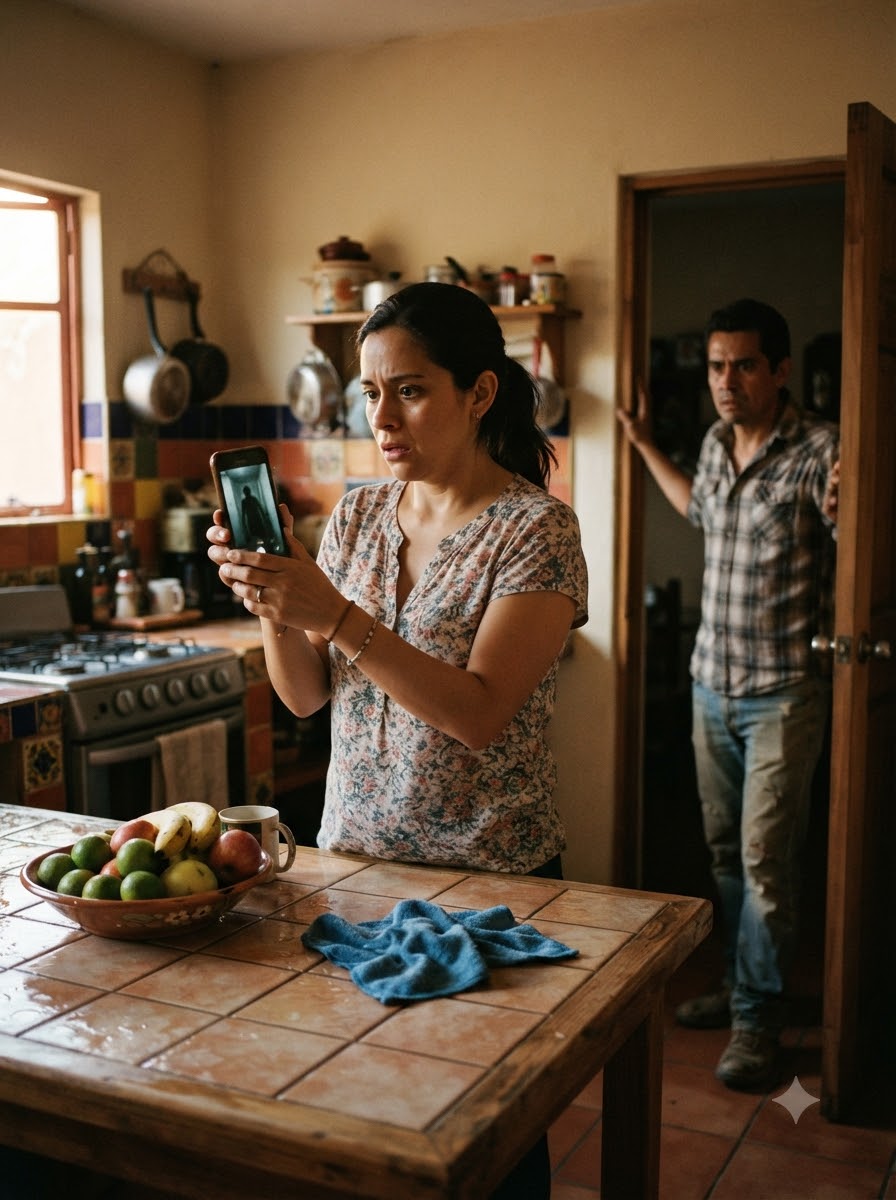
The message was still glowing on Mateo’s phone when his truck returned.
Come over right now, Mateo. Sofía has tried to escape again.
Elena stood frozen beside the kitchen table, one hand gripping the phone, the other pressed against her mouth.
Five years.
For five years, she had worn black every November on the anniversary of her daughter’s death. She had carried flowers to a grave containing a sealed coffin. She had awakened at night hearing Sofía’s childhood voice calling from the next room.
And now Mateo’s mother had written that Sofía had tried to escape.
Again.
The truck door slammed outside.
Elena forced herself to move.
She forwarded the message thread and every photograph she could find to her own phone. Then she slipped Mateo’s device beneath a folded dish towel and hurried into the pantry.
Her pulse hammered as she opened the bottom cupboard and pushed the phone behind a sack of flour.
A fist struck the front door.
“Elena?”
Mateo tried the latch.
“I forgot my phone.”
She picked up the damp cleaning cloth from the floor. By the time she opened the door, her hands were still trembling, but she had lowered her eyes so he would mistake terror for age.
Mateo entered wearing the same polished smile with which he had charmed the priest, the police and half the town.
“Sorry to come back so quickly.”
He glanced toward the table.
The smile vanished.
“My phone was here.”
“I haven’t seen it,” Elena said.
Mateo looked at her.
It was not the gentle expression he used when bringing sweet bread or offering to pay for repairs. It was flat and measuring.
“You were cleaning the table.”
“I’m always cleaning something.”
He searched beneath the chairs and beside the fruit bowl. Then he pressed his lips together.
“Did the screen light up?”
“No.”
The lie tasted like metal.
Mateo stepped closer. “Are you sure?”
Elena made herself meet his gaze. “Why would I lie?”
For several seconds, neither moved.
Then her landline rang.
The sound startled them both.
Elena reached it first. Her sister Rosa’s voice came through, exactly as Elena had hoped when she secretly dialed and disconnected moments earlier.
“Elena? You called?”
“Yes,” Elena said quickly. “I wanted to remind you that I’m coming over.”
There was a pause.
Rosa knew Elena had no plans to visit.
“Of course,” she replied. “I’m waiting.”
Elena looked directly at Mateo. “I’ll be leaving now.”
His eyes drifted toward her handbag.
“I’ll help you look first,” she added. “Perhaps you left your phone in the truck.”
Mateo’s smile returned, but it no longer fooled her.
“Perhaps.”
He walked outside. Elena shut the door, retrieved the phone from the pantry and slid it into the pocket of her apron. She grabbed her handbag and stepped into the street.
Mateo stood beside his truck, watching her.
“I’ll drive you.”
“No need. Rosa’s son is coming.”
At that moment, as if heaven had arranged it, a delivery motorcycle rattled around the corner. Elena waved wildly.
The rider was her neighbor’s grandson, Tomás.
“Take me to Rosa’s house,” she said, climbing on before he could ask why.
Behind them, Mateo shouted her name.
Tomás accelerated.
Elena did not look back.
At Rosa’s house, she locked the door and showed her sister the photographs.
Rosa stared at the screen until her face went gray.
The woman in the concrete room was painfully thin. A purple bruise covered one cheek. Her bare feet were dirty, and an iron ring had been bolted into the wall near the mattress.
Yet beneath the tangled hair, there was no mistaking Sofía’s narrow chin or the crescent-shaped birthmark near her left eye.
“She’s alive,” Elena whispered. “My child is alive.”
Rosa began to cry.
Elena did not.
Grief had drained out of her so suddenly that something harder had filled its place.
They called Commander Valdez, a state police investigator who had grown up on the next street. He arrived in plain clothes with an officer from the anti-kidnapping unit.
Mateo’s phone contained more than messages.
There were sedative schedules, bank transfers and photographs spanning years. Location data placed the device repeatedly at Carmen’s country property outside Tapalpa.
The newest picture had been taken three days earlier.
Valdez warned Elena that they still needed to proceed carefully.
“If they realize you know, they may move her.”
“They may kill her,” Rosa said.
Valdez nodded.
That was why they could not confront Mateo yet.
The police cloned the phone. Then Elena sent Mateo a message from it.
Found it under the cupboard. I’m sorry. Rosa’s grandson is bringing me home.
Mateo replied almost immediately.
Thank God. I’ll pick it up tonight.
Elena returned before sunset. Valdez had placed two officers in an empty house across the street. A tiny recorder was pinned inside Elena’s blouse.
When Mateo arrived, she handed him the phone and apologized.
He examined it for several seconds.
“Did you unlock it?”
“I wouldn’t know how.”
He studied her face.
Then he kissed her forehead.
“You’re like a mother to me.”
Elena nearly struck him.
Instead, she smiled.
The investigation moved through the night.
Police obtained an emergency search authorization after matching the basement photographs to construction records for Carmen’s estate. One detail proved decisive: a cracked green tile visible beside Sofía’s mattress came from a discontinued lot purchased under Carmen’s company name six years earlier.
At dawn, two unmarked vehicles drove toward the property.
Elena was ordered to stay behind.
She refused.
“My daughter has spent five years believing I abandoned her. When that door opens, she will see me.”
Valdez finally allowed her to travel in the second vehicle, provided she remained outside until the building was secured.
Carmen’s estate sat beyond a high stone wall, surrounded by pines and expensive silence. The main house had white arches, carved doors and a private chapel. Carmen often hosted charity lunches there. She had once received an award for helping vulnerable women.
Officers entered through the service gate.
A groundskeeper tried to run. They caught him near the stables.
It was Chucho, Carmen’s driver and caretaker.
He claimed there was no basement.
Then a police dog stopped at a locked storage building behind the chapel.
Inside, shelves of wine concealed a steel door.
Chucho began shouting that no one had permission to enter.
An officer cut the lock.
Beyond it, stone steps descended into darkness.
The smell came first—damp concrete, bleach and human confinement.
At the bottom stood another reinforced door with a small hatch. A plastic cup of water sat outside it beside a bottle of veterinary tranquilizers.
Valdez opened the hatch.
A frightened eye appeared on the other side.
“Sofía?” he called gently. “We are police. Your mother is here.”
There was no response.
Then a weak voice asked, “Which mother?”
The question shattered Elena.
She pushed past the officer guarding the stairs.
“Sofía!”
Inside the room, a chain scraped against the floor.
“Mamá?”
Elena ran down.
When the door opened, Sofía recoiled into the corner, shielding her head with both arms. She wore the same faded shawl from the photographs. Her wrists were raw. Her cheeks were hollow, and several teeth were broken.