My Son’s Blue IV Bag Was Poisoning Him—Until His Mother’s Secret Recording Played
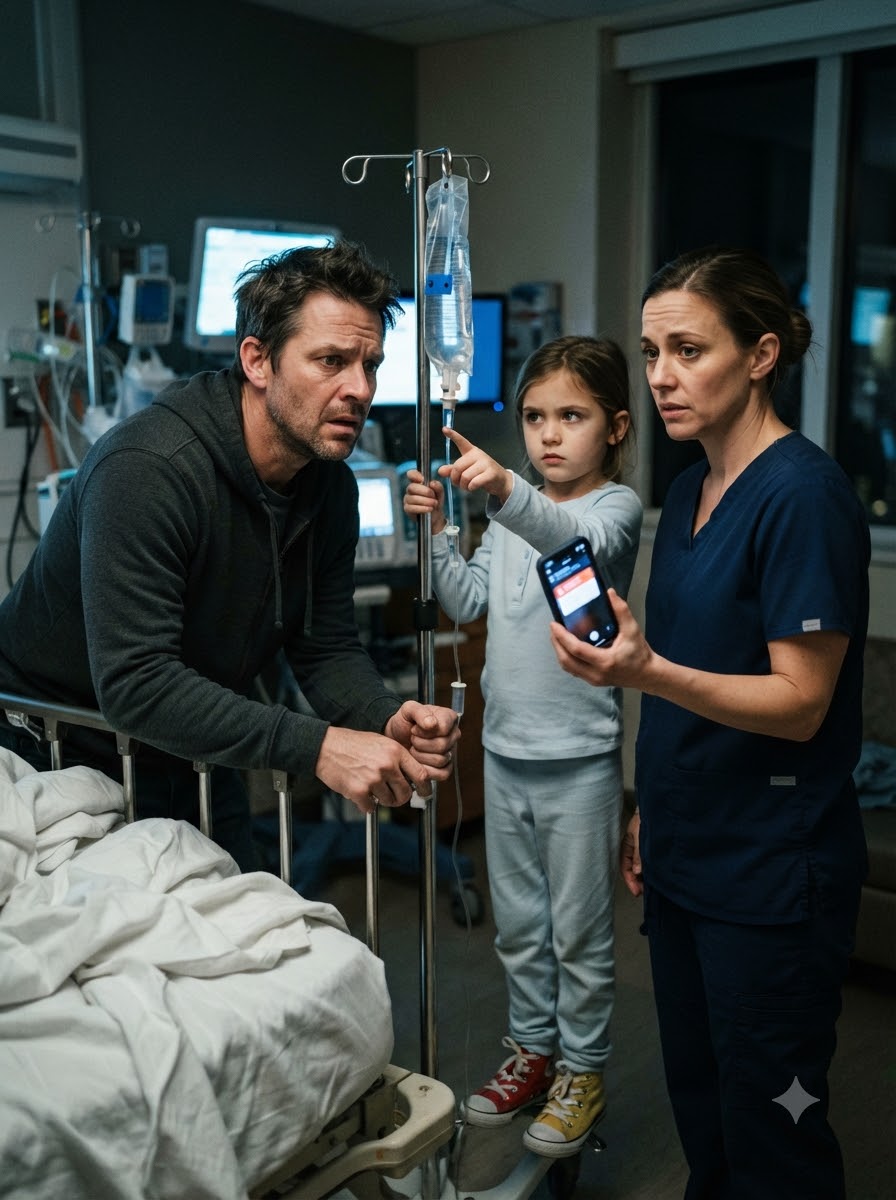
The IV pump chirped as my three-year-old son’s oxygen level began to fall.
A little girl in mismatched sneakers stood beside his bed, water dripping from her fingers.
“That’s the bad bag,” she whispered, pointing at the blue strip of tape across the IV pouch. “He always gets sick when they hang that one.”
I had one hand wrapped around her thin wrist and the other gripping a gold plastic bottle she had emptied across Nico’s forehead and chest.
“Get security,” I told the nurse. “Now.”
But Nurse Elena Ruiz wasn’t looking at the girl.
She was staring at Nico’s monitor.
His oxygen number had been dropping all afternoon. Now it rose from eighty-three to eighty-six.
Then eighty-nine.
His heart rate, which had been racing, began to slow.
Elena followed the tubing from Nico’s arm to the pump. When I had pulled the girl away, the line had kinked.
The infusion had stopped.
Elena’s face lost its color.
She reached into her pocket and unfolded a page covered in handwritten times, medication labels, and lot numbers.
“I thought I was imagining it,” she said.
“Imagining what?”
“Every serious crash Nico has had in the last two days began within thirty minutes of one of these bags being started.”
The girl rubbed her wrist and looked at me without crying.
“I told her yesterday,” she said. “But grown-ups don’t listen when you don’t have a badge.”
Her name was Lucia. She was seven years old, and her mother cleaned the pediatric floors at night.
She had seen what an entire hospital full of specialists had missed.
Or, as I soon discovered, what at least one of them had tried very hard not to see.
Minutes earlier, Dr. Rafael Salgado had stood at the foot of Nico’s bed and told me my son had five days to live.
He had delivered the sentence gently.
“We’ve done everything we can, Daniel.”
“What does everything mean?”
His expression had been polished by years of giving families terrible news.
“His organs are failing. Five days, perhaps a week.”
Miami glittered beyond the private suite’s windows. I had paid for specialists from Boston, New York, and Madrid. I had offered private aircraft, experimental consultations, whatever it took.
Three weeks before, Nico had been racing barefoot through our kitchen.
Now he lay under a white sheet, his body reduced to sharp shoulders, bruised skin, and wires.
My wife, Andrea, was supposedly in Dallas at a medical technology conference. She had spent ten years fighting her way into an executive position at Bravura Therapeutics, and this conference was meant to determine whether she became vice president.
I had told her Nico had taken a turn.
I had not told her the doctors were counting his remaining days.
Then Lucia had walked into the suite with one gray sneaker, one purple sneaker, and a bottle of “holy water” from the hospital chapel.
She said she had visited Nico twice before while her mother worked. She had noticed the blue-taped bags because blue was her favorite color.
She had also noticed that Nico shook whenever one was connected.
When the emergency team arrived, Dr. Salgado entered first.
He looked irritated until he saw the blue tape.
Then he stopped.
A pharmacist named Helen Park pushed past him, read the lot number, and pulled out her phone.
“This batch was flagged eleven minutes ago,” she said.
“For what?” I demanded.
Helen’s eyes remained on the bag.
“Possible contamination. Elevated concentrations of potassium and an unidentified compound.”
Elena clamped the tubing.
Dr. Salgado recovered quickly.
“Then this is a pharmacy matter,” he said. “Remove the bag and begin corrective treatment.”
“No,” I said.
Everyone turned toward me.
“The bag stays here.”
“Mr. Herrera, Nico needs immediate intervention.”
“You told me he was dying. That means I have nothing left to lose by preserving whatever is killing him.”
Salgado’s mouth tightened.
Elena looked at me, then placed the bag and tubing in a clear evidence container. She signed the seal and made Helen sign across it.
Only then did they begin flushing Nico’s line.
Within an hour, his oxygen reached ninety-five.
By midnight, the tremors stopped.
At two in the morning, he opened his eyes and asked for his mother.
I stepped into the bathroom so he wouldn’t see me break.
Andrea answered on the fourth call.
There was music behind her, glasses clinking, people laughing.
“Daniel?”
“The treatment is making him sick.”
Silence.
Not confusion.
Not disbelief.
Silence.
“Andrea,” I said. “Did you hear me?”
“Who told you that?”
The question landed harder than any confession could have.
I stared at my reflection beneath the fluorescent light.
“Why would you ask who told me?”
“I’m coming home.”
“Where are you?”
“Dallas.”
“Turn on the camera.”
She hesitated.
“Daniel, this isn’t the time.”
“Turn it on.”
When the video appeared, Andrea wasn’t in a Dallas hotel.
She was sitting in the passenger seat of a car. Through the window behind her, I saw the blue lights of the causeway and a sign for Mercy Harbor Hospital’s staff garage.
She had been less than a mile away while our son lay dying.
“You’re here,” I said.
Tears filled her eyes.
“I can explain.”
“Start.”
But a knock sounded on the bathroom door. Elena called my name.
I ended the call and returned to Nico’s room.
Hospital security had sealed the medication refrigerator. Two administrators were whispering in the hall.
Helen, the pharmacist, stood beside Nico’s bed with another printout.
“There’s a problem,” she said.
“The contamination?”
“The lot number on Nico’s bag matches the alert, but the packaging doesn’t.”
She placed two photographs side by side.
The manufacturer’s recalled bag had a heat-sealed port with a narrow rib around the cap. Nico’s had a smooth port.
“The label was copied,” Helen said. “This bag didn’t come from that batch.”
“Then where did it come from?”
“We don’t know.”
Dr. Salgado appeared in the doorway.
He had removed his white coat. Without it, he looked smaller, but his voice remained steady.
“This speculation is delaying care.”
Helen stiffened. “The bag contains a forged label.”
“That could be a manufacturing variation.”
“It isn’t.”
He looked at me.
“Daniel, your son is critically ill. Stress can make patterns seem meaningful when they aren’t.”
“Elena saw the pattern.”
“A nurse made informal notes. That is not a clinical study.”
“Lucia saw it too.”
His glance flicked toward the child, who sat in a hallway chair beside her mother.
“A seven-year-old?”
“A seven-year-old stopped the infusion that was killing him.”
Salgado’s eyes hardened for half a second.
Then Andrea stepped out of the elevator.
She wore a navy business suit and carried the leather conference bag she had packed three days earlier. Her face was swollen from crying.
Dr. Salgado moved toward her immediately.
“Andrea, thank God. Daniel is understandably distressed.”
She recoiled from him.
That was when I understood their connection went deeper than I knew.
Andrea had met Salgado six months earlier at a Bravura fundraiser. At least, that was what she had told me. He had taken a special interest in Nico’s unexplained fevers and offered to oversee his case personally.