Owen Left a Letter About Dad—Then His Teacher Found the Lake Recording
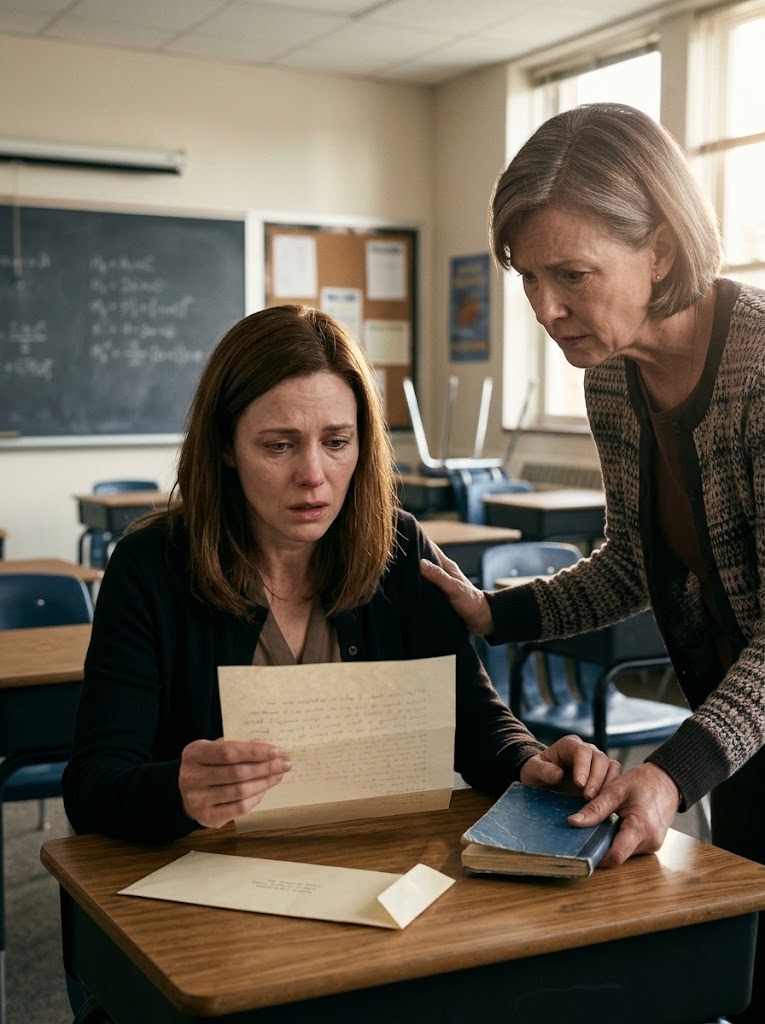
The first thing I noticed was the mud on my husband’s boots.
Daniel had come home from Owen’s funeral two hours earlier, carrying the black suit he had worn beside the lake. He had placed it over the back of a kitchen chair, poured himself a drink, and stood staring through the window as if grief had made the world outside impossible to recognize.
But the mud on his boots was fresh.
Not dried lake mud from the search. Not the pale gray dirt from the cemetery.
This was dark, wet soil threaded with thin brown roots.
“Where were you?” I asked.
Daniel’s hand tightened around the glass.
“At the cemetery.”
“You came straight home from the cemetery.”
He looked at me then. His eyes were red, but not from crying. Daniel had always been good at looking wounded when he was angry.
“I needed air.”
“You were gone for three hours.”
“I said I needed air.”
I looked down at his boots again.
For six weeks, I had been moving through life as if someone had emptied my body and left only the shell behind. Owen was gone. My thirteen-year-old son had disappeared into a storm-swollen lake while Daniel watched from the shore.
There had been no body.
No final goodbye.
Only the police report, the search teams, the solemn voices telling me that the current had been too strong and the water too cold for survival.
Daniel had arranged everything after I was hospitalized.
The funeral.
The obituary.
The burial plot with an empty casket.
I had been too shattered to question any of it.
But that night, looking at the mud on his boots, I felt something inside me stir.
Not hope.
Suspicion.
“You didn’t go to the cemetery,” I said.
Daniel’s expression changed.
Only for a second.
Then he smiled without warmth.
“You’ve been sitting in that boy’s room for weeks, and now you’re interrogating me about mud?”
“Where were you?”
He set the glass down so hard whiskey splashed onto the table.
“Your son is dead, Claire.”
The words hit me with such force that I gripped the counter.
Daniel immediately looked satisfied.
He had learned, over the years, exactly where to press.
“Owen is dead,” he continued. “You need to accept that.”
My throat closed.
“Don’t use his name to frighten me into silence.”
He laughed once.
“Silence? About what?”
I had no answer.
Not yet.
The next morning, Mrs. Dilmore called.
Her voice trembled so badly I could barely understand her.
“I’m not sure how to explain this,” she said. “But I found an envelope in my desk drawer. It’s from Owen. It’s addressed to you. Please come to the school right away.”
I drove there without telling Daniel.
Mrs. Dilmore was waiting outside her classroom. She looked pale, and she kept glancing down the empty hallway.
The envelope was yellowed at the edges.
For Mom was written across the front in Owen’s unmistakable handwriting.
My hands shook as I opened it.
Mom,
If you’re reading this, Dad probably told everyone I died at the lake.
I need you to know that I was scared of him.
Not because he yelled. Because he doesn’t have to yell anymore. He knows how to make people do what he wants.
The letter continued for four pages.
Owen wrote that Daniel had been taking money from my private account for almost three years. At first, the withdrawals had been small. Then they had become larger.
He had also opened credit cards in my name.
Owen had found the statements hidden in Daniel’s desk while looking for printer paper.
I remembered those statements.
I had seen several envelopes with my name on them. Daniel had told me they were advertisements and thrown them away before I could look closely.
Owen wrote that he had confronted his father.
Daniel had told him the money was for a business investment and that I would ruin everything if I found out.
Then Owen discovered something worse.
Daniel had been meeting a woman named Vanessa Cole at a motel outside town.
Owen had seen them together.
He had taken pictures.
The final page was written in hurried, slanted letters.
Dad knows I know.
He said if I told you, he would make sure you lost everything. He said nobody would believe a kid over him.
I put the pictures and the bank papers somewhere safe.
If anything happens to me, look in the place where Dad keeps the old fishing equipment.
Mom, I’m sorry.
I should have told you sooner.
I love you.
The letter fell from my hands.
Mrs. Dilmore caught my elbow.
“I didn’t know,” she whispered. “I swear to you, I didn’t know what it meant. I found it tucked behind the bottom drawer this morning. That drawer has been stuck for months. When the custodian finally fixed it, the envelope fell out.”
“Why would Owen give it to you?”
“He didn’t. I think he slipped it into the drawer when he was waiting after school.”
I read the letter again.
Every word seemed to burn through me.
“Did he ever say anything to you?”
Mrs. Dilmore hesitated.
“He asked me once if adults could be arrested for lying to their families.”
My heart lurched.
“What did you tell him?”
“That people could be arrested for fraud, theft, threats. I asked if someone was hurting him.” Her eyes filled. “He said no. Then he asked me whether a person could disappear without anyone looking too hard.”
I pressed the letter against my chest.
“Why didn’t you tell me?”
“Because I thought he was talking about someone in a movie. He was thirteen, Claire.”
She reached into her desk and pulled out a small plastic bag.
Inside was a brass key.
“I found this beneath the envelope.”
A strip of masking tape was wrapped around it.
On the tape, Owen had written three words.
Dad’s shed. Bottom.
I drove home with the key in my fist.
Daniel’s truck was gone.
The old fishing shed stood behind the house, half-hidden by overgrown blackberry bushes. Daniel kept it locked, though he had not used it since Owen’s accident.
I had assumed the lock was for his expensive rods.
Now I understood it was for whatever he feared someone might find.
The key turned.
Inside, the shed smelled of damp wood, gasoline, and lake water.
Fishing poles leaned against one wall. Life jackets hung from hooks. A rusted metal cabinet stood beneath the window.
Bottom, Owen had written.
I pulled out the tackle boxes, the folded chairs, the plastic containers filled with lures. Beneath them sat a long black equipment case.
It was locked.
I searched the cabinet until I found a second key taped beneath a shelf.
The case opened with a metallic click.
Inside was a waterproof camera, three memory cards, two bank envelopes, and a blue duffel bag.
The bank envelopes contained statements from my account.
Nearly forty thousand dollars had been withdrawn over three years.
The credit card balances totaled more than twenty thousand.
There was also a folder of insurance documents.
My life insurance policy.
Owen’s life insurance policy.
I stared at the page until the words blurred.