My Family Skipped Grandfather’s Funeral—Then a General Recognized His Ring
My mother did not ask how the funeral went.
She did not ask whether the minister had remembered my grandfather’s favorite hymn, or whether the rain had held off, or whether I had managed to get through the words I had written for him.
Her first question was, “Did you take anything from the house?”
I stood in my grandfather’s kitchen, surrounded by the life she had refused to help bury.
“What?”
“Your father noticed the dresser drawer was open,” she said. “We’re having an estate company clear the place tomorrow. You had no right to remove property.”
The coffee cup Walter Hale had used every morning still sat upside down beside the sink. His work boots were under the table. A yellow legal pad lay beside the telephone with my name written across the top.
“You didn’t come,” I said.
“We discussed this, Noah. The drive was impractical.”
“It was two hours.”
“Your father had a meeting.”
“He owns the company.”
She gave a tired sigh, as if I were the one making death inconvenient.
“Just tell me what you took.”
I looked down at the worn silver ring on my right hand. I had found it in a wooden box on my grandfather’s dresser beside a folded flag, several photographs, and a sealed envelope addressed to me.
“Nothing you cared about,” I said.
Then I hung up.
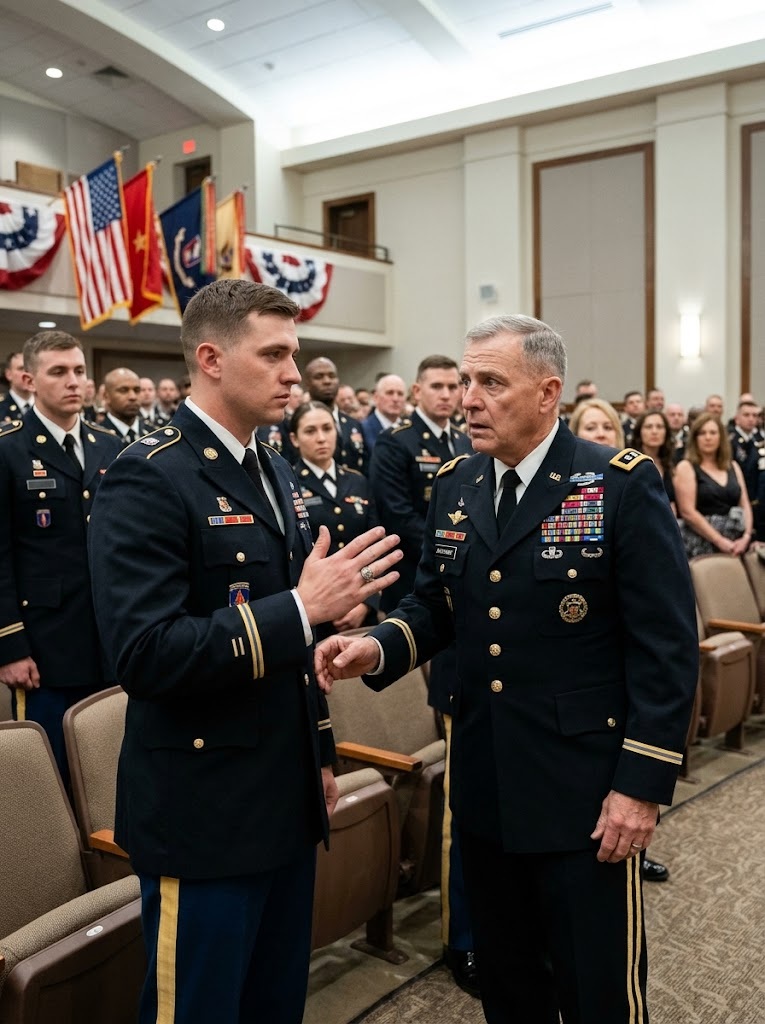
Three days later, Major General Marcus Bell stopped in the middle of a formal reception at Fort Grant, stared at that same ring, and demanded to know where I had gotten it.
The room went silent so quickly I heard the flags shift behind the stage.
I was a captain assigned to logistics, one of dozens of officers gathered after a promotion ceremony. General Bell had been moving down the receiving line, shaking hands and offering the polished remarks senior commanders learn to deliver without effort.
When he reached me, his gaze dropped.
His hand tightened around mine.
“Where did you get that?”
For a second, I thought I had violated some obscure uniform regulation.
“It belonged to my grandfather, sir.”
Bell’s face lost its color.
“What was his name?”
“Walter Hale.”
A glass clinked against the floor somewhere behind us.
The general released my hand, but he did not look away from the ring.
“Sergeant Major Walter Hale?”
“Yes, sir.”
He drew a slow breath.
“When did he die?”
“Four days ago.”
“And who attended his funeral?”
The question struck harder than it should have.
“I did, sir.”
Bell waited.
“No one else?”
“No.”
Something changed in his expression then. Shock gave way to anger, the cold and controlled kind.
“You’ll come to my office after the reception.”
“Yes, sir.”
He lowered his voice.
“Bring the ring. And anything you found with it.”
I thought of the sealed envelope in my apartment.
“Yes, sir.”
General Bell did not stay for the reception.
An hour later, I sat across from him in an office lined with photographs, challenge coins, and framed citations.
He held my grandfather’s ring under a desk lamp.
It was plain except for a faded black stone and a tiny engraving inside the band. I had assumed the marks were scratches. Under the light, they formed three numbers and a hawk with one broken wing.
Bell touched the engraving with his thumb.
“There were eight of these made,” he said. “Not by the Army. By the men who came home.”
He opened a drawer and removed a ring almost identical to mine.
The same black stone. The same hawk.
His was marked with a different number.
I stared at it.
“What does it mean?”
Bell leaned back.
“In 1991, during a reconnaissance mission north of the Saudi border, my aircraft went down. Officially, it was a mechanical failure during training. In truth, we were carrying intelligence that identified mobile launch sites and a compromised allied network.”
I knew enough not to interrupt.
“Six of us survived the crash,” he continued. “Enemy patrols reached the site before our recovery team did. Your grandfather was leading a special operations detachment nearby. His orders were to preserve the intelligence package and withdraw.”
“But he didn’t.”
“No.”
Bell’s eyes settled on the ring.
“He came for us.”
The mission remained classified for almost twenty years. Walter had crossed open ground under fire, carried two injured men to cover, and returned to the wreckage for Bell after an explosion crushed his leg.
He had kept Bell alive for fourteen hours.
When extraction finally came, Walter refused the first helicopter because one of his soldiers was missing.
“He found him,” Bell said. “And brought him back.”
I tried to reconcile that man with the grandfather who had taught me to sharpen mower blades and complained when grocery stores rearranged their aisles.
“Why didn’t anyone know?”
“Parts of the mission were buried for diplomatic reasons. By the time the records were corrected, your grandfather refused public recognition.”
Bell rose and walked to a cabinet.
He removed a thick file.
Inside were photographs of eight younger men standing beside a transport aircraft. My grandfather was in the middle, lean and unsmiling, one hand resting on General Bell’s shoulder.
There were witness statements, declassified reports, and a recommendation for the Distinguished Service Cross.
At the bottom was a letter in my grandfather’s handwriting.
Recognition belongs to the men who did not return. I came home. That was enough.
My vision blurred.
My family had called him stubborn. Difficult. A washed-up old soldier who kept too much junk.
My father once joked that Grandpa’s greatest military achievement had probably been learning to fold socks.
“Sir,” I said, “my mother seemed worried about what I took from his house.”
Bell’s expression sharpened.
“What else did you find?”
I told him about the wooden box and the envelope.
“Open it,” he said.
I drove to my apartment with Bell and Colonel Sarah Wynn, the installation’s staff judge advocate. The envelope was where I had left it, beneath the folded flag.
My name had been written in block letters.
Inside was a key, a storage-unit number, and a note.
Noah,
If Diane or Paul asks about the ring, do not give it to them.
Take General Bell or an attorney with you to Unit 214 at Franklin Veterans Storage. Everything needed to tell the truth is there.
I am sorry I waited so long. I kept hoping your mother would choose to be my daughter again.
Grandpa
I read it twice.
Colonel Wynn asked whether Diane and Paul were my parents.
I nodded.
Then my phone rang.
My father.
I answered on speaker.
“Where are you?” he demanded.
“At my apartment.”
“The estate crew found the box empty. Your mother says you took a ring and some papers.”
“I took what Grandpa left for me.”
“He wasn’t competent to leave anyone anything.”
General Bell’s eyes narrowed.
My father continued before I could speak.
“Walter had dementia. He made accusations. He hid things. Your mother and I had power of attorney, so whatever he gave you belongs to the estate.”
“When was he diagnosed?”
A pause.
“That’s private.”
“Who diagnosed him?”
“Don’t play lawyer with me, Noah. Bring us the ring tonight.”