I Stopped Paying Their Bills—Then Carol Found the Folder I Kept Hidden
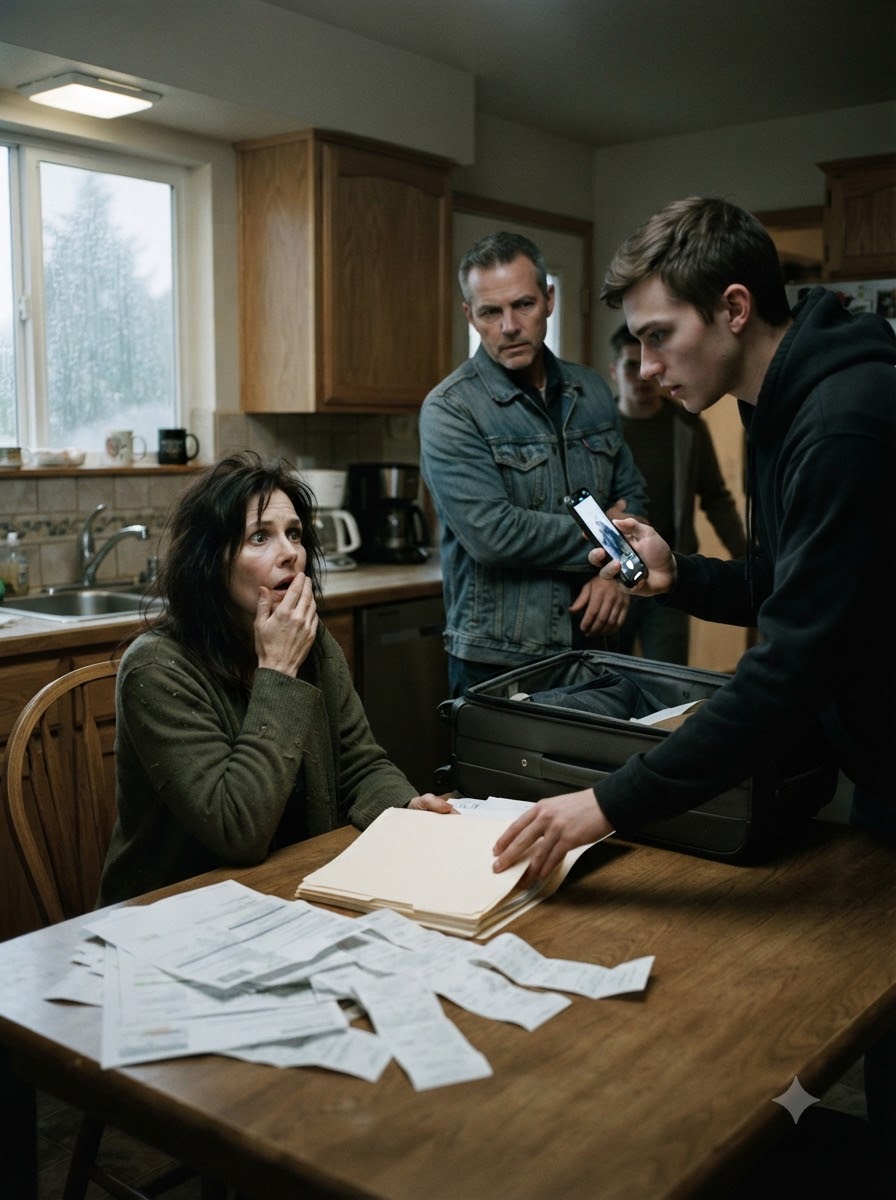
The tow truck arrived at 6:40 on a wet Thursday morning.
Its amber lights turned our bedroom walls orange, then black, then orange again.
I was halfway down the stairs when Trevor ran outside in socks, shouting that the driver had the wrong address. Carol rushed after him in her robe. Justin stood in the open doorway, filming with his phone as if humiliation became less real when viewed through a screen.
The driver had already hooked up Trevor’s silver Subaru.
“You can’t take it,” Carol yelled. “We made the payments.”
The driver glanced at his paperwork.
“Three payments past due.”
“That’s impossible.”
Then Carol looked at me.
It was the same look she had been giving me for a month, ever since I stopped quietly running the machinery of our family.
Accusing. Frightened. Certain I would fix whatever had broken.
“Michael,” she said. “Do something.”
I stepped onto the porch. Cold rain blew under the eaves.
“Whose name is on the loan?” I asked.
Trevor stared at me.
“You know whose name.”
I didn’t.
The driver handed me a copy of the repossession order.
At the top, under borrower, was my full legal name.
Michael Andrew Harris.
Beneath it was a signature that looked enough like mine to pass if no one studied it.
I studied it.
The M leaned the wrong way. The final s in Harris curled backward. Whoever had signed it knew the shape of my handwriting but not the motion behind it.
Carol stopped talking.
The tow truck driver watched my face.
“Sir?” he said carefully.
“I never signed this.”
Trevor’s anger flickered.
“What do you mean?”
“I mean that isn’t my signature.”
Behind me, Justin lowered his phone.
Carol pulled her robe tighter and said the worst possible thing.
“Not out here.”
Not, What are you talking about?
Not, There must be a mistake.
Not even, Let me see.
She said, “Not out here.”
That was how I knew.
The Subaru disappeared down our street with water spraying behind its tires. Trevor stood in the driveway as if he had just watched someone drag away a part of his body.
Then he turned on me.
“You canceled the payments to punish us.”
“No,” I said. “I stopped transferring extra money into the household account. That car was never supposed to be mine.”
“You said you were staying out of our lives.”
“I am.”
He jabbed a finger toward the empty curb.
“This is staying out?”
Carol stepped between us.
“Everybody inside.”
I remained under the porch light with the forged loan agreement softening in the rain.
For twelve years, I had thought the cruelest thing in our house was being treated like an appliance. Useful when needed, intrusive when visible.
That morning, I realized someone had been using my name even when I wasn’t in the room.
I met Carol when Trevor was eleven and Justin was nine.
Their father, Daniel, existed mostly as a promise from another state. He called before Christmas, forgot birthdays, then returned with enough charm to make everyone feel guilty for remembering his absences.
I never competed with him.
I attended conferences. Covered sports fees. Sat beside hospital beds. Fixed cars. Filled out financial aid forms. Kept copies of insurance cards in the glove compartment because no one else remembered.
The boys called me “Carol’s guy.”
They said it jokingly.
“Carol’s guy can pick us up.”
“Carol’s guy has a truck.”
“Ask Carol’s guy. He always pays.”
Carol would smile tightly and tell me not to be sensitive.
Then, one Monday night, Trevor told me to stay out of their lives because I asked him to clear the dinner table.
Justin backed him up.
“You’re Mom’s husband,” he said. “That doesn’t make everything here yours.”
I had looked at the food I bought, beneath the light I paid to keep on, in the kitchen whose leaking pipes I had repaired.
Then I said, “I’ll respect exactly where you’ve placed me.”
The next morning, I removed myself from every optional obligation that belonged to the boys.
I canceled gas cards attached to my account. Removed my card from their college and pharmacy portals. Stopped reminders, pickups, grocery requests and rescue calls.
I did not cancel health insurance. I did not withhold food or utilities. I continued paying my agreed share of the mortgage and household expenses.
I simply stopped supplying the invisible labor and extra money everyone had mistaken for weather.
A month later, the Subaru was gone.
And my signature was on its debt.
I drove directly to work, locked my office door and called the lender.
The customer service representative confirmed the loan had been opened fourteen months earlier. The application used my Social Security number, income, date of birth and an email address that looked like mine.
It had one extra letter.
The statements had gone to paperless billing. Payments came from our joint household account until the month I stopped making my automatic transfer.
“How much is owed?” I asked.
“Twenty-eight thousand, six hundred and forty dollars, including late fees.”
I wrote the number down.
My hand stayed steady until she mentioned another account.
“What other account?”
There was a personal line of credit opened eight months earlier.
Balance: $14,900.
I ended the call and pulled all three credit reports.
By noon, I had found four accounts I did not recognize.
The auto loan.
The personal credit line.
A credit card with a $9,300 balance.
A private education loan for Justin, despite the fact that Justin had never started college.
Total debt exceeded $61,000.
Every account had been opened after Carol and I refinanced the house two years earlier. That process had required copies of my tax returns, driver’s license, pay stubs and Social Security card.
Copies Carol had kept in a blue accordion folder in our home office.
I went home before anyone expected me.
The folder was gone.
I searched the filing cabinet, desk drawers and closet shelf. Nothing.
Then I noticed pale scratches around the lock on Carol’s old cedar sewing chest.
The key hung where it always had, behind a framed photograph of the boys.
Inside the chest, beneath folded fabric, I found the blue folder.
I also found a prepaid phone, a stack of bank statements and a bundle of envelopes secured with a rubber band.
The envelopes contained receipts.
Money transfers to Daniel.
Eight hundred dollars. Twelve hundred. Two thousand. Five hundred.
Month after month.
More than $19,000 in two years.
There were also printed emails between Carol and Daniel.
At first, I read them as a husband looking for an explanation.
By the fifth page, I read them as evidence.
Daniel had been asking for money. Rent. Legal fees. A business opportunity. A truck repair. Always an emergency, always temporary.
Carol sent it.
When she ran short, she opened accounts using my information.
One email made my throat close.
Daniel had written, Does your husband know he’s financing his replacements?
Carol replied, Michael doesn’t look closely. He likes feeling needed.
Another said, The boys still think I’m the one covering school and cars. Don’t ruin that.
Carol’s answer was worse.
They think Michael is controlling with money anyway. It’s easier this way.