My Father-in-Law’s Final Letter Exposed the Debt My Wife Hid in Our House
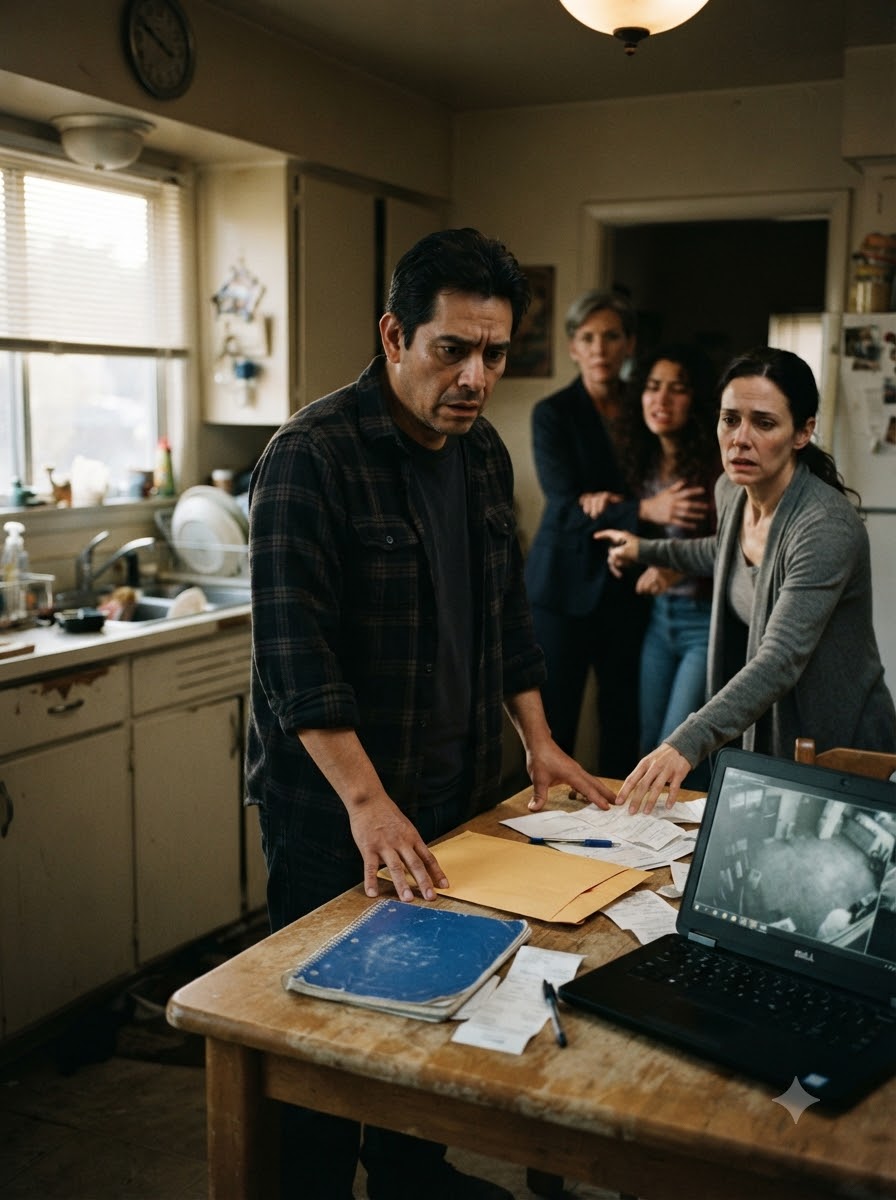
The morning Jacob Morales died, Martin Salcedo was standing in the kitchen with a grocery receipt in one hand and an overdue electric bill in the other.
The numbers blurred together.
Thirty-eight dollars for beans, rice, tortillas, coffee, eggs, and meat.
One hundred and forty-six dollars for Jacob’s prescriptions.
Two hundred and twelve dollars for electricity.
And only nineteen dollars left in Martin’s checking account until payday.
Behind him, the old man sat in his usual patio chair, his gray fedora resting on his knees. The radio beside him whispered through a station full of static. He had been quiet since breakfast, quieter than usual.
Martin turned from the counter.
“Jacob?”
The old man didn’t answer.
Martin stepped outside and touched his shoulder.
Jacob’s skin was cold.
For twenty years, Jacob Morales had eaten at Martin’s table without paying a single cent. He had lived in the narrow back room beside the laundry area, used Martin’s electricity, taken his medications, and filled the pantry with the steady appetite of someone who knew the next meal was guaranteed.
Martin had never called him cruel names to his face.
But he had called him a burden.
Sometimes he said it to Ellen, his wife. Sometimes he said it to himself. Once, during a fight so loud the children hid in their bedroom, he said it directly to Jacob.
“You’ve been here twenty years,” Martin shouted. “When exactly are you planning to stop living off us?”
The words had hung in the air.
Jacob had lowered his eyes.
“Soon enough,” he said.
That answer had made Martin even angrier because it sounded less like defiance than an apology.
Now, with Jacob’s cold hand under his fingers, Martin felt the old rage collapse into something heavier.
Ellen came running from the hallway.
“What happened?”
Martin could not speak.
She saw her father, screamed, and dropped to her knees beside the chair.
The paramedics arrived within minutes, though there was nothing they could do. Jacob had died peacefully, the doctor said. No struggle. No sign of pain. His heart had simply stopped while the radio played and the morning sun warmed the patio.
Martin stood near the kitchen door while Ellen cried into her hands.
His first thought was not that Jacob was gone.
His first thought was that the prescriptions would no longer need to be filled.
The shame of it followed him for years.
Jacob had never been a bad man. He was quiet, stubborn, and thin as a fence post. He walked slowly, drank his coffee sweet, and warmed his own tortillas. He rarely asked anyone for anything except a ride to the clinic.
But he had never offered money, either.
Martin worked at an auto repair shop in Phoenix. He came home with grease beneath his fingernails and pain in his shoulders. Every payday, he watched the pantry empty faster than his paycheck could replace it.
Their two children had grown up sharing a bedroom because Jacob occupied the only spare room. Martin sold his truck to pay for Jacob’s cataract surgery. He postponed repairs to the roof because Jacob’s prescriptions had gone up again.
Ellen always defended her father.
“He has no one else,” she would say.
“He has us,” Martin answered. “But we don’t have much ourselves.”
Then Ellen would cry, and Martin would regret speaking.
Jacob would sit in the corner, pretending he hadn’t heard.
That was how twenty years passed—through birthdays, Christmases, layoffs, hospital visits, debts, and small resentments no one dared name.
The funeral was held three days later at a modest church near the neighborhood where Jacob had spent most of his life. There were more people than Martin expected, but few of them stayed long.
Two of Jacob’s sons arrived late in expensive cars. Ryan, the oldest, wore a black suit that looked as though it had been purchased that morning. He cried loudly during the service, then checked his phone before the priest had finished speaking.
At the cemetery, Ryan put a hand on Martin’s shoulder.
“Well,” he said, glancing toward the grave, “you’re finally free, brother-in-law.”
Martin stared at him.
Ryan gave a humorless laugh. “Don’t look at me like that. Dad lived with you for twenty years. You must have spent a fortune.”
Martin wanted to tell him exactly how much.
Instead, he looked at the fresh earth and said nothing.
That night, Jacob’s room seemed smaller than it had ever been. His bed was neatly made. His shoes sat beneath it, polished and aligned. On the dresser were three framed photographs: Ellen as a little girl, Martin and Ellen on their wedding day, and their children at a school ceremony.
There were no photographs of Ryan or Jacob’s other children.
Martin noticed that but did not understand it.
He opened the closet to gather Jacob’s clothes for donation. Behind a stack of folded blankets, he found a small metal cash box.
The box was locked.
Martin carried it to the kitchen.
Ellen watched him from the table, her face swollen from crying.
“What is it?”
“I don’t know.”
He tried the keys from Jacob’s key ring. The third one opened it.
Inside were a few old bank envelopes, a brass watch, and a blue notebook filled with neat, cramped handwriting.
Martin opened the notebook.
Most of the pages contained numbers and dates.
2004—$480
2005—$1,200
2006—$900
2007—$2,400
Some entries had names beside them.
Martin.
Ellen.
Roof.
Medicine.
School.
He turned several pages.
The sums grew larger.
He found receipts for the roof repair, the cataract surgery, the children’s school uniforms, and a series of grocery purchases from stores Martin recognized. The dates matched weeks when he had believed Jacob had contributed nothing.
But the receipts were not in Martin’s name.
They were paid with money orders from someone named J. Morales.
Martin’s mouth went dry.
“What does this mean?” Ellen whispered.
Before he could answer, someone knocked at the door.
A man in a dark suit stood on the porch, holding a leather briefcase.
“Mr. Martin Salcedo?”
“Yes.”
“My name is Daniel Whitaker. I represent the late Jacob Morales.”
Ellen rose so quickly her chair scraped the floor.
“My father?”
Mr. Whitaker nodded. “He left precise instructions. I’m here to deliver a letter and review certain documents with the family.”
“Now?” Martin asked.
“Now, if you’re willing. He specified that the letter be opened after his burial and in the presence of his immediate family.”
The lawyer looked past Martin into the house.
“Your wife is here. I also contacted Jacob’s other children.”
An hour later, Ryan arrived with his two brothers and a sister. They entered as if they were attending a business meeting, not standing in the home where their father had lived for two decades.
Ryan glanced at the blue notebook on the table.
“What’s all this?”
Mr. Whitaker placed a thick folder beside it.
“Estate documents.”
Ryan’s expression changed at once.
“Estate?”
“There may be assets.”
Ryan looked at Martin. “Dad didn’t have assets. He lived in a back room.”
“He had assets,” the lawyer said.
Ryan pulled out a chair.
“Then let’s get this over with.”