Two Starving Twins Waited at Beatrice’s House—Then Her Hidden Recording Named Lenora
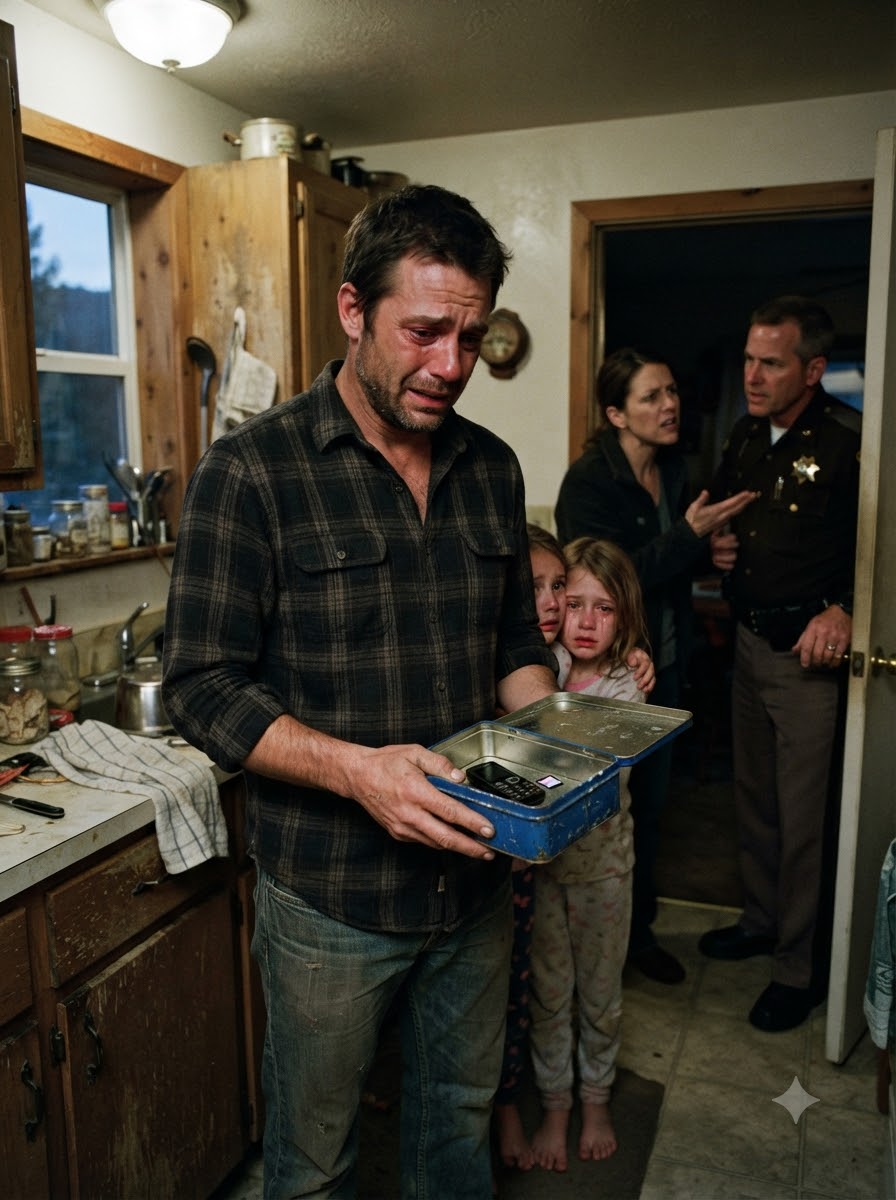
The brass knob gave a slow testing turn from the outside, and I understood with perfect clarity that whatever Beatrice had been trying to leave behind in this house had not stayed buried with her.
On the other side of the door was Lenora Voss.
I knew her face from photographs, though I had met her only twice. Beatrice’s older sister. Pale blond hair cut to her jaw. Expensive coats. A smile that never reached her eyes.
The knob stopped turning.
“Mr. Vale?” she called. “It’s Lenora. I’m here for the girls.”
June’s fingers tightened around my sleeve.
Joy had backed herself beneath the kitchen table. Her knees were pressed to her chest. She had tucked the remaining piece of cracker into her fist and was holding it so hard it had broken into powder.
I moved between the girls and the door.
“Step away from the house,” I said.
A short laugh came from the porch. “You don’t understand what’s happening.”
“I understand two children were abandoned here.”
“They’re my nieces.”
“Then you should have brought them inside.”
“They ran away.”
I glanced at June. She was shaking her head so violently her hair whipped across her face.
Lenora heard the silence. “Beatrice was unstable near the end. She made promises she couldn’t keep. The girls have been difficult since their mother died.”
Their mother.
I stared at the door.
“You said they were your nieces,” I said. “Who is their mother?”
Lenora didn’t answer.
Far below the house, a vehicle climbed the gravel road. Sheriff Mercer’s old county SUV appeared between the pines, its headlights bouncing over the stones. Lenora must have seen it, because her voice changed.
“Let me take them before this becomes a misunderstanding.”
“You’ve had plenty of time to prevent one.”
Mercer got out with one hand resting near his belt. He was broad, gray-bearded, and familiar with the mountain roads. His deputy, a young woman named Tessa Hill, came around the passenger side carrying a flashlight and a folder.
Lenora stepped off the porch.
“I’m their legal guardian,” she said.
Mercer looked at me through the glass. “Is that true?”
“I don’t know.”
“That’s not what I asked her.”
Lenora’s chin lifted. “I have temporary placement authority.”
“Show me.”
She reached into her handbag and produced a folded document.
Mercer didn’t take it. He told her to place it on the hood of his SUV. Tessa retrieved it, photographed both sides, and passed it to him.
I watched his expression flatten.
“What?” I asked.
“This is a photocopy of a power-of-attorney form,” he said. “Not a custody order.”
Lenora’s smile returned, thinner now. “I told you. Family matter.”
Mercer looked at the girls. “How long have they been here?”
“Since this morning,” I said.
“Did you leave them?”
Lenora’s eyes hardened. “I brought them to their aunt’s property because Beatrice instructed me to do so.”
“Beatrice died three weeks ago.”
“That doesn’t invalidate her wishes.”
“Did she tell you to leave them without food or shoes?”
“They had food.”
I held up the crust June had been clutching. “This is what they had.”
Lenora’s gaze flicked toward the window. “Children exaggerate.”
June made a small sound. Not a cry. A warning.
Mercer opened the front door after I unlocked it. He crouched several feet away from the girls and spoke gently. “I’m Sheriff Mercer. Nobody is taking you tonight. Can you tell me where you were before you came here?”
Joy looked at Lenora.
That look contained more history than any statement.
“Answer him,” Lenora snapped.
Joy flinched beneath the table.
Mercer rose. “Ms. Voss, step back to the vehicle.”
“You have no right.”
“I do now.”
Lenora’s face sharpened into something almost unrecognizable. “If you remove those children from my care, you’ll be responsible for what happens to them.”
“They’re already in your care.”
She turned to me. “Beatrice would hate what you’re doing.”
The words struck because Beatrice had spent years making me feel like an intruder in her family. Whenever I questioned Lenora’s requests for money or asked why Beatrice came home from visits looking exhausted, she would say, She’s all I have.
Now I wondered whether that had been a plea instead of a defense.
Mercer took Lenora’s phone and instructed Tessa to photograph her hands, shoes, and vehicle. They found no blood, but the rear floor mat held a child-sized sandal, a torn pink backpack, and a plastic grocery bag containing two empty juice boxes.
The girls recognized the sandal.
“It’s mine,” June said.
Lenora said they had dropped it during a tantrum.
Mercer asked where the other sandal was.
She didn’t know.
That was the first crack.
The second came from the house.
While Tessa took statements from the girls, I walked through the rooms with Mercer. Beatrice had left the place exactly as she always did: every surface clear except the ones she considered useful. Her garden gloves rested by the back door. A stack of mail sat on the piano. Her reading glasses lay open on a book about wildflowers.
But there were signs someone had lived there recently.
Two child-sized blankets were folded in the linen closet. A carton of milk sat behind the wine bottles in the refrigerator, dated two days earlier. On the bathroom counter were a bottle of strawberry shampoo and a toothbrush with the bristles worn flat.
Mercer found a black plastic bag behind the woodstove. Inside were three dresses, two pairs of underwear, and a small stuffed rabbit with one ear missing.
The clothing smelled of smoke.
“Could be Beatrice keeping things here,” he said.
“Beatrice never mentioned children.”
“Maybe she didn’t want you to know.”
The truth of that settled between us.
I went to the bedroom. The bed was made, but one pillow had a shallow depression in it. Beneath the mattress I found a cardboard file box sealed with blue painter’s tape.
The name BEA was written on top.
My hands started trembling before I opened it.
Inside were bank statements, photographs, medical records, and a thin spiral notebook. The first photograph showed Beatrice standing beside a young woman I had never seen. The woman had the same green eyes as June and Joy. She was pregnant, smiling weakly, one hand resting on her stomach.
On the back, Beatrice had written: Mara, six months.
The medical records identified the woman as Mara Voss.
I knew the name.
Three years earlier, Beatrice had told me her sister had died from an overdose. She said Mara had been a troubled girl who left behind nothing but debts. Lenora had organized the funeral.
I turned the photograph over again.
A second image showed Mara holding newborn twins. June and Joy. They were red-faced, tiny, and furious at the camera. Beatrice stood behind them with tears on her cheeks.
The notebook began with a sentence written in Beatrice’s hand.
Mara is alive.
I sat on the edge of the bed.
The next pages were dated over two years.
Mara had not overdosed. She had been hospitalized after a beating by her husband, Caleb Rusk. He was later arrested for assault, but before the case went to trial, Mara disappeared from a shelter with the twins. Beatrice had spent months searching for her.