A Barefoot Girl Pushed Newborn Twins Into the ER—Then Lena Found the Recording
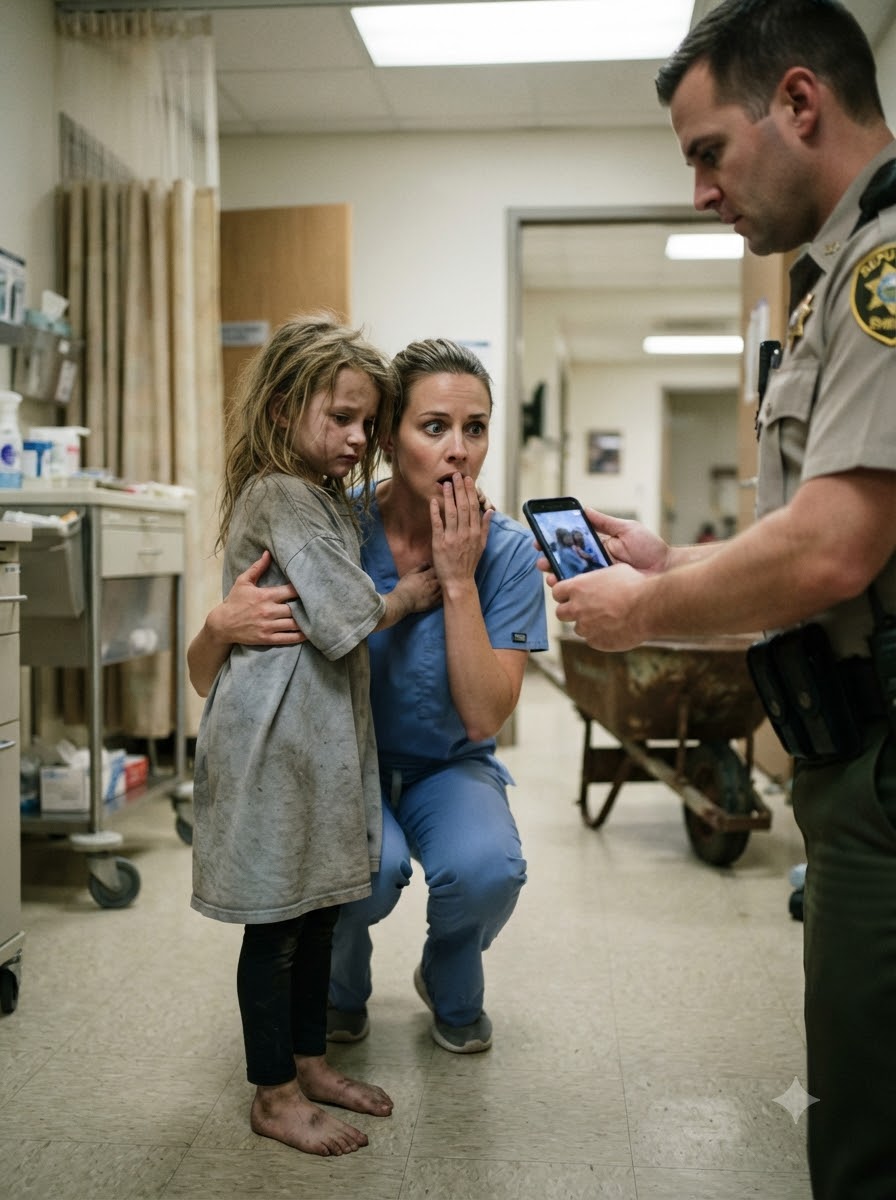
The wheelbarrow hit the emergency-room doors hard enough to leave a muddy crescent on the glass.
For several seconds, seven-year-old Grace Mercer thought the doors were locked.
She shoved again, barefoot and trembling, both hands wrapped around rusted handles that had already torn her palms open. The left wheel squealed. One of the newborns beneath the yellow sheet made a sound so faint she almost mistook it for the wheel.
“Please,” Grace whispered. “Please open.”
The automatic sensor finally caught her movement.
Warm air rushed over her as the doors parted.
The receptionist looked up, expecting an adult to follow.
No one did.
There was only a tiny girl in an oversized gray shirt, her knees dusty, her feet bleeding, pushing a wheelbarrow into the bright lobby at six in the morning.
Two small shapes lay inside.
“Help,” Grace rasped. “My brothers won’t wake up.”
Lena Ortiz, the triage nurse, was across the lobby before the receptionist found her voice.
She pulled back the yellowed sheet.
Two newborn boys lay side by side on folded towels. Their skin was gray-pale, their lips dry. One gave a weak twitch beneath Lena’s fingers.
The other did not move at all.
“Trauma bay!” Lena shouted. “Two neonatal patients. Severe hypothermia and dehydration.”
The lobby erupted.
Orderlies seized the wheelbarrow. A pediatric team came running with warming blankets and oxygen. Someone lifted the first baby. Someone else began working on the second.
Grace held on to the handle.
“Don’t take them.”
Lena turned back.
The child looked ready to fight every adult in the building.
“We’re helping them,” Lena said. “I promise you, we will not leave them.”
“They have to stay together.”
“We’ll keep them together.”
Only then did Grace release the wheelbarrow.
Her knees folded.
Lena caught her before her head struck the tile.
Grace weighed almost nothing.
She smelled of dust, sour milk and the smoke from the woodstove she had kept feeding because her mother had told her babies must never get cold.
In the trauma room, the twins disappeared beneath hands, wires and warmed blankets.
“Temperature thirty-three point one.”
“Oxygen saturation seventy-eight.”
“Get vascular access.”
“Glucose is critical.”
Grace sat on the edge of a bed with a paper cup held between both hands. A nurse named Tasha stopped her from gulping the water too quickly.
“Little sips,” Tasha said. “You’ll make yourself sick.”
Grace obeyed, though her eyes never left the curtains around her brothers.
Lena knelt in front of her.
“What are their names?”
“Eli and Noah.”
“How old are they?”
“Mommy said nine days on Tuesday.”
“And where is your mommy now?”
Grace stared at the floor.
“Home.”
“Is she hurt?”
“My mommy has been sleeping for three days.”
Every nearby voice stopped.
Even the monitor alarms seemed to sharpen.
Lena leaned closer.
“Sleeping how, sweetheart?”
“She won’t open her eyes. I shook her. I put water by her mouth. I put the sugar gel in her cheek like she taught me, but it didn’t work.”
Sugar gel.
Lena’s expression changed.
“Does your mother have diabetes?”
Grace nodded. “The kind with shots.”
“Did you call anyone?”
“The phone didn’t work.”
“What about your father?”
Grace’s fingers tightened around the cup.
“Dean isn’t my real daddy. He said Mommy was being dramatic. He said she always ruins everything.”
“When did he say that?”
“The night she fell down.”
Lena felt cold move through her.
“Was he there?”
Grace nodded again.
“He stepped over her. Then he took her purse and the red medicine bag.”
Tasha looked at Lena.
Neither woman spoke for a beat.
“What happened after that?” Lena asked.
“Dean told me not to touch anything. He said he was going to get help.”
“Did he come back?”
“No.”
Grace looked toward the trauma curtains.
“The babies cried all night. Then yesterday they stopped crying. Mommy said if something bad happened, hospital people know what to do.”
Her mouth trembled.
“I was going to come back for Mommy. I took the babies first because they’re too little to walk.”
Behind the curtain, one infant gave a thin, furious cry.
Grace froze.
“That’s Eli.”
Her whole face crumpled with relief.
A few seconds later, the second monitor changed rhythm. A doctor bent close, adjusted the oxygen and rubbed a tiny back.
Noah released a hoarse, protesting sound.
Grace covered her mouth and began to sob.
Lena held her while the staff worked around them.
The twins were alive.
But somewhere beyond the red barn, the bridge and the road with the broken sign, their mother might not be.
Deputy Aaron Bell arrived with a county map.
Grace traced the route with one blistered finger.
“The house has a green door,” she said. “There’s a swing, but one rope broke.”
Aaron radioed the location to patrol units and paramedics.
Then Lena asked the question required for the chart.
“What is your mother’s full name?”
“Rebecca Mercer.”
At the nurses’ station, Charge Nurse Evelyn Shaw dropped a pen.
“Say that again.”
Grace flinched.
“Rebecca Anne Mercer.”
Evelyn turned toward an old framed photograph near the staff corridor. It showed eight emergency nurses standing in front of the hospital fifteen years earlier.
One of them was a laughing young woman with dark curls and bright green eyes.
Evelyn touched the glass.
“Rebecca Anne Mercer worked here,” she said. “She trained half the nurses on this floor.”
Lena looked from the photograph to Grace.
“You know her?”
“She saved my life.”
Years earlier, Evelyn explained, a violent patient had attacked her during a night shift. Rebecca had pulled the emergency alarm, dragged Evelyn behind a locked medication-room door and kept pressure on a neck wound until surgeons arrived.
Then Rebecca had vanished from the hospital’s staff.
Everyone had been told she had resigned after stealing narcotics.
Evelyn had never believed it.
Forty minutes later, deputies found the green door at the end of a dirt road.
Wheel tracks cut through the mud, wobbling toward the county highway. Tiny bloody footprints marked the porch boards.
The house was cold.
Two empty bassinets stood near the woodstove. Bottles had been lined carefully beside the sink. A kitchen chair had been pushed against the counter so Grace could reach the faucet.
Every cupboard within her reach stood open.
On the floor lay torn crackers, a jar of peanut butter and an empty tin of infant formula.
“Bedroom!” an officer shouted.
Rebecca Mercer lay motionless on the floor beside the bed.
Her breathing was shallow. Her skin was damp and icy.
Beside one hand was an old hospital badge.
The paramedic checked her blood sugar and swore.
It was dangerously low.
Yet on the dresser sat Rebecca’s insulin pen, nearly empty.
The strange part was that Rebecca had a continuous glucose monitor attached to her arm. Its receiver should have screamed warnings long before she collapsed.
The receiver was in the wastebasket.
Its battery had been removed.
Paramedics gave glucose and rushed Rebecca toward the hospital.
Deputy Bell remained behind.
A simple medical emergency no longer explained what he was seeing.
The landline cord had been cut cleanly near the wall. Rebecca’s cellphone lay under the sofa with its screen smashed. A dead bolt high on the back door had been locked from the outside with a hasp someone had recently installed.