They Could Run a Life Together. He Needed to Know If They Still Had a Marriage
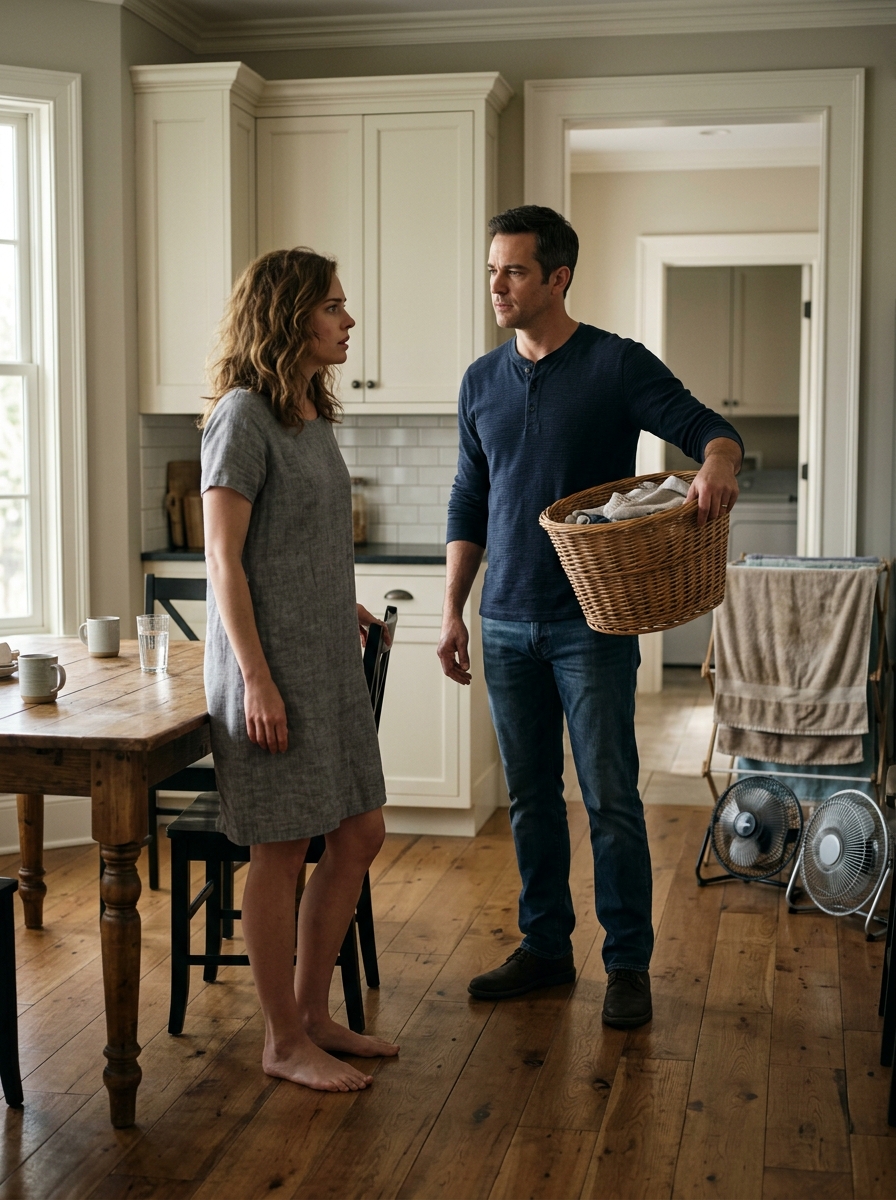
The first thing Celeste missed was not Theo.
It was the coffee.
That embarrassed her.
On the first Sunday of their six-week “unmerging,” as Theo called it, he brewed a full pot. He wasn’t petty enough to measure out beans for one. But he didn’t warm her blue ceramic mug, add the dash of oat milk she liked, or leave it beside the newspaper with the handle turned toward her right hand.
The coffee was available. The anticipation was gone.
Celeste stood barefoot in the kitchen, staring at the empty place beside the paper.
Theo entered carrying a laundry basket.
“Morning,” he said.
“Morning.”
His clothes were folded inside the basket. Only his.
Five days earlier, at 2:13 a.m., they had woken to water striking the laundry-room floor.
By 2:15, Celeste was at the main shutoff valve while Theo pulled storage boxes out of the spreading puddle. By 2:19, he had reached the emergency plumber. Celeste photographed the bowed section of ceiling for insurance. They worked around each other in pajamas and bare feet, passing towels, buckets, and tools without collision.
At 3:07, when the last drip fell into a stockpot, Theo had looked at his wife with something close to awe.
Her dark hair was wet at the ends. A streak of plaster dust crossed one cheek. She was forty years old, furious at the pipe, and beautiful to him.
He opened his arms.
Celeste stepped past him to unplug a damp extension cord.
“Nice save,” she said, raising one fist.
He bumped it automatically.
Then she began listing next steps: plumber, remediation company, insurance adjuster, replacement drywall.
Theo listened and realized he couldn’t remember the last time they had embraced without illness, grief, travel, or someone watching. Their affection had become ceremonial. A cheek kiss before a flight. A hand on his shoulder during a photograph. A brief hug if one of them received terrible news.
They slept in the same bed every night, but even that had become practical. The guest room mattress hurt Celeste’s back. Theo’s editing equipment occupied part of the room. Their bedroom had the good blackout curtains.
At seven that morning, with damp towels heaped in the hallway, he told her he could no longer accept efficiency as proof that their marriage was alive.
He would move into the guest room. For six weeks they would stop doing automatically what two competent adults could do for themselves. They would ask for help, company, and touch instead of assuming or avoiding them. They would see a counselor twice before deciding what came next.
Celeste had stared at him as if he’d proposed setting fire to the undamaged half of the house.
“You’re turning us into roommates to prove we’re roommates.”
“No,” he had said. “I’m removing the camouflage.”
Now, on Sunday morning, she poured her own coffee.
Theo shifted the laundry basket against his hip. “There’s plenty.”
“I can see that.”
He hesitated. “I didn’t know if making your cup counted as automatic caretaking.”
“Apparently it does.”
“That isn’t a punishment.”
“It feels like one.”
Theo set down the basket. “Then let’s talk about it.”
Celeste nearly laughed. For years, they had been able to make consequential decisions in under three minutes. They had refinanced their house, coordinated medical care, and rebuilt a section of porch with less discussion than this cup of coffee apparently required.
“I miss the mug,” she admitted.
Theo looked at the empty spot beside the paper.
“That’s useful to know.”
Her irritation sharpened. “I’m not one of your audio files. You don’t need to collect data on me.”
“I know.”
“Do you?”
He rubbed his thumb over the basket handle. “I’m trying not to decide what you feel before you say it.”
Celeste wanted to tell him this was ridiculous. Instead, she heard the exactness of his answer.
“Fine,” she said. “I miss having the mug there.”
“Tomorrow, do you want me to make it?”
She hated how vulnerable the question made her feel.
“Yes.”
Theo nodded once. “Okay.”
He picked up the basket and walked toward the guest room.
Celeste watched him go. What she felt was not yet missing him. It was anger that the smallest kindness now required exposure.
***
Their counselor, Dr. Priya Bell, was forty-six and had the unnerving habit of waiting through silence without trying to rescue anyone from it.
At their first appointment, Celeste sat at one end of a gray sofa and Theo at the other. There was enough space between them for a third person.
Dr. Bell read over the notes she had taken.
“Separate bedrooms. Individual household routines. Explicit requests for shared time or help. Six weeks, followed by a decision about continuing the marriage.”
“When you say it like that, it sounds deranged,” Celeste said.
Theo looked at her. “You agreed.”
“I agreed at four in the morning with a hole in the ceiling.”
“You agreed again Friday.”
“Because you were already packing.”
“I moved eight feet across a hallway.”
Dr. Bell lifted one hand, not quite interrupting. “Celeste, what do you believe Theo is trying to make happen?”
“He wants me to prove I love him in a language he approves of.”
Theo’s jaw tightened.
“And what language is that?” Dr. Bell asked.
“Physical affection. Romantic declarations. Long conversations with no purpose.”
“That last one sounds especially sinister,” Theo said.
Celeste shot him a look.
He exhaled. “Sorry.”
Dr. Bell turned to him. “What are you trying to make happen?”
“I’m trying to find out whether there’s a relationship underneath everything we maintain.”
“And if there isn’t?”
Theo looked down at his hands. “Then I don’t want us to spend another decade pretending the maintenance is the relationship.”
Celeste crossed her arms. “He says that as if practical care is fake.”
“I’ve never said it’s fake.”
“You say it’s camouflage.”
“When it’s the only thing left, yes.”
The room went quiet.
Dr. Bell asked how long affection had been absent.
Theo said fourteen months.
Celeste said, “That’s absurd.”
He turned toward her. “When did we last kiss?”
“We kiss.”
“When?”
She opened her mouth.
They both remembered the same thing: a neighborhood holiday party in December, two months earlier. Their host had raised a phone for a photograph and shouted, “Kiss like you mean it.” Celeste had touched her mouth to Theo’s for less than a second.
Before that, there had been a goodbye kiss at an airport. Before that, neither could say.
“Fine,” Celeste said. “We don’t kiss often.”
“We don’t hold hands. We don’t sit against each other. You flinch when I touch your waist.”
“I don’t flinch.”
“You hold your breath.”
“That’s not the same thing.”
“It feels the same from where I’m standing.”
Dr. Bell let that settle.
Then she asked what had been happening fourteen months earlier.
Celeste’s gaze moved to the window.
Her younger sister Dana had been living with them.
Dana was thirty-four when a collision left her with a traumatic brain injury and limited mobility. The hospital released her after six weeks, but she could not safely live alone. Celeste and Theo turned their dining room into a temporary bedroom. They installed rails, rearranged the downstairs bathroom, learned medication schedules, and covered the parts of Dana’s care insurance would not provide.