The Key His Husband Set on the Table Changed What Consent Meant in Their Marriage
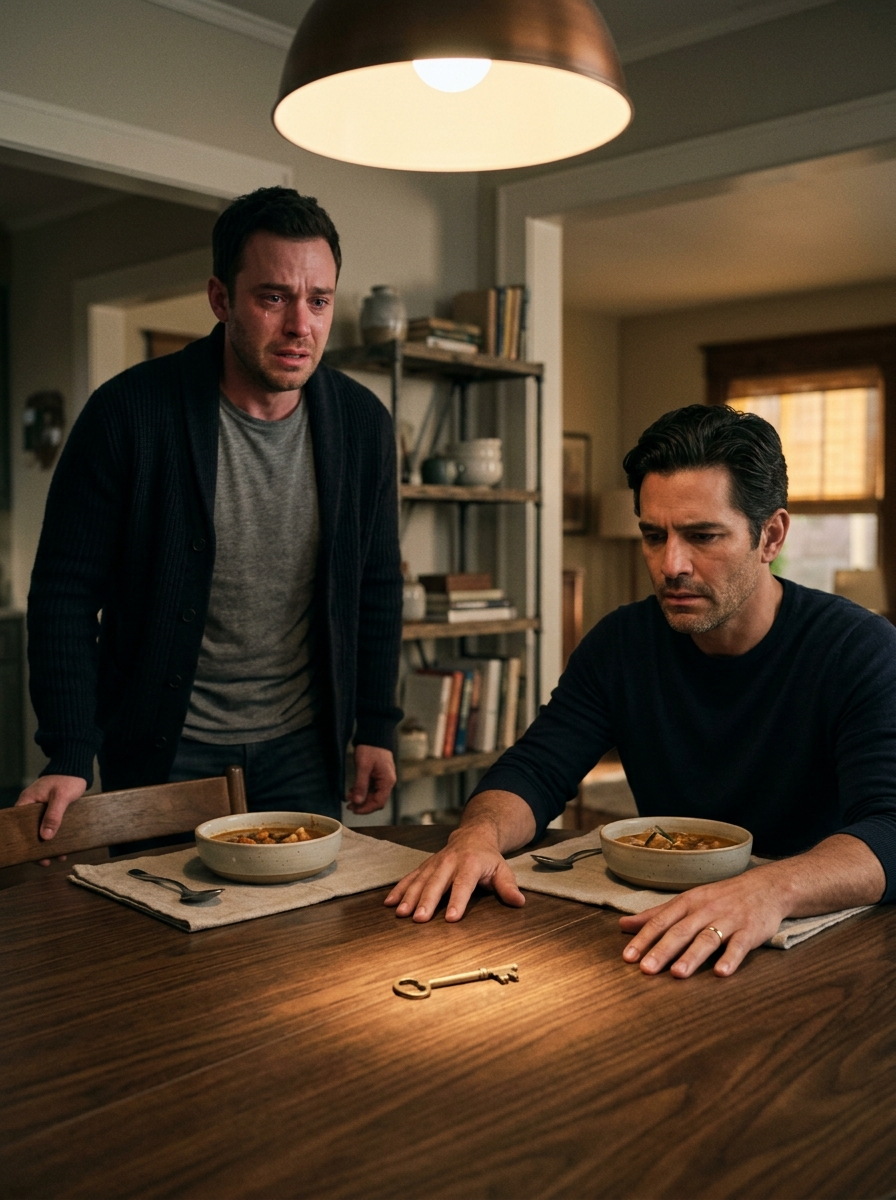
The brass key spun once on the kitchen table before falling flat between them.
“How long?” Mateo asked.
“Thirty days.”
“When do you go?”
“Tomorrow.”
Mateo nodded as if Darius had given him the dimensions of a room instead of announcing his departure from one. At forty-one, Mateo had a face that usually betrayed every feeling before he could name it. Tonight, it seemed to have closed all its doors.
“Are you leaving me?” he asked.
“I’m leaving the house.” Darius pulled his cardigan tighter around himself. “I don’t know if that means I’m leaving you.”
“You already signed something?”
“This afternoon.”
“So before you asked if I was having an affair.”
“Yes.”
The word landed hard.
Darius had rented the room expecting the worst. For five months, Mateo had stopped initiating intimacy, stopped lingering beside him after brushing his teeth, stopped reaching across the couch during movies. Darius had watched that distance grow and supplied his own explanation: another man, probably Emmett from Mateo’s firm.
But there was no affair.
There was only Mateo’s confession that he had watched Darius disappear during their most private moments and had been too ashamed to ask where he went.
“So no matter what answer I gave you tonight, you were moving out,” Mateo said.
“I needed to know I could ask the question without being trapped inside your answer.”
“Trapped?” Mateo pushed his chair back. “Have I ever stopped you from leaving this house?”
“That’s not what I mean.”
“Then tell me what you mean.”
Darius looked around the kitchen. Mateo had bought the narrow brick rowhouse three years before they met. His name was on the deed. His salary paid the mortgage now that Darius’s event-production job had vanished in a round of layoffs.
They had been married seven years. They shared groceries, holidays, emergency contacts, and a drawer full of takeout menus. But the prenup they had signed still said the house belonged solely to Mateo.
“I mean I need one door in this city that belongs to me,” Darius said. “Even if it’s only rented.”
Mateo’s expression tightened. “You think I would throw you out for refusing sex?”
“No.”
“Then why are we talking like I’m Caleb?”
Darius had not said his former boyfriend’s name in years.
At twenty-six, newly out and barely speaking to his parents, Darius had moved into Caleb’s apartment. His name had never gone on the lease. The first time Darius declined intimacy, Caleb became quiet for three days. The second time, a packed suitcase appeared in the hallway.
Caleb apologized before Darius actually left. He cried. He promised. Darius stayed another fourteen months and learned that affection could be shelter, but only if he remained agreeable.
“You’re not him,” Darius said. “That doesn’t mean I stopped being the person who lived with him.”
Mateo looked down at the key. “I never knew about the suitcase.”
“I told you he was controlling.”
“That’s not the same thing.”
“It was the version I could say without seeing pity on your face.”
For a moment, neither man spoke. The dishwasher reached the end of its cycle and clicked off. The sudden quiet made the house feel cavernous.
Mateo sat again.
“Last summer,” he said carefully, “before you lost your job, were you already… leaving like that?”
“Sometimes.”
“How long?”
“I don’t know.”
“I need you to know.”
“Well, I don’t.” Darius’s voice sharpened. “I didn’t keep records.”
Mateo flinched, and Darius immediately wanted to apologize. That reflex—the need to soften every impact before someone decided he was too difficult—was so quick it barely felt like a choice.
He swallowed the apology.
Mateo rubbed both hands over his face. “The last time we tried, you stared at the smoke detector. I asked if you were okay, and you said you were fine before I finished the question.”
“I remember.”
“What were you thinking?”
“That I wanted you to be happy.”
“That isn’t what I asked.”
“It’s what I have.”
Mateo stared at him. “Darius, did you want to be there?”
The honest answer climbed slowly, scraping all the way up.
“Not then.”
Mateo closed his eyes.
Darius felt the familiar urge to rush toward him, to say it had not been awful, that Mateo had not forced anything, that Darius loved him. All of those things were true. None changed the answer.
“You said yes,” Mateo whispered.
“I thought yes was cheaper.”
Mateo stood and walked to the sink. He gripped the counter but did not turn around.
“I need you to understand something,” Darius said. “I’m not saying you knew.”
“I should have known.”
“No. You should have asked better. I should have answered honestly. Both can be true.”
“And after I noticed, I said nothing for five months.”
“That part was cruel.”
Mateo turned. “I thought giving you space was the decent thing.”
“Space without an explanation is just abandonment with good posture.”
The words struck cleanly. Mateo nodded once.
“You’re right.”
That should have eased something. It did not.
Darius put the key back in his pocket.
“Where is the room?” Mateo asked.
“An attic room in a woman’s house near the university. Private entrance. Month-to-month.”
“Do you want help moving?”
“No.”
“Can I ask you to text when you get there?”
Darius considered the question rather than automatically protecting Mateo from the answer.
“Yes,” he said. “You can ask.”
***
The room belonged to a retired chemistry teacher named Denise, who wore silver braids and explained the heating system as if Darius might be tested on it.
The ceiling sloped above a narrow bed. There was a blue armchair, a pine desk, and a hot plate beside a window overlooking an alley. The room smelled faintly of cedar chips and laundry detergent.
It was nobody’s idea of home.
That first night, Darius lay on top of the blanket and listened to buses sigh at the corner.
At 9:14, Mateo texted.
You there?
Darius typed three different replies before sending: Yes.
A minute later, Mateo responded.
Thank you for telling me.
No heart. No demand to come home. No declaration that they would fix everything.
Darius hated how relieved he felt.
He also hated how much he wanted Mateo to beg.
The next morning, he woke with his jaw aching from clenching it. For several confused seconds, he did not know where he was. Then he saw the unfamiliar ceiling and remembered that he had paid for the right to lie beneath it.
Three days passed before Mateo asked if Darius would meet him for coffee.
They chose a crowded café where the tables were too close for either of them to raise his voice. Mateo arrived early and had not ordered for Darius, though he knew exactly what Darius liked.
“I wasn’t sure what you wanted,” he said.
The sentence could have been about coffee or their entire marriage.
Darius ordered for himself.
When he returned to the table, Mateo said, “I found three couples therapists who have experience with trauma and intimacy. I haven’t contacted any of them.”
“Are you trying to fix me?”
“No. I’m trying to learn what to do with an answer I might not like.”