Grandpa Left Me College Money—Then His Diary Exposed My Parents’ Secret
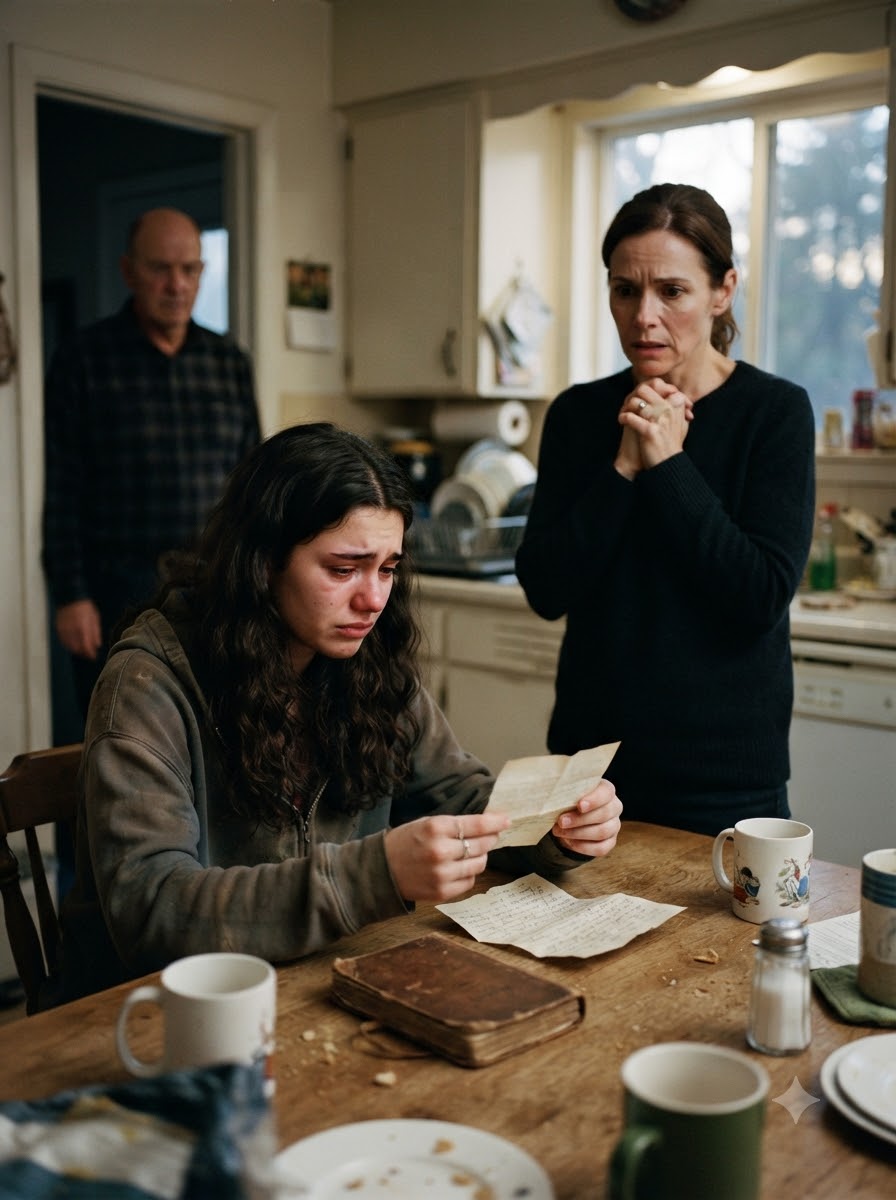
The first thing my mother did after admitting they had spent my college money was reach for a notepad.
Not an apology.
Not the checkbook.
A notepad.
I was standing at the kitchen counter with my backpack still over one shoulder, waiting for my father to tell me there had been some mistake. The room smelled like burnt coffee and the onions my mother had fried for dinner. Mandy sat at the table, staring at her phone as if none of us were speaking.
I looked from one face to the next.
“Where is Grandpa’s money?”
My father’s fingers tightened around his coffee mug. He had been avoiding my eyes for ten minutes.
My mother sighed. “We already told you. Mandy needed it.”
“She needed seventy-five thousand dollars?”
“She needed capital for her business,” Mandy said without looking up. “It wasn’t like we gave it to some stranger.”
The words landed with a cold finality. Not even she thought she had to explain herself.
Grandpa had left me seventy-five thousand dollars for college. He had said it in front of my parents, my uncle, and the lawyer who handled his estate. He had repeated it so often that I could still hear his voice.
“That money is for her education,” he had said. “No one touches it for anything else.”
I had been fifteen then, sitting beside him in the small office at the farm while sunlight fell through the dusty blinds. I did not understand estate law. I did understand that he had looked directly at my mother when he said it.
Now my mother picked up the notepad.
“You’re eighteen,” she said. “You’re old enough to understand that money doesn’t grow on trees.”
“Grandpa left it for me.”
“And we raised you.”
I stared at her.
She began writing.
“For eighteen years,” she said, “we paid for food, clothing, medical care, school supplies, transportation, utilities, and housing.”
The pen moved steadily.
My father looked down at the table.
Mandy finally lifted her head. “Mom, this is ridiculous.”
My mother ignored her. “You’ve had a roof over your head your entire life. You’ve been fed. You’ve had clothes on your back. You’ve had Christmas presents.”
“You mean the clothes Mandy outgrew,” I said.
My mother’s mouth tightened. “Don’t start.”
She kept writing.
I watched her turn childhood into a ledger. The lunches packed when I was too young to pack them myself. The dentist appointments. The school fees. The winter coat I had worn for three years because Mandy had grown tired of it after one season. She added everything to the page as if she had been waiting for an opportunity to invoice me.
Then she drew a line beneath the total.
Two hundred and eighteen thousand dollars.
“If you want that money,” she said, pushing the notepad toward me, “pay us back for every year we raised you.”
For a moment, I could not hear anything except the refrigerator humming behind me.
I looked at the number, then at my mother.
“You spent my college fund on Mandy,” I said. “And now you’re charging me for being your daughter?”
“No one is charging you for being our daughter,” she snapped. “We’re reminding you that you haven’t exactly supported this family.”
“I was a child.”
“You were an expensive child.”
My father flinched, but he still said nothing.
That silence was the last thing I needed to understand. My mother could say anything she wanted because everyone in that house had already agreed I was the person who could be sacrificed.
I took the notepad, folded it in half, and put it into my backpack.
My mother reached for it. “What are you doing?”
“Keeping the bill.”
“You’re being dramatic.”
“No,” I said. “I’m finally listening.”
I walked out before she could answer.
The air outside was cold enough to hurt my teeth. I went down the front steps and kept walking. I had no coat, no plan, and barely enough money for the bus, but I could not stay in that kitchen another second.
For most of my life, I had tried to explain away what happened in our family.
Mandy was older, so of course she received things first. Mandy was more outgoing, so of course she got more attention. Mandy had struggled in school, so of course my parents had to help her. Mandy had a boyfriend, a car, a business idea, a problem, a crisis.
There was always a reason.
I had learned to make myself smaller around those reasons.
The only place I had never needed an explanation was Grandpa’s farm.
He owned a stretch of land outside town where the road narrowed and the fields rolled toward the horizon. There was a weathered farmhouse, a red barn, a stable, and a chicken coop that leaned slightly to one side. In the summer, the grass grew high around the fence posts. In the winter, the wind rattled the windows all night.
Grandpa made room for me without making me ask.
When I was eleven, I spent the first week of summer there. At home, Mandy had taken over the living room with friends, and my mother told me to stop hovering. I packed a bag and called Grandpa from the hallway.
He picked me up an hour later.
He did not ask what had happened until we were halfway to the farm. Then he glanced at me and said, “You can tell me, or you can sit quietly. Both are allowed.”
That was the first time an adult had given me a choice without making me feel guilty for having one.
Over the next few years, the farm became my real home. My parents agreed when I asked to live there during the school year. They acted as if it were a generous arrangement, but I saw the relief in my mother’s face when she realized she would have one less child to manage.
Grandpa helped me with homework at the kitchen table. He taught me how to mend a fence, identify storms, and tell when a horse was nervous. He asked about my plans and remembered the answers.
When I told him I wanted to study environmental science, he said, “Then that’s what you’ll do.”
I laughed. “You say that like it’s easy.”
“No,” he said. “I say it like it’s yours.”
The summer before he died, he took me into his office and opened a brown leather file.
“I’ve made arrangements,” he said.
I thought he meant the farm.
He showed me the will and explained that certain property would go to my uncle, some savings would go to my father, and seventy-five thousand dollars would be set aside for my college education.
“Your parents will be responsible for managing it until you turn eighteen,” he said. “But it is not theirs. It is yours.”
My mother had been in the room. I remembered the way she smiled without showing her teeth.
“Of course,” she said.
Grandpa looked at her for a long moment.
“Not a car,” he said. “Not a vacation. Not another business venture. College.”
My father nodded quickly. “We understand.”
Grandpa died six months later.