Bryce Sold Grandfather’s Mustang—Until the Buyer Found the False VIN Plate
Three days after my grandfather’s funeral, my cousin Bryce posted a video from inside the Mustang I had helped restore with him.
The camera started on Bryce’s face, flushed with triumph. Then it swung toward the dashboard, the black steering wheel, the chrome-trimmed gauges, and the Highland Green hood visible through the windshield.
Behind him, my uncle Ray laughed.
“Tell them whose car this is,” Ray said.
Bryce grinned at the camera. “Grandpa knew who his real favorite was.”
The caption said the same thing.
I watched the video twice from the kitchen table, unable to move. My mother stood at the counter with her back to me, rinsing coffee cups that were already clean. Neither of us had slept properly since the funeral. The house still smelled like lilies, furniture polish, and the ham casserole relatives had left behind.
Bryce’s post had been up for less than an hour, but people were already commenting.
Lucky guy.
Your grandpa had taste.
Can’t wait to see you cruise it.
One comment came from a neighbor: Your grandfather always said that car was going to his mechanic.
My hands began to shake.
Not because Bryce had lied. Bryce had been lying about the Mustang for years.
It was because he was sitting in the wrong car.
The real 1967 Shelby GT500 Fastback was not in my grandfather’s driveway.
It was hidden behind three locked doors, in a restoration shop forty miles away.
And four months before my grandfather died, he had legally sold it to me for one dollar.
I had the bill of sale. I had the title. I had the video recorded at the DMV.
Bryce had no idea.
Neither did Uncle Ray.
I put my phone facedown.
My mother finally turned around. “What happened?”
I showed her the video.
For several seconds, she said nothing. Then the color drained from her face.
“Where did he get the keys?”
“That’s not the question.”
Her eyes flicked toward the hallway, toward the closed door of the room where Grandfather had kept his documents. “You said the real car was safe.”
“It is.”
“But that one looks exactly like it.”
“It’s supposed to.”
I had spent the first fourteen years of my life believing the Mustang was simply an old car in my grandfather’s barn. I knew it was special because everyone who visited stared at it, but I didn’t understand why until I was old enough to read the faded auction papers tucked inside a drawer.
A matching-numbers 1967 GT500 Fastback in Highland Green could sell for more than two hundred thousand dollars. Grandfather’s had its original engine, transmission, interior, and rare factory options. The body had been repainted once, but the restoration was faithful. He had bought it in pieces after returning from Vietnam and spent decades bringing it back.
I spent every Saturday in his garage from the time I was fourteen.
He taught me how to rebuild a carburetor, how to listen for a bad bearing, how to hold a wrench so I wouldn’t strip a bolt. By the time I was sixteen, I could pull an engine. By eighteen, I could identify a Ford block by casting marks and date codes.
Bryce never came into the garage unless Grandfather was paying him to sweep.
He preferred his phone, expensive sneakers, and the attention he got by calling me “Grandpa’s grease monkey.”
Whenever Grandfather mentioned leaving me the Mustang, Bryce would snort.
“Who wants a car that old?” he’d say. “You can’t even drive it without smelling like gasoline.”
Grandfather would look at him over his glasses.
“That’s because you’ve never done anything worth smelling like gasoline for.”
I used to laugh.
Later, I understood that those arguments had been warnings.
Six months before Grandfather died, he called me late one evening.
“Come by before work tomorrow,” he said.
His voice sounded different. Thin and controlled.
When I arrived, he was sitting in the kitchen with a folder open in front of him. The Mustang was visible through the window, under its canvas cover.
“I found Ray and Bryce in the barn last night,” he said.
“What were they doing?”
“Photographing the title.”
I felt my stomach tighten.
Grandfather picked up a yellow prescription bottle from the table. “They came in through the side door. They thought I was asleep.”
“Did you confront them?”
“I asked Ray why he had his phone pointed at my papers.”
“What did he say?”
“That Bryce wanted to know how to transfer the car after I was gone.”
Grandfather’s laugh held no humor. “I told him I wasn’t gone yet.”
Ray had claimed they were only checking the vehicle identification number. Bryce had said he was making a list of Grandfather’s assets to help with the estate.
Neither explanation made sense. The title was in a locked drawer. The Mustang had a current registration. There was no reason to photograph it in the middle of the night.
The next morning, Grandfather called his old army friend, Walter Crane, who owned Crane Classic Restoration in the next county.
Walter arrived with a flatbed before lunch.
They did not move the real Mustang.
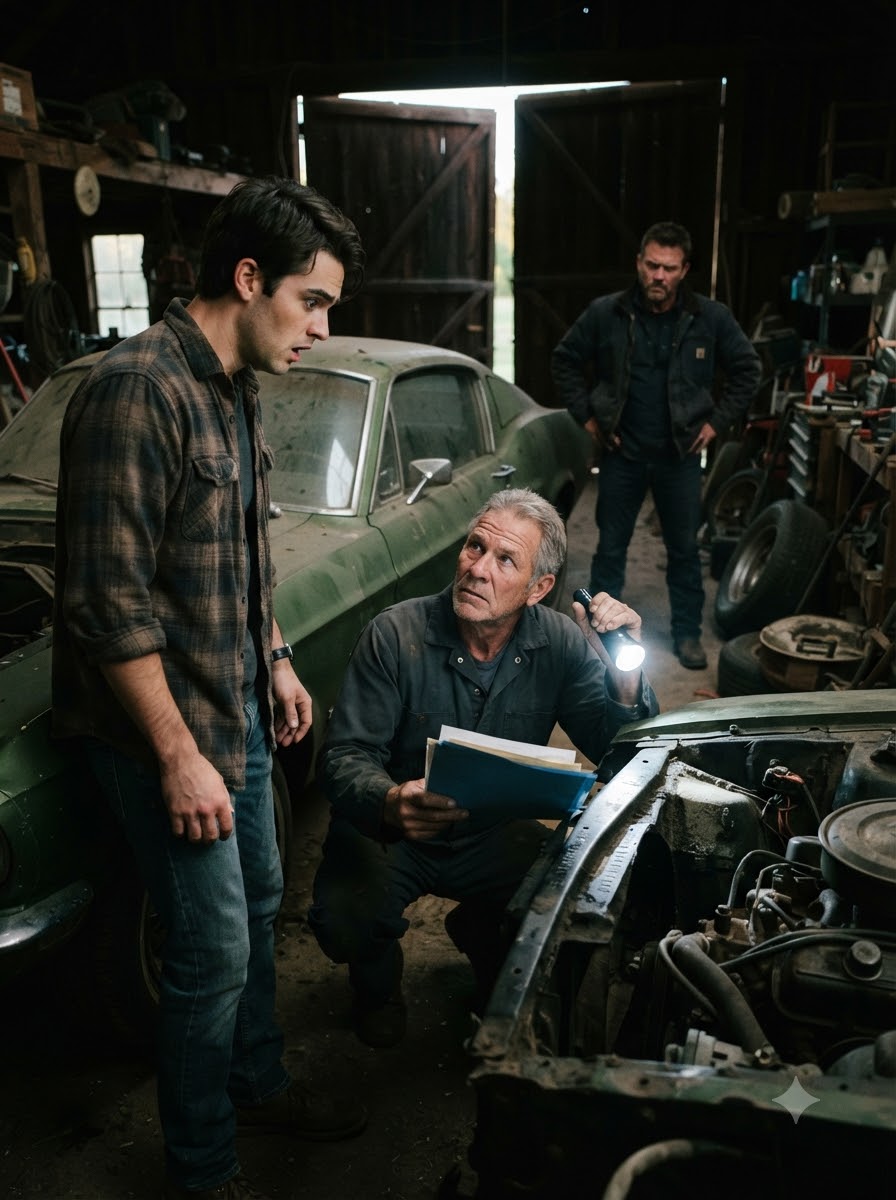
They moved a rusted, non-running 1967 coupe shell from Walter’s storage yard into Grandfather’s barn.
The shell had no usable engine, no valuable interior, and no matching parts. But its body lines were close enough. Walter painted it the same Highland Green and fitted it with wheels that looked right from a distance.
Then Grandfather created a duplicate folder.
Inside were photocopies, old receipts, and a title belonging to the shell. He made the papers appear hurried and incomplete. He left the folder on the workbench, where anyone searching for evidence would find it.
I thought the plan was clever.
I did not realize how frightened he had been.
“The real car needs to disappear,” Grandfather told me.
“Where?”
“Walter’s shop. But we’re doing more than hiding it.”
The following week, we went to the DMV together.
Grandfather wore his best jacket. I wore the shirt he had given me for Christmas, the one with the grease stain permanently embedded near the cuff.
A clerk named Marisol processed the transfer. Grandfather sold me the Mustang for one dollar.
I objected to the amount.
“You can’t give me a car worth that much for a dollar.”
“I can give you anything I want,” he said.
“People will think I took advantage of you.”
“Then let them think it. The price is not the protection. The paperwork is.”
He signed the bill of sale. I signed beneath him. Marisol verified both our identification cards and recorded the transfer. Before we left, Grandfather asked if he could make a video.
Marisol agreed as long as she remained off camera.
In the video, Grandfather stated his name, the vehicle identification number, the year and model of the Mustang, the sale price, and the fact that he was acting willingly and without pressure.
Then he turned to me.
“I rebuilt this car with my own hands,” he said. “I’m selling it to the person who helped me finish it.”
He looked directly into the camera.
“Anyone who says otherwise is trying to steal it.”