I Wheeled His Mother Into His Mistress’s Apartment—She Asked for a Hidden Folder
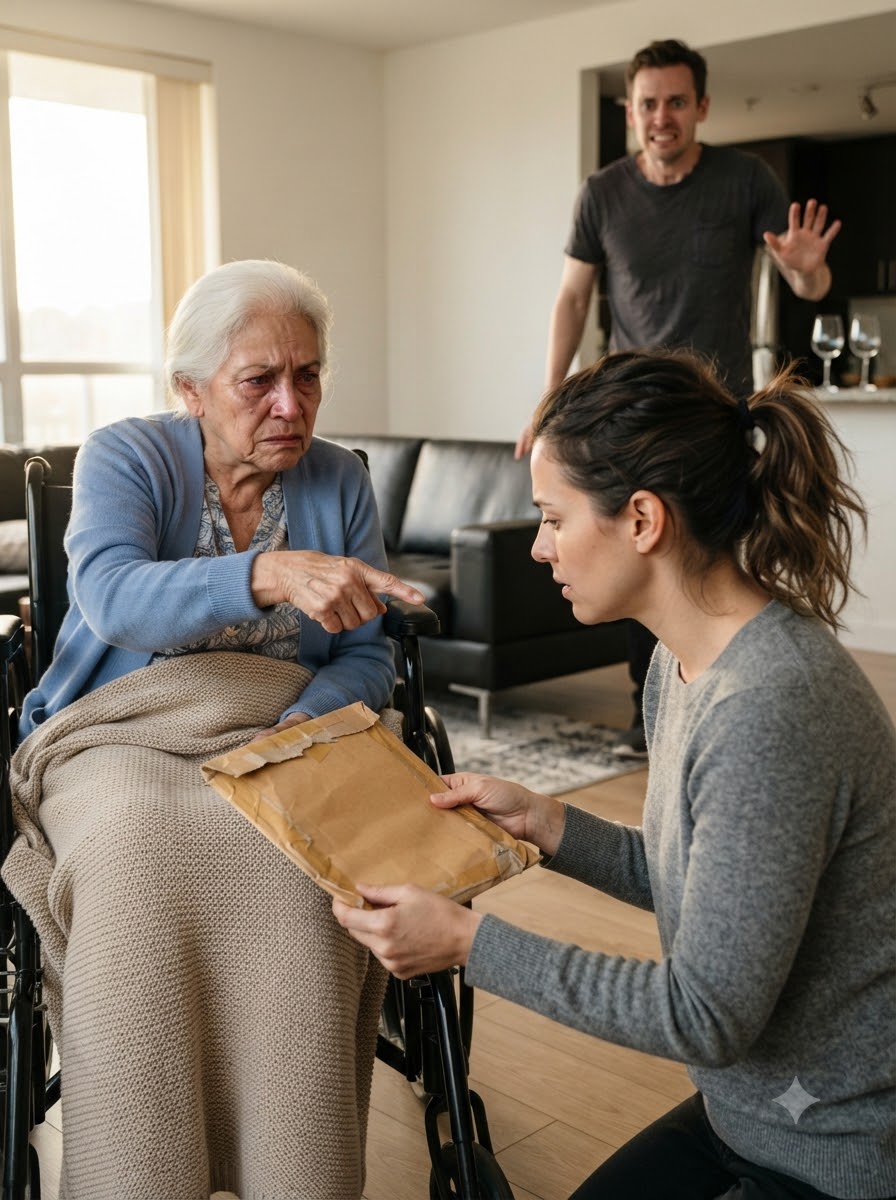
For seven years, I took care of my husband’s mother in every way except on paper.
Her name was Carmen. A few months before Miguel and I got married, she had a stroke that left her right side weak and unreliable. She couldn’t get out of bed by herself. She couldn’t bathe, dress, or use the bathroom without help. Her pills had to be crushed. Her body had to be turned at night so her skin wouldn’t break down. Every doctor’s appointment was a production of ramps, transfers, paperwork, and patience.
The week before the wedding, Miguel held my hands and promised, “We’ll do this together.”
That promise lasted about eight days.
After that, “together” meant I was up before sunrise washing Carmen and making breakfast while Miguel scrolled through his phone at the kitchen table. It meant I memorized every prescription and dosage while he shrugged and said, “You’re better with that medical stuff.” It meant I changed her wet sheets at two in the morning while he slept through her calls from the next room.
Whenever I asked him to step in, he smiled like he was praising me.
“You’re just better at it than I am. She gets upset when I try.”
I believed him for a long time. I thought he was overwhelmed, that seeing his mother so helpless broke something in him.
I didn’t realize he’d simply found someone to do it for free.
Carmen didn’t make it easier. Even after the stroke, she found the energy to criticize everything. My rice was too dry. The towels were folded wrong. The soup needed salt. When I sat down for ten minutes after lifting her into bed, she’d sigh loudly enough for me to hear it from the hallway.
I told myself she was scared, and that being dependent at her age would make anyone bitter.
So I kept going.
The truth came out on an ordinary Tuesday afternoon.
I was carrying a laundry basket past the coffee table when Miguel’s phone lit up. He was in the shower. I wasn’t snooping. The message was just there, bright and impossible to miss.
“This place is so much more fun than home. Stay with me again tonight?”
I stood frozen with an armful of his mother’s nightgowns.
For months, Miguel had said work was keeping him late. He’d said he needed space and time to clear his head. He’d said he was exhausted by “everything going on at home.”
Everything going on at home was me, keeping his mother alive while he slept with another woman.
When he came out of the bathroom with a towel around his neck, I held up the phone.
I didn’t ask who she was. I didn’t ask how long it had been going on, or whether he loved her.
I asked the only question that mattered.
“What’s your plan for your mother?”
His face changed, but it wasn’t guilt I saw. It was panic.
That told me everything. He was planning to leave me, but he wasn’t planning to take her. He wanted the girlfriend, the fresh start, and the freedom, while his wife stayed behind doing the work he’d dodged for seven years.
The next morning, he was gone.
He left no note, no money, and no care plan. He never said a word about her medications. He just packed a suitcase while I was helping Carmen with her breakfast and walked out.
For the next week, Carmen asked about him every day.
“Is Miguel working late again?”
“Is he eating properly?”
“Tell him his mother wants to see him.”
I didn’t have the heart to tell her. I kept crushing her pills, changing her clothes, washing her sheets, and cleaning the pressure sore that had opened on her hip.
I called Miguel every night, and every night it went to voicemail.
On the eighth morning, he finally picked up on the fourth ring.
“What?”
There was no hello and no question about his mother.
I kept my voice steady. “I’m bringing your mother to your apartment today.”
There was a long silence. Then he hung up.
I’d needed to know whether he would fight for even a moment, and now I knew.
That afternoon, I gave Carmen a slow, careful bath. I dressed her in the soft blue cardigan she liked and folded her favorite knitted blanket over her knees. Then I packed a big canvas bag with her prescriptions, creams, pads, extra linens, appointment cards, seven years of medical records, and a typed copy of her daily routine, the one Miguel had never once bothered to read.
When I told Carmen we were going to see her son, her whole face lit up.
“Miguel will be so happy,” she whispered.
I couldn’t answer her.
I’d gotten his address from a friend of his who felt guilty enough to give it to me. The building had polished stone floors, gold fixtures, and a lobby so quiet I could hear the wheelchair tires rolling across the marble.
For seven years I’d watched him complain about money while I clipped coupons and stretched groceries, and somehow he could afford this.
I rang the bell, and Miguel opened the door.
Behind him, a woman in a cream silk nightgown stood in the kitchen with a spoon hovering over a bowl of yogurt. She was younger than me, with perfect hair and bare feet.
She stared at me, then at Carmen, then at the bulging medical bag hanging from the wheelchair handles.
Nobody said a word.
Carmen beamed up at her son. “Miguel.”
All the color drained from his face.
“What are you doing?” he hissed at me.
I pushed the wheelchair past him and into the apartment.
“Bringing your mother home to her son.”
“You can’t just—”
“I can.”
I parked her beside his expensive gray sofa, adjusted the pillow behind her neck, and set the bag on his glass dining table.
The woman finally put her spoon down.
Miguel stepped closer and dropped his voice like we were discussing a restaurant bill.
“Take her back. We’ll talk about this later.”
It was the same assumption that had carried him through seven years of marriage: I would handle it, like I always had.
I unzipped the bag.
“Morning pills are in the blue container. Blood pressure medication is at eight. She needs to be repositioned every two to three hours, including overnight. The cream is for the sore on her hip. It has to be cleaned first. Her next neurology appointment is written inside the folder.”
Miguel stared at the bottles and pads like they belonged to a stranger.
The woman turned to him slowly.
“You told me your mother had someone taking care of her.”
He said nothing, so I answered.
“She did. It was me.”
Something shifted in her face, like a picture rearranging itself.
Miguel reached for my arm. I stepped back.
Then I looked straight at both of them.
“You wanted my place in his life. Congratulations. Now take the part he left out.”
Her spoon slid against the bowl with a sharp little clink.
Miguel went pale, and so did she.