Lily Said Her Bed Was Too Small—The Camera Caught Nathan’s Voice
At 2:07 in the morning, my mother-in-law opened my daughter’s bedroom door and climbed into her bed.
She did it quietly, as if she had done it many times before.
The security camera above Lily’s bookshelf captured everything: the slow turn of the handle, the gray-haired figure slipping into the room, the hand lifting the blanket, the deliberate way Eleanor Vance pressed herself against my sleeping eight-year-old granddaughter.
Lily stirred.
Then she moved toward the edge.
Her knees nearly touched the floor.
Eleanor settled behind her and wrapped one arm around Lily’s waist. For several seconds, she simply watched the child sleep.
Then she bent close to Lily’s ear.
I couldn’t hear the words through the camera’s weak microphone, but I saw Lily’s eyes open.
I saw her body go rigid.
And I saw Eleanor place one finger against her lips.
I watched the footage three times before I could breathe properly.
For weeks, Lily had been telling me her bed felt too small.
It was a ridiculous complaint on the surface. Her bed was enormous for a child. It was a six-foot upholstered frame with a thick mattress, wide enough for two adults to sleep comfortably. Her room was warm, bright, and carefully arranged. Fairy-tale books filled the shelves. A soft yellow nightlight glowed beside the dresser. Her stuffed rabbit, Button, slept beside her pillow every night.
I had created the room because I wanted it to feel safe.
I had never wanted Lily to fear being alone.
Every evening, I read her a story, kissed her forehead, and reminded her that I was only across the hall.
For years, she had fallen asleep easily.
Then, one Monday morning, she came into the kitchen with dark circles under her eyes and hugged me around the waist.
“Mom,” she whispered, “my bed felt too small.”
I glanced toward the hallway.
“You have the biggest bed in the house.”
She shrugged against me.
“It felt like someone was pushing me away.”
I assumed she had dreamed it.
The next morning, she said it again.
And the next.
“It feels like someone is beside me.”
“I wake up at the edge.”
“Can you leave my door open?”
I asked if she was having nightmares. She said no.
I asked if anything had happened at school. She said no.
I asked whether anyone had touched her or frightened her. Her face changed, but she shook her head.
That frightened me more than a clear answer would have.
One morning, while I was brushing her hair, she looked at me in the mirror.
“Mom,” she said, “did you come into my room last night?”
“No.”
“Are you sure?”
I turned her around.
“Lily, I would never lie about that. Why?”
She twisted the hem of her pajama top between her fingers.
“It felt like someone was lying next to me.”
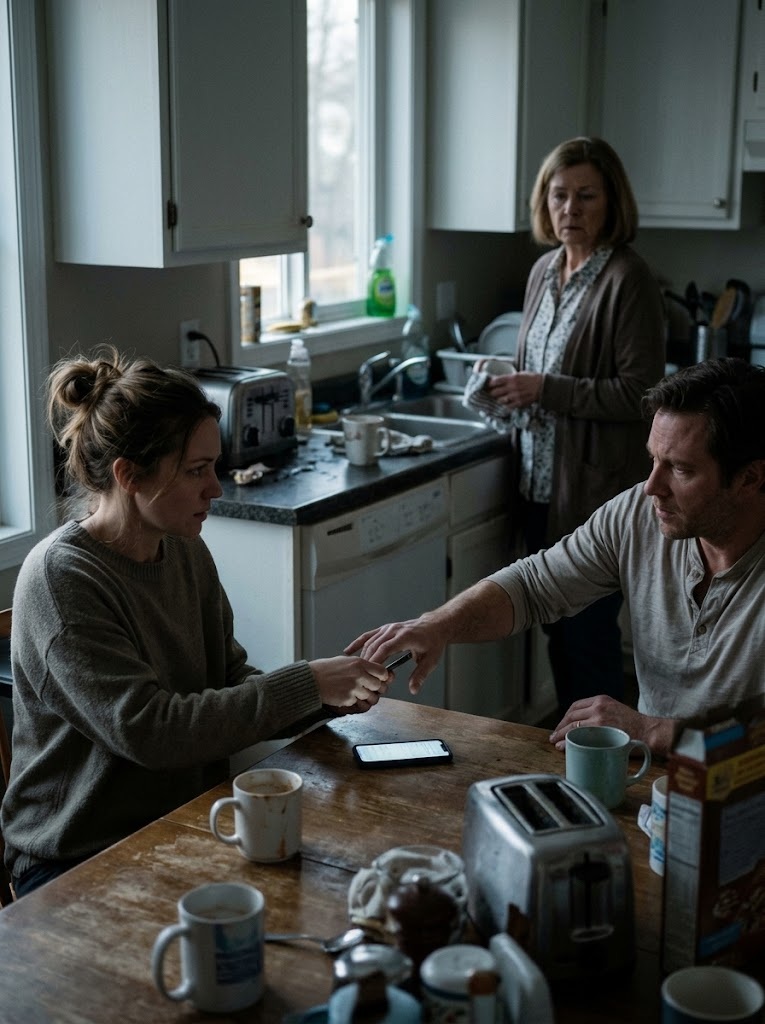
My husband, Nathan, was in the kitchen when I told him.
He was a surgeon, and after a night shift he often returned home exhausted, with his mind still inside the hospital. He was scrolling through messages while drinking coffee.
“The doors are locked,” he said. “Nobody is getting inside.”
“I know that.”
“Then it was a dream.”
“She keeps saying the same thing.”
“Kids repeat things.”
He said it lightly, but there was something too quick in his response.
I looked at him.
“You don’t think it’s strange?”
Nathan finally raised his eyes.
“I think you’re scaring yourself.”
That afternoon, I bought a small indoor security camera. I told myself it was for peace of mind. I told Lily it was a new monitor that would let me check on her if she needed me.
She accepted that explanation.
Eleanor did not.
She was staying with us temporarily while renovations were completed at her condominium. She had arrived three months earlier with two suitcases, a stack of prescriptions, and a wounded expression that made refusing her impossible.
She had always been difficult, but recently she had become something else.
Possessive.
She wanted to take Lily to school, pick her up, help her bathe, and put her to bed. If I entered the room while they were together, Eleanor’s face tightened.
“A grandmother needs private time with her granddaughter,” she once said.
“Of course,” I replied. “But I’m her mother.”
Eleanor looked over Lily’s head.
“Blood is not the only thing that makes a family.”
I asked what she meant.
She smiled without warmth.
“Children remember who truly raises them.”
Other comments followed.
“A child should know where she belongs.”
“Some mothers are only temporary guardians.”
“Family history has a way of correcting itself.”
Whenever I mentioned the remarks to Nathan, he dismissed them.
“She’s lonely.”
“She’s adjusting.”
“She says strange things when she’s anxious.”
Once, Eleanor found me looking through Lily’s school papers and said, “You should be careful. If anyone questioned your fitness, your little routines wouldn’t protect you.”
I stared at her.
“Are you threatening me?”
She laughed.
“Don’t be dramatic.”
After that, I began keeping my bedroom door locked at night.
I didn’t tell Nathan.
The night I installed the camera, Lily went to sleep at 8:43. I sat in the darkened kitchen, pretending to read while watching the live feed on my phone.
For two hours, nothing happened.
At 2:07, the bedroom door moved.
Eleanor entered.
She was wearing a long gray robe. In one hand, she held something small and pale. She crossed to the bed, tucked the object beneath Lily’s pillow, and climbed in.
When Lily stirred, Eleanor whispered into her ear.
This time, I turned up the volume.
The words came through in a thin, breathy murmur.
“Your mother is going to take you away from me.”
Lily made a small sound.
Eleanor tightened her arm.
“Listen to me. She doesn’t love you the way I do. She wants to send you away. She told your father you were too difficult.”
Lily’s eyes opened wider.
“If you tell her I came here, she’ll be angry. She’ll blame you. Then she’ll take you somewhere you can’t come back from.”
My hand covered my mouth.
Eleanor continued.
“You belong with your father’s family. You belong with me. When the time comes, you must tell the judge you want to live here.”
She pressed her lips to Lily’s hair.
“Say it.”
Lily’s mouth moved.
“I want to stay.”
“Louder.”
“I want to stay.”
Eleanor smiled.
Then she placed the pale object beneath the pillow and pulled the blanket up around Lily’s shoulders.
I was so stunned I couldn’t stand.
My daughter had not been imagining someone beside her. She had been physically pushed toward the edge while a grown woman filled her with terror.
But the last sentence echoed most loudly.
When the time comes, you must tell the judge.
I had no idea what Eleanor was planning.
I saved the footage to three separate locations. I downloaded it to my laptop, sent it to a private email account, and copied it onto a flash drive. Then I opened the camera’s earlier recordings.
There were nine nights.
On seven of them, Eleanor entered Lily’s room.
The first time, she stayed for six minutes.
The second time, twenty-three.