My In-Laws Used Our Spare Key—Then Denise Played Adam’s Voicemail
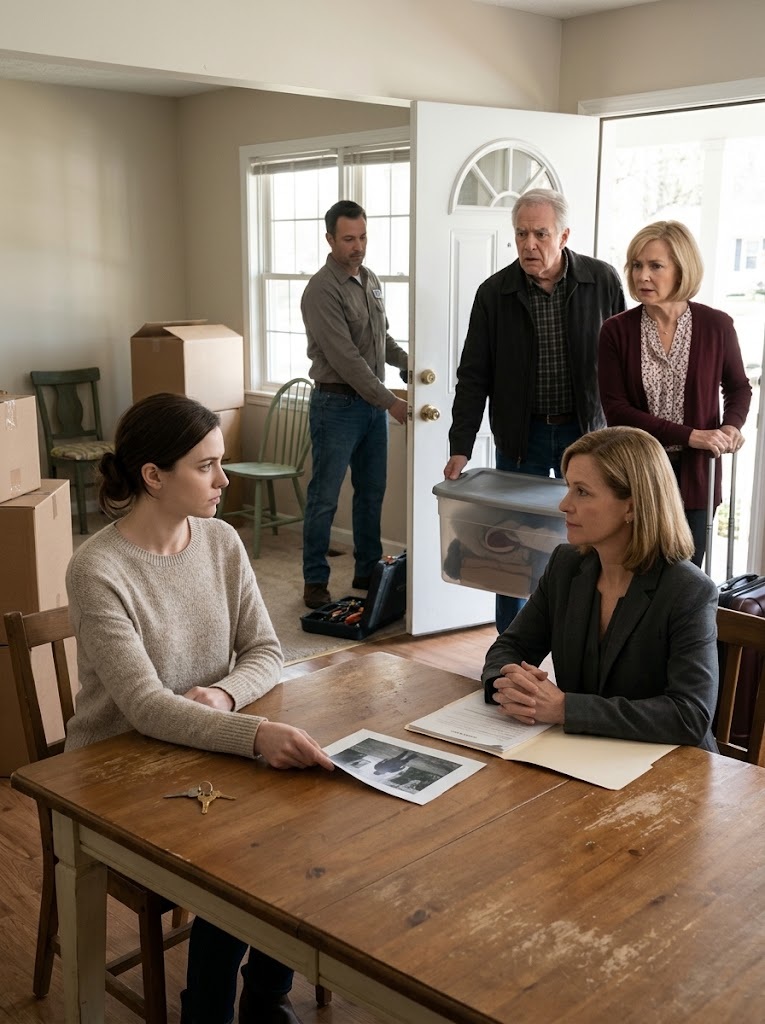
The front door opened at 2:07 on Monday afternoon, and my mother-in-law walked into my house carrying enough luggage to stay for months.
George came first, bent around a large plastic storage bin. Marsha followed with two rolling suitcases and a canvas tote bulging with shoes.
Neither of them knocked.
“Put the winter things in the office closet,” Marsha said. “Adam said Claire barely uses that room.”
Then she looked up.
I was sitting at the dining table.
Across from me sat Denise, our property manager, with a copy of our lease open in front of her. Beside her stood a locksmith holding a new deadbolt.
Marsha’s hand slipped from the suitcase handle.
George stopped so abruptly that the storage bin struck his knee.
For a moment, nobody spoke.
Then I slid a photograph across the table.
It showed Marsha in my office three days earlier, leaning over an open drawer where I kept our tax returns, bank statements, and insurance papers.
Her face was turned toward the camera.
There was no mistaking her.
“What is this?” she whispered.
Denise looked at the key still pinched between George’s fingers.
“That,” she said calmly, “is what we were hoping you could explain.”
A week earlier, I had believed my problem was a spare key.
The real problem was that my husband had already given away much more than access to our house.
The argument began the morning after Adam and I moved in.
Cardboard boxes covered half the living room. I was trying to find the coffee filters when his parents arrived carrying muffins and a stapled packet labeled BASIC HOME MANAGEMENT.
George had made it himself.
It included suggested thermostat settings, a gutter-cleaning schedule, recommendations for lawn care, and a page titled “Rules for Preserving Property Value.”
We were renters.
George walked through the rooms tapping walls, testing faucets, and criticizing the placement of furniture we had not even unpacked.
Marsha opened cupboards without asking.
She had a way of inspecting my life while pretending to help.
Finally, George stood in the middle of the living room and extended his hand.
“So,” he said. “When do we get our spare key?”
I laughed because the alternative was admitting he was serious.
Marsha did not laugh.
“Family needs access in an emergency,” she said. “Suppose you’re away and a pipe bursts?”
“The property manager has an emergency key.”
“That isn’t the same.”
“It seems exactly the same.”
George lowered his hand, but his expression hardened. He was not accustomed to being denied anything by Adam.
My husband caught my eye from the kitchen.
It was the look he always gave me when his parents pushed too far.
Don’t make this a thing.
Then, before I understood what he was doing, Adam opened the utility drawer, removed the spare key, and placed it in his father’s palm.
“Just for emergencies,” Adam said.
George closed his fist around it.
Marsha smiled at me.
“See?” she said. “Easy.”
I waited until they left before confronting Adam.
“You had no right to do that.”
“It’s my house too.”
“It’s our rented house, and we agreed nobody else would have a key.”
“They’re my parents, Claire, not strangers.”
“Then they can knock like everyone else.”
Adam rolled his eyes.
“They’re trying to help. You interpret everything they do as an invasion.”
He said it with such weary certainty that I almost questioned myself.
Almost.
Two days later, I came home to find the coffee mugs rearranged.
It was a tiny thing. The blue mugs had always been on the lower shelf, handles facing right. Now they were on top, sorted by size.
Adam said he had not touched them.
The following afternoon, the medicine cabinet was open.
On Friday, a folder containing our lease and renters insurance documents was no longer aligned with the edge of my desk.
I was precise about that room because I worked there. Everything had a place. Adam teased me about it, yet now he claimed not to notice anything different.
“My parents aren’t sneaking around our house,” he said.
“I didn’t say they were.”
“You didn’t have to.”
That evening, I emptied my office wastebasket and found a crumpled lemon-scented cleaning wipe.
I did not buy lemon wipes.
Marsha used them for everything. She carried a packet in her purse and wiped restaurant tables before sitting down.
When I held it up, Adam looked irritated rather than surprised.
“It probably got mixed in with the moving stuff.”
“It was wet yesterday.”
“Then maybe your mother came by.”
“My mother lives three hours away.”
He turned back to the television.
I stood there holding that sharp-smelling yellow cloth and realized my husband was not confused.
He was covering for them.
The next morning, I called Denise.
At first, I felt ridiculous explaining the mugs, the cabinet, and the wipe. Then I mentioned the key.
Denise went silent.
“Your lease prohibits transferring or copying keys to non-residents without written permission,” she said. “Did you authorize this?”
“No.”
“Did Adam request approval?”
“Not that I know of.”
I heard keyboard clicks.
“He did send an email asking about adding temporary occupants,” she said.
My skin prickled.
“When?”
“The day after you signed the lease.”
“What did you tell him?”
“That all adult occupants require an application, screening, and the consent of every current tenant.”
I gripped the phone.
“He never told me.”
Denise paused.
“Claire, have George or Marsha moved belongings into the house?”
I looked toward the guest room.
Its closet door stood open by an inch.
I had vacuumed in there the previous day and knew I had closed it.
Behind the vacuum cleaner, I found a new case of the mineral water George drank and a navy garment bag embroidered with the initials M.E.H.—Marsha Elaine Hart.
On the upper shelf were two shoe boxes and a plastic pouch containing prescription bottles.
I photographed everything.
That night, I gave Adam one final chance.
“Did you tell your parents they could live here?”
He kept scrolling on his phone.
“They’re renovating. There’s a timing issue.”
“That isn’t an answer.”
“They might need the guest room for a few nights.”
“They’ve already put clothes and medication in the closet.”
His thumb stopped.
Then he shrugged.
“It’s not a crime to store a few things.”
“How long is ‘a few nights’?”
“Why are you determined to make this hostile?”
“How long?”
He finally looked at me.
“Six or eight weeks. Maybe longer if the contractors run behind.”
I stared at him.
His parents had spent four months “renovating” their kitchen when all they had done was replace the counters.
“You agreed to this without me.”
“They need help.”
“They own a four-bedroom house.”
He looked away.
Not an emergency key.
Not a short visit.
An arrangement.
I sent the photographs to Denise and asked her to meet me Monday.
On Sunday evening, I installed a small motion-activated camera in my office. It faced the desk and filing cabinet, not any private area. I placed a thin strip of paper inside the drawer and left a bank statement visible beneath it.
At 11:42 the next morning, while I was supposedly at work, my phone alerted me to movement.