My Father-in-Law Mocked My Service—Until Brandon Opened the Folder He Hid
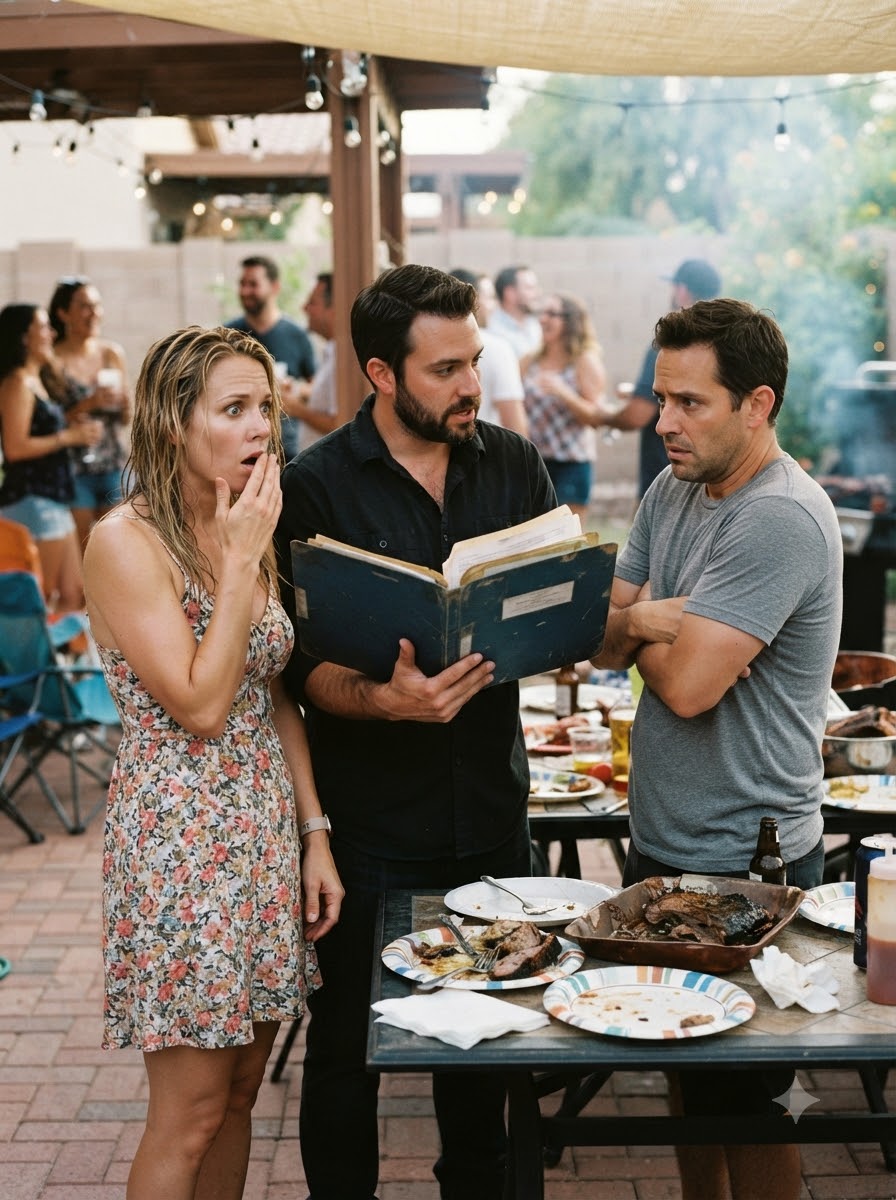
“Nobody invited you,” my father-in-law said.
He said it with a beer in one hand and the backyard gate in the other, as if he were announcing a change in the weather.
I was standing three feet away with a foil-covered brisket warming my palms.
For eighteen years, Michael Fields had found a way to make me feel like an intruder in every room where I had cooked, cleaned, comforted, or quietly paid the bill.
This time, thirty relatives heard him.
He looked past the brisket and straight at my face. “This is a Fields family cookout.”
I glanced over his shoulder. His sister, Carol, had stopped arranging paper plates. Two of Michael’s nephews stared at the grass. His wife, Ellen, stood near the grill with a dish towel in her hands.
Nobody said anything.
Michael smiled.
“You’re a cook,” he added. “Always were.”
The words landed harder than they should have. Maybe because I had spent years pretending they didn’t matter. Maybe because I had spent the entire morning making his mother’s brisket recipe, the one Ellen taught me when I was newly married and desperate to be accepted.
I set the dish on the patio table.
“Enjoy lunch,” I said.
Then I walked away.
I didn’t slam the gate. I didn’t cry. I didn’t give Michael the dramatic scene he could later retell as proof that I was unstable, oversensitive, or exactly as useless as he claimed.
I crossed the concrete toward the rental car while the sprinkler hissed behind me and classic rock played through a portable speaker.
I was almost to the driveway when a silver pickup rolled in.
The driver’s door opened.
Brandon Fields stepped out.
He had been missing from family gatherings for nearly six years. He was leaner than I remembered, with close-cropped hair, a weathered face, and a prosthetic left leg visible beneath his cargo shorts. He shut the truck door and looked toward the backyard.
Then he saw me.
“Christina?”
I stopped.
Brandon’s gaze moved past me to his father, who was still leaning against the gate with his beer. Michael’s satisfied expression faded.
Brandon walked toward us.
“What did you say to her?”
Michael lifted his chin. “This doesn’t concern you.”
Brandon kept coming.
He reached his father, grabbed him by the arm, and pulled him away from the gate. The bottle slipped from Michael’s hand and struck the concrete, spraying beer across both their shoes.
“What did you say?” Brandon repeated.
Michael yanked his arm free. “I told her the truth. This is a family gathering. She married into the family.”
Brandon’s face went still.
Not calm. Still.
I had seen that expression before, years earlier, on soldiers who had just received news they were not emotionally prepared to survive.
He turned to me.
“You never told them,” he said.
I didn’t know what he meant.
“Told us what?” Ellen asked from the patio.
Brandon looked at his father again.
“She was the reason I came home alive.”
The backyard fell silent.
Michael laughed once, too loudly. “Oh, don’t start this.”
Brandon ignored him.
“Christina found the route change,” he said. “The one that sent our convoy through Qarim Pass. She flagged it twice. Three times, actually. Your father buried the warning.”
I felt the old heat rise in my chest.
“Brandon,” I said quietly.
But he was already speaking.
“She got the warning pulled back through channels after my unit was ambushed. She found out someone had altered the movement schedule. She gave my commander the alternate route. We took it the next morning.”
Michael’s face had gone gray.
Brandon pointed at the prosthetic leg beneath his shorts.
“I lost this leg two days later because the backup vehicle ignored the route. But I lived because she kept digging.”
A child began to cry near the sprinkler. Someone hurried to pick him up.
Michael shook his head. “She’s been filling your head with nonsense.”
“I never spoke to Brandon about it,” I said.
“Of course you didn’t,” Michael snapped. “You love pretending to be important.”
Brandon reached into the pocket of his cargo shorts and pulled out a small plastic evidence bag.
Inside was a brass key.
“Then maybe you’ll explain this,” he said.
Michael stared at it.
Brandon turned to the family.
“Dad gave me this key when I was in the hospital. Told me it opened a storage unit where he kept my Army papers and some old family documents. He said he was protecting me from Christina.”
Michael’s mouth tightened. “I never said that.”
“You said she was using me. You said she wanted credit for my injury.”
“That is not what happened.”
Brandon held up the bag. “I found the key in your desk three weeks ago. I used it on the unit.”
Michael took one step toward him.
“What did you find?” Ellen asked.
Brandon looked at her. “Boxes. A locked file cabinet. And a recorder.”
The air seemed to leave the yard.
I thought of Michael’s favorite story about me: Christina sits behind a computer. Christina pushes paper. Christina has never done anything real.
He had never asked what kind of paper.
I grew up on Army posts. My father taught me to read topographic maps before I could reach across the kitchen table. My mother taught me how to keep my voice level when people tried to provoke me.
I joined the Army at twenty-two and served in military intelligence for two decades. I spent two combat deployments analyzing movement patterns, intercepts, informant reports, and operational changes. I helped commanders decide where soldiers would travel and which roads they should never take.
Much of that work remained classified.
I could not defend myself at Christmas by spreading reports across the dessert table.
So I stayed quiet.
After I retired, I worked as a civilian intelligence analyst in Georgia. Derek knew the truth. He had always known. But when his father insulted me, Derek usually said, “That’s just Dad,” as if cruelty were a personality trait nobody could challenge.
I had stopped expecting protection from him.
I had not expected Brandon to provide it.
Michael looked around the yard, searching for someone to join him.
“You’re all going to believe him?” he demanded. “He’s been bitter for years. He blames me for his injury.”
Brandon’s jaw tightened.
“You told everyone I was careless,” he said. “You told people I ignored instructions.”
“You did.”
“No. I followed the route your company submitted.”
Michael looked at me. “And now she’s turned him against me.”
I finally spoke.
“What company?”
He hesitated.
Brandon answered for him. “Fields Tactical Logistics.”
A few relatives exchanged glances.
Michael had started the company after retiring from municipal contracting. He bragged about supplying bases overseas, though he always described his work as simple transportation and equipment management.
I remembered his old jokes. How he knew which units were moving before the newspapers did. How he could arrange trucks in places where no trucks were supposed to be available. How he told people the military was “one big filing cabinet” if you knew which drawer to open.
At the time, I thought he was exaggerating.