Richard Took My Children—Then My Mother’s Safe Exposed His Custody Lie
Richard told me I was useless while I was still wearing the dress I had ironed for court.
He said it quietly, near the water fountain, while his lawyer packed away the exhibits that showed his income, his house, and the photographs of our children’s tidy bedrooms. I had brought photographs too. Emma making pancakes with flour on her nose. Tyler asleep against my shoulder. The judge had not been deciding who loved them more, though. She had been deciding where they would live while our divorce continued.
Richard had a salary, a lawyer, and the house. I had been out of paid work since Tyler was born.
When the judge ordered that Emma and Tyler remain with him under temporary custody, Richard leaned close enough that no one else could hear.
“You should have listened when I said you couldn’t do this without me.”
Outside, Emma spotted me through the rear window of his BMW. She was eight, old enough to know something terrible had happened and too young to understand why nobody would fix it. She put her palm against the glass.
I raised mine. Richard pulled out before I reached the car.
Two hours later, I arrived at my mother’s farmhouse with one suitcase, twelve hundred dollars, and a custody order granting me two supervised visits a week. The porch sagged. The kitchen smelled of cedar and the lavender soap my mother used to buy by the case. I set my suitcase down and gripped the counter until the shaking passed.
My mother, Evelyn, had been dead for eleven months. I had delayed coming back because every room still contained some version of her. That night, I slept beneath a sheet that smelled faintly of her linen closet and woke before dawn expecting to hear her kettle.
Instead, I heard rain finding a leak above the pantry.
I put a bowl beneath it. Then I made a list.
Find work. Fix house. Get lawyer. See children.
I wrote the last line twice.
For three days, I cleaned because cleaning had an end I could see. I patched the porch screen and coaxed the furnace into starting. On the fourth day, Mrs. Henderson arrived from next door carrying tuna noodle casserole and a face full of concern.
She watched me clear a place for the dish among my mother’s old mail.
“Your mother was proud of that economics degree of yours,” she said. “She kept an article from your college paper about a scholarship you won.”
“That was a long time ago.”
“Richard liked everyone thinking you couldn’t manage money.” She adjusted the casserole dish. “Evelyn didn’t.”
I almost told her Richard had only worried about me. The words rose automatically, worn smooth by ten years of use. I let them die.
The following week, Mountain View Community Bank hired me part-time. The manager, Denise Alvarez, began our interview by asking whether I was comfortable balancing a cash drawer. Twenty minutes later, we were discussing loan-loss reserves and why a local developer’s projected rental income made no sense.
Denise sat back. “Why haven’t you worked in banking before?”
“I meant to,” I said.
She offered me fifteen dollars an hour. I accepted before she could change her mind.
At night I sat at my mother’s kitchen table with a notebook, adding my wages to the twelve hundred dollars and subtracting gas, groceries, and the repair the roof would soon need. The attorney I had consulted wanted a retainer I couldn’t pay. Richard’s lawyer had called me financially unstable. Looking at those numbers, I understood why Richard had sounded so certain in court.
Then, on a cold Saturday afternoon, I noticed the paneling on the side porch.
One narrow board had been cut more precisely than the others. Its paint was the right color but not quite as cracked. I fetched a crowbar, worked it into the seam, and pulled.
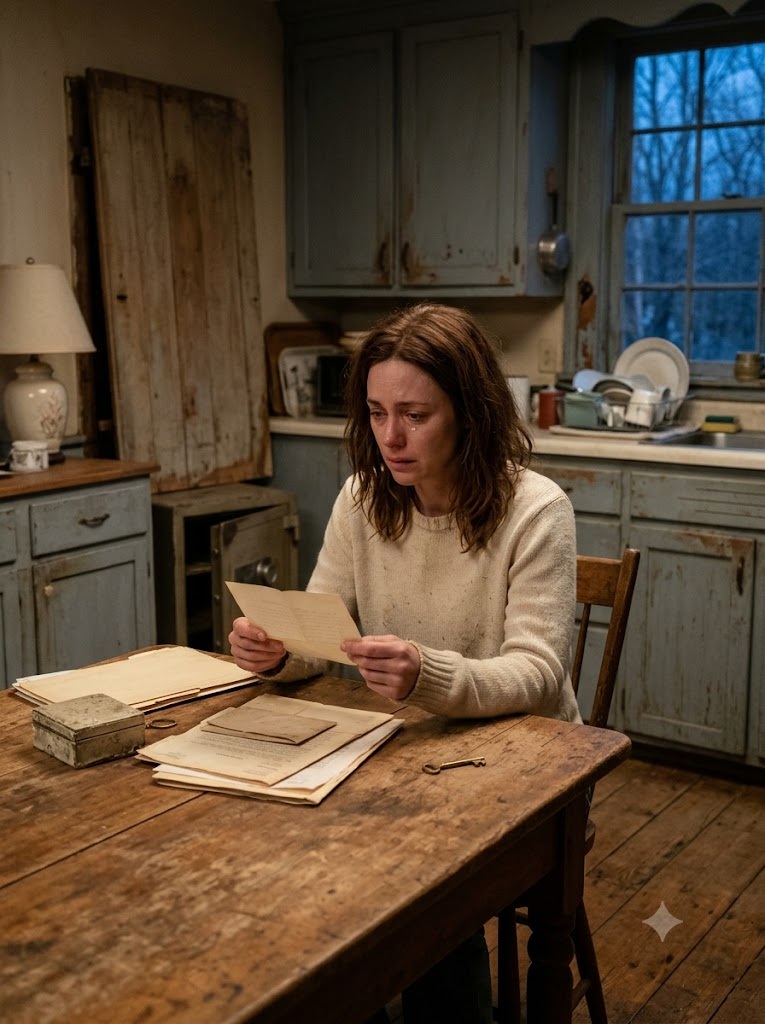
Behind the board was a compartment between the porch and pantry walls. Inside it sat a metal safe wrapped in thick plastic.
I carried it to the kitchen table. My mother’s birthday failed. So did the year my father died. I stared at the four-number lock for a long time before trying the month and day I was born.
It opened.
On top lay an envelope with my name in my mother’s handwriting.
“My dearest Miranda,” it began, “if you are reading this, then he finally made you believe you had nothing.”
I read that sentence three times.
My mother wrote that she and my father had invested steadily for decades. She had kept living in the farmhouse, driving the same car, and buying coats only when the old ones wore through. Richard knew the house was mine, but he had never been curious about its contents. My mother had counted on that.
“I couldn’t choose your marriage for you,” she wrote. “I could make sure you had choices if it ended.”
Beneath the letter were account statements, deeds to two small rental houses, bond records, and a life insurance policy naming me as beneficiary. There was a key taped to a County National Bank card and a folder of instructions for an attorney named Nora Bell. The estate paperwork my mother had given me the year before suddenly made sense: the assets were held in a trust I had become entitled to administer when she died.
I stayed up until two in the morning checking dates and totaling balances. Even before the rental properties, there was enough to pay a lawyer and repair the roof. I put my pencil down and cried harder than I had in the courthouse.
Then I found the last folder.
On its tab my mother had written: For custody court, if Richard uses the children.
Inside was a copy of a check made out to Cedar Grove Academy for $18,400. The check was drawn on a savings account I had opened before I married Richard, an account I believed had been closed years ago. My signature on it was a careful imitation.
Behind it were account statements showing three withdrawals I didn’t recognize. Then came a letter from the bank to my mother, acknowledging her request for copies of the transaction records. The money had been used for Emma’s school tuition and a deposit on Richard’s office lease.
Richard had once told me his firm paid that tuition as a benefit. He had used my savings and let me thank him for it.
There was more. My mother had saved an email from Richard asking her to persuade me to sign away my interest in our marital home during a refinance. He described it as “a formality Miranda doesn’t need to get bogged down in.” Attached was a draft letter for my mother to send, explaining that I had always found financial matters overwhelming.
My mother had replied, “Miranda understands numbers perfectly well. Do not ask me to tell her otherwise.”
I could hear her voice in that sentence.
At the bottom of the folder lay a small digital recorder in a padded sleeve and a note. My mother had recorded conversations in her own kitchen after Richard began visiting her without me. She had written down the dates and kept the original device. I listened with both hands around a mug of cold tea.