Our Adopted Son Feared We’d Return Him—Then He Found Who Ruined Us
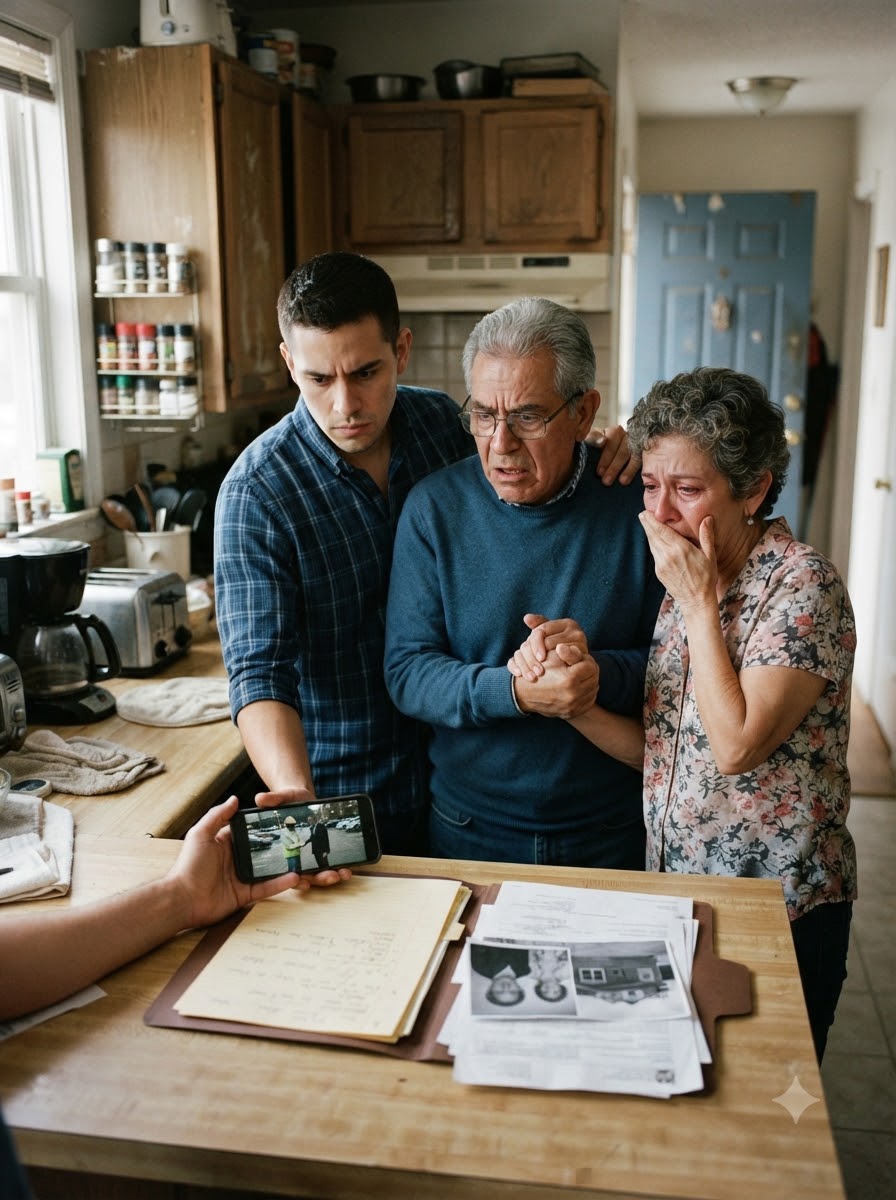
The night I learned our ruin had not been an accident, my son was standing in our kitchen with blood on his sleeve and my brother-in-law’s phone in his hand.
It was nearly midnight.
Raúl and I had spent the evening packing twenty-three years of our life into grocery-store boxes because the bank was scheduled to take possession of our house the following Friday.
The cabinet shop was gone. Our savings were gone. Even my wedding ring was sitting in a pawnshop on Fredericksburg Road.
Mateo had been out helping an HVAC crew with an emergency call. I heard his truck pull up, then the back door opened so hard it struck the wall.
He came in breathing fast.
“What happened?” I asked.
“I need you both to listen before anybody calls Pilar.”
Raúl rose from the table.
The blood was from a cut along Mateo’s forearm. Not deep, but ugly.
In his other hand was a black phone in a cracked leather case.
I recognized it immediately.
“That’s Tomás’s,” I said.
Tomás was my sister Pilar’s husband. He had handled the books for Raúl’s shop for twelve years. He had also been the person sitting beside us at the bank when Raúl borrowed against our home to keep paying his employees.
Mateo placed the phone on the table as though it might explode.
“I found him inside the shop.”
Raúl’s expression hardened. The property had been locked since the liquidation company took inventory.
“Doing what?”
“Removing files from the office.”
Mateo had driven past after work and seen a light in the back. When he entered through the loading bay, he found Tomás stuffing folders into a plastic bin.
Tomás claimed he was collecting tax documents for Raúl.
Then Mateo saw him toss something into the old scrap burner.
“He tried to burn the ledgers,” Mateo said. “When I grabbed one, he shoved me into a rack.”
My husband stared at the blood.
“He did that to you?”
“I cut myself on a hinge. He ran. Dropped the phone.”
“Why would Tomás burn anything?” I asked, though part of me already knew.
Mateo looked at Raúl.
“Because Victor Salazar didn’t simply stop paying you.”
Victor was the commercial contractor whose bankruptcy had destroyed us. His company had owed the shop more than two hundred thousand dollars for custom cabinetry installed in three apartment developments.
For months, Victor had blamed delayed inspections and frozen construction loans. Raúl had believed him because they had worked together for six years.
Then Victor’s company filed for bankruptcy.
Raúl’s unpaid invoices became nearly worthless claims behind banks, tax agencies, and secured lenders. The shop collapsed under the cost of materials and wages already paid.
Mateo unlocked Tomás’s phone.
The screen displayed a photograph of a bank transfer.
Victor Salazar’s company had sent forty-eight thousand dollars to a business called TMG Consulting three weeks before filing bankruptcy.
The registered owner of TMG Consulting was Tomás Gabriel Mendoza.
My brother-in-law.
Raúl lowered himself into a chair.
“No,” he said.
Mateo swiped to the next image.
Another transfer. Thirty-two thousand dollars.
Then another.
There were text messages beneath them.
V: Once R signs the revised completion certificates, I can move the final draw.
T: He won’t read them. He trusts me.
V: Make sure the cabinet invoices stay in the old company.
T: And my percentage?
V: Same account as before.
For a long time, the only sound in the kitchen was the hum of the refrigerator we had promised to leave for the bank.
Raúl read the messages twice.
Then he whispered, “He sat at this table.”
Yes.
Tomás had sat at that table and explained why we had to use our savings.
He had sat there when Raúl signed the home-equity loan.
He had brought Pilar with him the night we decided to sell the house, carrying supermarket chicken and saying family stood together in hard times.
Mateo put a scorched ledger beside the phone.
“I think this is only part of it.”
Six weeks after Raúl and I adopted Mateo, I found him on our couch at two in the morning, fully dressed.
His shoes were tied. His little backpack was locked against his chest.
He had already been returned by three families.
At the county family-services office in San Antonio, his caseworker had warned us that he might reject affection before we could reject him.
“Previous placements described him as difficult,” she said gently.
Across the room, nine-year-old Mateo sat rigidly on a plastic chair, his hands flat on his knees. Toys were scattered beside him, untouched.
He looked like a child trying not to leave fingerprints on anyone’s life.
My sister Pilar told me Raúl and I were too old to make our lives harder on purpose.
I looked around our quiet kitchen, at a table built for more people than ever sat around it.
“Maybe hard isn’t the same as wrong,” I said.
The first months with Mateo were careful and strange.
He asked permission before opening the refrigerator. He folded his pajamas every morning. If we asked what he wanted for dinner, he said anything was fine.
He never called us Mom or Dad.
Then came the night with the backpack.
“Are you running away?” Raúl asked from the hallway.
Mateo shook his head.
“I’m ready.”
“For what?”
“In case you tell me to go.”
I sat at the opposite end of the couch. Every instinct told me to pull him close, but he was a child who needed space more than touch.
“Not tonight,” I said. “Not because you get angry someday. Not because you get a bad grade. Not because this is harder than we expected.”
He watched my face as if promises were tricks adults performed before changing their minds.
Trust did not arrive all at once.
It came in ordinary pieces.
At eleven, Mateo asked if he could paint one wall of his bedroom blue.
At fourteen, he stopped keeping his backpack packed.
At seventeen, after a fight over curfew, he slammed his bedroom door. Ten minutes later, he opened it again.
“You’re still mad?” he asked.
“Very.”
“You’re not sending me anywhere?”
“No. But you’re grounded.”
He laughed so hard that Raúl had to look away to hide his smile.
Now Mateo was twenty-two, and the three of us sat at the same kitchen table while proof of our betrayal glowed on Tomás’s phone.
By sunrise, we had photographed every page of the burned ledger.
Raúl wanted to confront Tomás immediately. Mateo stopped him.
“If he was destroying records, he knows someone may be looking,” he said. “We need everything first.”
It startled me to hear such steadiness in his voice.
I still saw the boy with the packed backpack. But he had become a man who repaired rooftop compressors in August heat and saved every spare dollar for certification courses.
He understood systems. He knew that when one part failed, you did not simply strike it harder. You traced every line until you found the break.
We called an attorney named Elena Marquez, whose daughter attended the middle school where I worked in the cafeteria.
Elena met us before her office officially opened.