My Son Called Me a Burden—Then His Key Stopped Working
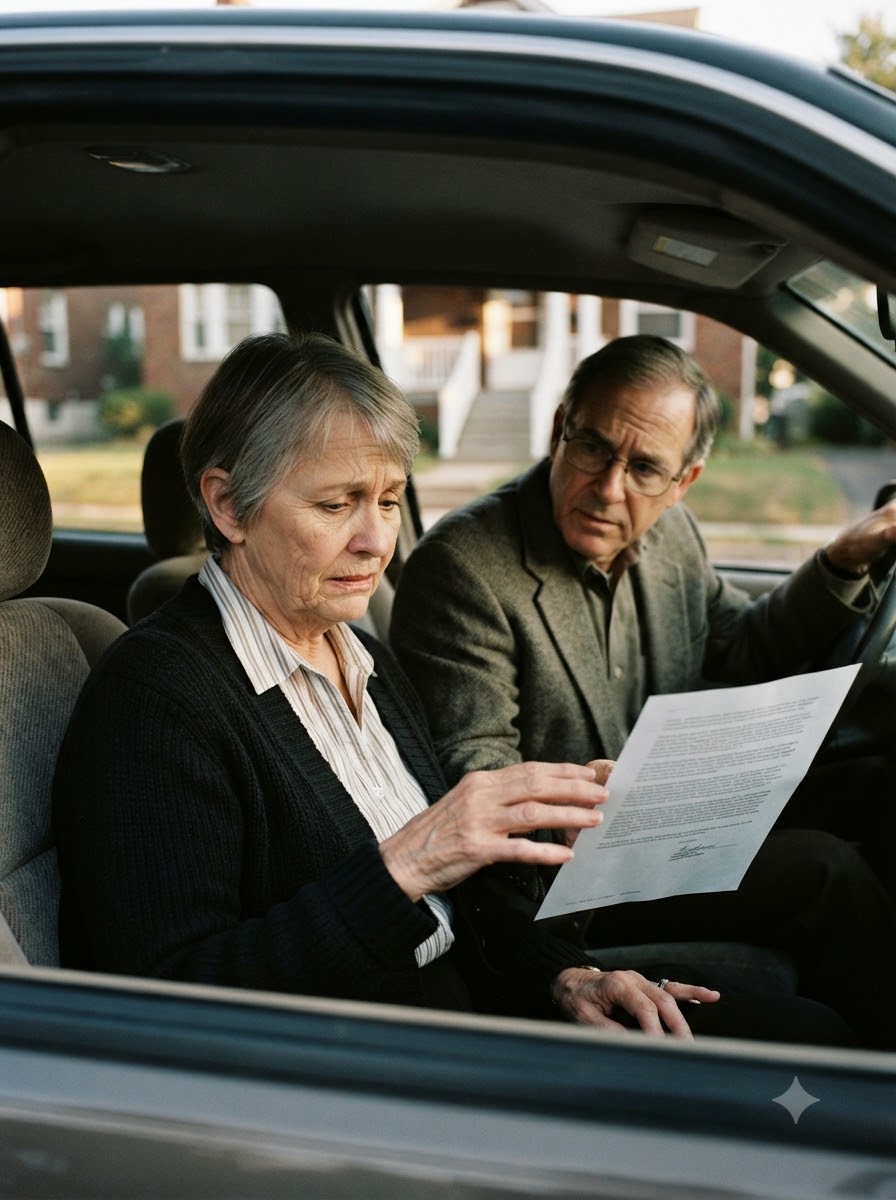
The key would not turn.
Daniel stood on the porch in his airport clothes, one hand gripping a hard-shell suitcase and the other twisting the silver key in the lock.
He tried once.
Then again.
On the third attempt, he leaned his shoulder against the door as if force might persuade it to remember him.
Melissa stood behind him in oversized sunglasses, a row of shopping bags hanging from one wrist. A silk scarf was tied around her neck, and the gold bracelet she had admired in a Paris boutique flashed whenever she moved.
“Maybe it’s jammed,” she said.
Daniel looked over his shoulder. “It wasn’t jammed when we left.”
He tried again.
The key slid into the lock, but it would not turn.
That was when his smile vanished.
For thirty-two years, that door had opened for him.
It had opened when he was a muddy boy with a broken bicycle. When he was sixteen and sneaking home after midnight. When he was twenty-eight and newly married. It had opened for every Thanksgiving, every birthday, every Sunday visit that had become less about seeing me and more about inspecting the property.
Now it stayed shut.
Across the street, inside a parked moving truck, I watched him stare at it.
My hands were folded tightly in my lap.
I had imagined this moment so many times that I thought I would feel triumphant.
Instead, I felt tired.
Not weak. Not sorry.
Just tired of being treated as if my life were an inheritance waiting room.
Daniel pulled the key out and examined it.
Then he looked at the house.
The house belonged to someone else.
Three weeks earlier, it had still been mine.
It was a two-story brick home at the end of Cedar Grove’s maple-lined street. Frank and I had bought it when Daniel was three. We had spent thirty-two years paying off the mortgage, repairing the roof ourselves, refinishing the floors, and arguing cheerfully over paint colors.
Frank had died eighteen months before.
After that, the house changed.
Not in its structure. The walls remained solid. The kitchen still smelled faintly of cinnamon and coffee. Frank’s old chair still sat by the front window, angled toward the street.
But the rooms had become too quiet.
I had expected Daniel to come closer after his father died.
At first, he did.
He brought groceries. He fixed a loose cabinet hinge. He took the trash bins to the curb when I forgot.
Melissa brought soup in neat plastic containers and spoke to me in a gentle voice that made every criticism sound like medical advice.
“You shouldn’t be climbing those stairs so often.”
“You’re still driving at night?”
“Have you considered something smaller?”
I knew they meant well, or at least I told myself they did.
Grief makes a person generous with explanations.
When Daniel began asking about property taxes, I assumed he was concerned.
When Melissa sent me brochures for retirement communities, I assumed she was thinking ahead.
When they started discussing “transitions,” I thought they were talking about my loneliness.
Then the questions became more specific.
“How much is the house worth now?”
“Have you updated your will?”
“Where are the important documents kept?”
“Do you have power of attorney assigned?”
Daniel asked them casually, usually while opening a refrigerator or checking a smoke detector.
Melissa never asked directly. She would sit at my kitchen table, hands folded around a mug, and tell me about someone she knew who had become confused and lost everything.
“You have to protect yourself,” she said one afternoon.
I looked at her. “From whom?”
She blinked, then smiled.
“From circumstances.”
The first time I felt something was wrong, I found a folder on the dining room table.
Daniel had left it behind after a visit.
It contained property tax estimates, listings for homes in my neighborhood, and handwritten calculations about what a sale would leave after closing costs.
At the top of one page, he had written:
Estimated net: $790,000–$820,000.
I stared at the numbers until they blurred.
That evening, I called him.
He laughed when I asked about the folder.
“Oh, Mom, that’s nothing. Melissa was just doing research. You know how she is.”
“I know how I am,” I said. “I’m not selling the house.”
“No one said you had to.”
“You calculated what would be left.”
There was a pause.
Then his voice became patient in a way I recognized from childhood, the tone he used when he wanted me to believe I had misunderstood something obvious.
“We’re trying to help you make smart decisions.”
“I haven’t asked for help.”
“You shouldn’t have to ask.”
That night I slept badly.
The following week, Daniel and Melissa left for Europe. Italy first, then France. They sent photographs from Rome, Florence, and Paris. Daniel stood beneath a cathedral with one arm around Melissa. She posted a picture of them laughing over wine beside a river.
The captions talked about fresh starts, freedom, and building the life they deserved.
I tried not to look.
The day before they left, Daniel called while I was upstairs folding laundry.
I saw his name on the screen but missed the call.
A minute later, my phone chimed with a voicemail.
I pressed play expecting to hear travel details.
Instead, there was the slam of a car door.
Then Melissa laughed.
Not the careful laugh she used in my kitchen. This one was sharp and impatient.
Daniel said, “She’s a burden, Mel. She just doesn’t see it. We’ve held our lives back long enough.”
The towels slipped from my hands.
For several seconds, neither of them spoke.
Then Melissa said, “Once the house is handled, everything gets easier.”
The recording ended.
I listened to it four times.
The words did not change.
Neither did the sound of his voice.
There had been no anger in it. No momentary frustration. He had not been shouting after an argument.
He had sounded calm.
Certain.
That calmness hurt more than the insult.
I sat on the floor beside the laundry basket and looked at the pencil marks on the wall where we had measured Daniel as he grew.
Four years old.
Seven.
Ten.
Fourteen.
Frank had written the dates in tiny letters beneath the lines. I could still picture him holding a ruler against Daniel’s head while Daniel complained that his father was pressing too hard.
I had spent my life making room for that boy.
Now he had reduced me to a burden standing between him and a house.
I cried that night.
I walked from room to room in the dark, touching the banister, the piano keys, Frank’s chair, the kitchen counter where he used to dry dishes.
By morning, my face felt stiff, but the tears were gone.
I made coffee.
Then I opened the filing cabinet in Frank’s office.
Frank had kept everything. Deeds, insurance policies, tax records, handwritten notes from contractors, receipts for appliances we no longer owned.
Behind an old folder labeled “Roof Repair,” I found an envelope with Daniel’s name on it.
Inside were copies of emails.
I read the first one twice before I understood it.
Melissa had written to an attorney named Howard Pike.