My Mother’s Hidden Recording Exposed What Mr. Donati Planned for Sophia at Bellissimo
The envelope was already open when Sophia Parker came home.
It lay on the kitchen table beneath the yellow light, its contents spread like evidence: a foreclosure notice, three past-due medical bills, and a bank statement showing that the last $4,800 from her mother’s life-insurance policy had vanished.
Sophia stopped in the doorway.
Her roommate, Tessa, stood at the sink with her back turned. She was still wearing the pale blue blouse she used for work, though one sleeve was damp and rolled to her elbow.
“You opened my mail,” Sophia said.
Tessa’s shoulders tightened.
“I didn’t mean to.”
“That’s not an answer.”
Tessa turned around slowly. Her face was blotchy, but there were no tears in her eyes.
“I was going to tell you.”
Sophia grabbed the bank statement. “You were going to tell me that you stole my mother’s insurance money?”
Tessa flinched at the word.
“I borrowed it.”
“You transferred it into your account.”
“I needed it.”
“So did I.”
The apartment seemed to shrink around them. The peeling walls, the humming refrigerator, the stack of nursing-school textbooks Sophia had not opened in more than a year—all of it pressed in at once.
Her mother had died eight months earlier after a brutal battle with cancer. Sophia had left nursing school to care for her, draining her savings and taking on credit-card debt for medication, transportation, and home care. When the insurance company finally paid, Sophia had planned to use the money to keep the apartment, settle the hospital balance, and return to school.
Instead, someone had taken it.
Tessa crossed her arms. “You weren’t using it.”
Sophia stared at her. “I was saving it.”
“You were hiding it in a savings account while I was drowning.”
“You had no right.”
Tessa’s expression changed then. The guilt disappeared, replaced by irritation.
“You want to talk about rights? You have been living here for almost a year without paying your full share. You were always short. Your mother’s bills, your tuition, your emergencies—there was always something.”
“I paid what I could.”
“And I covered the rest.”
“With rent. Not with my mother’s insurance money.”
Tessa looked away.
That tiny movement told Sophia there was more.
She snatched the phone from the table and opened her banking app. The transfer had been made through a linked account. Not a stolen card. Not a random withdrawal.
Someone had known her password.
Sophia looked up. “How did you get into my account?”
Tessa said nothing.
“How?”
“I guessed.”
“You didn’t guess.”
The password was her mother’s birthday followed by the initials of the hospice where she had died. Sophia had never written it down. She had never told Tessa.
Then she remembered the night Tessa had helped her sort insurance paperwork. Tessa had sat beside her at the kitchen table, bringing coffee and tissues while Sophia cried over forms she barely understood.
Sophia’s stomach turned.
“You watched me type it.”
Tessa’s silence was confirmation.
Sophia called the bank. The representative told her the transfer had been authorized from a device registered to the apartment. The money had gone first to Tessa’s account, then to a cashier’s check issued three days later.
The check had been deposited at a car dealership.
Tessa had bought a black Mercedes.
Sophia looked through the window at the vehicle parked beneath the streetlamp. She had noticed it that morning and assumed Tessa had finally found a better-paying job.
“You bought a car with my mother’s money.”
Tessa lifted her chin. “I needed reliable transportation.”
“You bought a seventy-thousand-dollar car.”
“It was used.”
Sophia laughed once, a broken sound. “You’re unbelievable.”
Tessa’s face hardened. “You think your grief makes you special? You think everyone has to keep paying for your tragedy?”
Sophia folded the bank statement with shaking hands.
“No,” she said. “But I think the person who stole from me should be afraid.”
Tessa stepped closer. “Who are you going to call? The police? They’ll see two roommates fighting over money. You’ll look unstable. You have no proof I didn’t have permission.”
Sophia looked at the open envelope.
The fear in Tessa’s voice was buried beneath the arrogance, but it was there.
Sophia did not call the police that night.
She went to work.
Bellissimo was nearly full when she arrived. The restaurant’s polished marble floors gleamed beneath the chandeliers, and the kitchen was already shouting with the panic of a Friday dinner rush.
Mr. Donati caught her before she could clock in.
“You’re late.”
“I’m three minutes early.”
“Then use those three minutes to stop looking like someone died.”
Sophia tied her apron around her waist. “Someone did die.”
Donati’s face tightened. “And yet the tables still need serving.”
She said nothing.
For eight months, she had worked double shifts six days a week. Her feet ached constantly. Her hands were dry and cracked from industrial soap. She had dropped three plates that week because sleep had become something that happened accidentally, usually on the bus.
Donati had deducted the cost from her pay.
At twenty-six, Sophia had expected to be finishing her nursing degree. Instead, she was surviving on tips and living with someone who had stolen the only money her mother had left her.
Near the end of the first shift, she carried a plate of veal across the dining room. Her hand slipped.
The plate struck the marble and exploded.
“Cazzo, che merda,” she whispered.
Her grandmother had taught her the curse when Sophia was a child, back when Italian had filled their kitchen on Sundays. The words escaped before she could stop them.
The restaurant went silent.
Mr. Donati appeared at her shoulder, red-faced. “That’s the third plate this week.”
“I’m sorry.”
“You’ll be paying for it.”
Before Sophia could answer, the maître d’ hurried toward the entrance.
“Mr. Moretti,” he called, bowing. “Your table is ready.”
Every conversation in the restaurant lowered.
Alessio Moretti entered with three men in dark suits.
Chicago knew the Moretti name. They owned construction firms, nightclubs, trucking companies, and half a dozen businesses no one could explain. Their family had been linked to extortion, bribery, and disappearances, though no prosecutor had ever managed to make anything stick.
Alessio was thirty-two and had taken control after his father’s sudden retirement to Sicily. He was tall, broad-shouldered, and dressed in a charcoal suit that looked as though it had been made around him.
His eyes moved across the room and stopped on Sophia.
For one sharp second, neither of them looked away.
Then Donati shoved a tray into her hands.
“Table seven. Moretti.”
Sophia’s stomach dropped.
“Find someone else.”
“Everyone else is busy.”
“He’s dangerous.”
Donati leaned close. “Then try not to spill anything on him.”
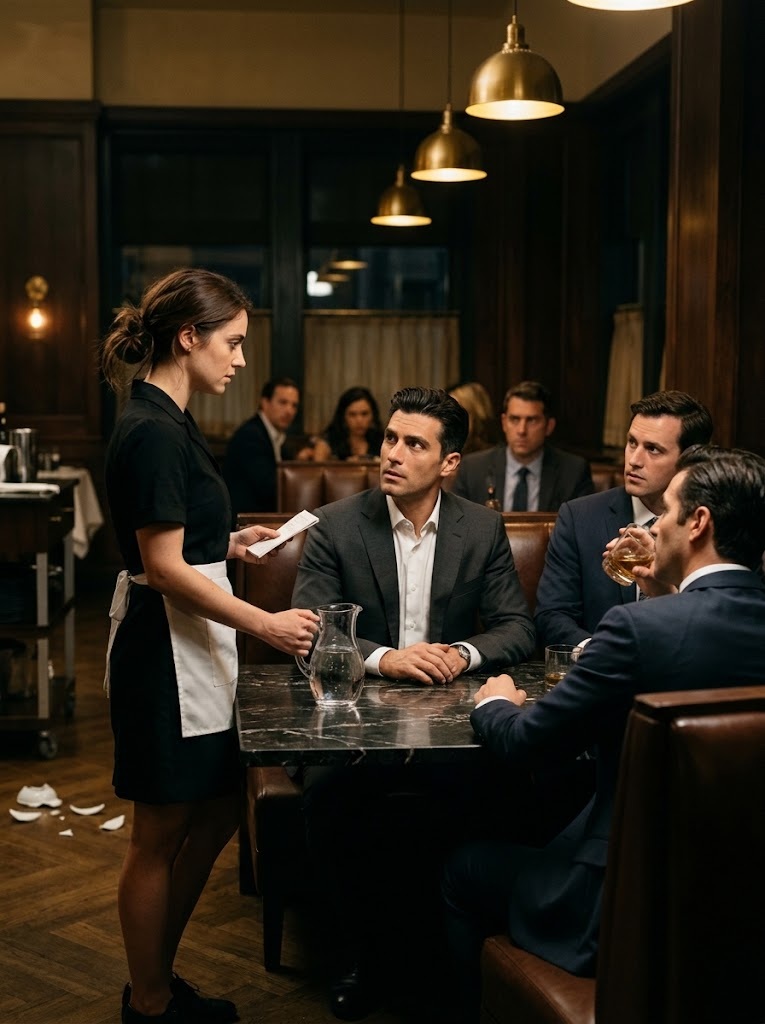
Sophia approached the table with a notepad pressed against her palm. The three bodyguards ordered whiskey. Alessio ordered sparkling water.
He did not look at the menu.
“You’re Sophia Parker,” he said.
It was not a question.
She forced a professional smile. “Have we met?”
“No.”
“Then how do you know my name?”
His gaze briefly dropped to her trembling hand. “You wear a name tag.”
She glanced down. The tag had been clipped to her apron.
Heat rose to her face. “Of course.”